
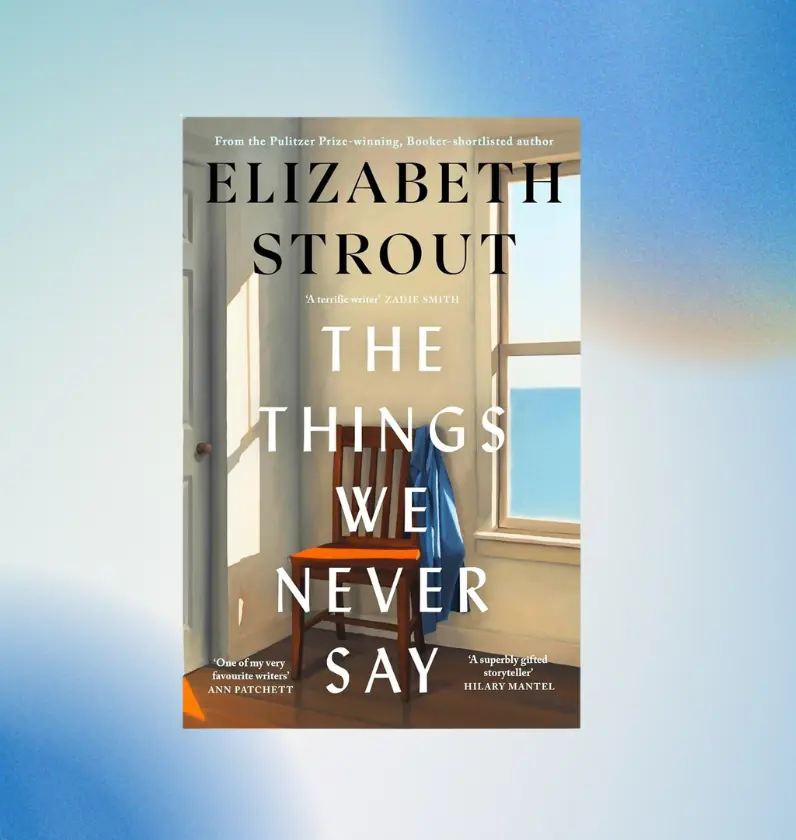
Review: Elizabeth Strout's The Things We Never Say dissects a life lived in silence
Pulitzer Prize-winning author Elizabeth Strout, predominantly known for her novel Olive Kitteridge, has returned with another moving meditation on the delicate and ambiguous nature of human relationships.
As the title of her new novel suggests, The Things We Never Say offers a searing exploration of the role of silence. Conventional wisdom would have us believe that some degree of solitude inspires contemplation and, thereby, facilitates our emotional well-being. However, some forms of silence can be destructive, pulling us into an endless spiral of despair and leading to a sense of alienation.
Strout’s compelling new work examines this motif with sensitivity and grace. The novel’s epigraph, which features a quote from Carl Jung, echoes the theme of loneliness. Interestingly, the Swiss psychiatrist didn’t view this condition as the mere “absence of people.” Instead, he likened it to an inability “to communicate the things that seem important to oneself” and the willingness to hold beliefs others find objectionable and “inadmissible”.
Incidentally, Strout’s protagonist, Artie Dam, encounters a similar form of isolation, which urges him to ponder Jung’s view on free will. His loneliness stems from a silence that has cast a shadow over his marriage and other intimate relationships, but he continues to maintain his composure.
From the novel’s outset, Artie is advised by his friend on a sun-kissed, mid-June day to remain “jovial”. Yet, his chances at happiness have been eclipsed by a constant spell of despair, much of it beyond his control. Past and present uncertainties threaten to weigh him down in equal measure.
A moving novel by an acclaimed American author grapples with how politics affect our daily well-being and the dual-edged nature of silences in human relationships
Artie is haunted by the memory of losing his working-class family, from whom he had grown distant after marrying the relatively well-to-do Evie. The intervening years haven’t subdued the effect of this tragedy, even though he has carved out a new life for himself since then. Artie’s marriage ushers him into the comfortable distractions of an affluent social circle as well as the joys of fatherhood.
The present, too, offers little consolation. Traumatic events have steered his son, Rob, away from his parents. The emotional distance between them may not be as intense as Artie’s aloofness from his own family, but it still leaves a lingering ache in his heart.
At the same time, Artie has to confront the terrors and ambiguities of a fractured, post-Trumpian America, where divisive politics is the order of the day. As a high school history teacher, he recognises how oppressive phases can irreparably alter the destiny of a nation. His students’ anxieties about the changing times confirm his suspicion that the future is bleak and threatening.
Disillusioned by the state of the world, Artie briefly contemplates death, only to discover that his growing pessimism hasn’t thwarted his will to live. Amid all these challenges, he discovers a secret that has the potential to shake the foundations of the fragile world he inhabits.
Any attempt to delineate Artie’s predicament in spoiler-filled detail will only prevent readers from experiencing for themselves the richness and poignancy of the novel’s plot. Suffice it to say, the life-altering secret isn’t treated with a gossipmonger’s eye for scandal in Strout’s capable hands.
The Things We Never Say doesn’t promise melodramatic confrontations or sizzling revelations. The carefully constructed calm of Artie’s life is shattered with a whimper, not a bang. Stripped of the stereotypical air of drama, the novel views silence as a balm of sorts. At one stage, readers may begin to appreciate the beauty in what has been broken and find an almost perverse comfort in the characters’ reluctance to address the resulting chaos.
The author is by no means advocating silence as a remedy to an emotional crisis. She intends to reveal how it settles into relationships and, if allowed to linger for too long, erodes their essence. In Artie’s case, silence acts as a temporary shield until it envelops him like a slow, insidious poison.
Strout doesn’t depict the spiritual and emotional disintegration of the protagonist’s world in a dark, depressing vein. The Things We Never Say doesn’t pull readers into the emotional turmoil plaguing its cast of characters. As a result, the novel benefits from a deceptive air of levity, even though it is a haunting evocation of our times. At times, the story may offer a glossier, more palatable version of some unsettling realities, but that doesn’t make it any less subversive.
The author should be commended for revealing the extent to which a populist, right-wing agenda can alter the rhythm of our lives and affect people’s emotional well-being. Even in these harrowing times, she urges us to search for the hidden traces of humanity. While Artie succeeds in finding them, a few isolated acts of kindness aren’t sufficient in buoying him through the darkness.
The strength of the novel lies in its deft, realistic characterisation. Most of the characters possess an honourable streak, making them all the more likeable, irrespective of the choices they make. Even characters who would have seemed despicable in ordinary circumstances are redeemed through a fair, nuanced portrayal. Through this technique, Strout reminds us that people harbour some semblance of humanity, even when they are influenced by the suffocating air of oppression surrounding them. Be that as it may, the author doesn’t actively endorse any of their misdemeanours in an effort to achieve objectivity.
The novel is loosely based on a linear arc, but occasionally deviates from it to pursue the emotions that tug at the characters’ heartstrings. Following these emotional threads lends a meditative and wistful quality to the text. However, this might seem a tad jarring to readers who are accustomed to a more plot-driven approach to storytelling. Fortunately, Strout handles these transitions with flair and never flags in her effort to present a compelling, tragic and quietly disturbing portrait of our times.
Seeded with refreshing insights into how anxieties surrounding politics influence our choices, The Things We Never Say critiques the nature of the world as we know it. The criticism isn’t intended to be deliberately oppositional. Through her vivid and realistic portrayal of existing tensions, Strout aims to find a pathway towards cultivating a different world for future generations.
Indeed, it is a relief to see a fiction writer holding out the promise of hope amid the doomsday scenario that holds sway.
Originally published in Dawn, Books & Authors, August 30th, 2026








Comments