
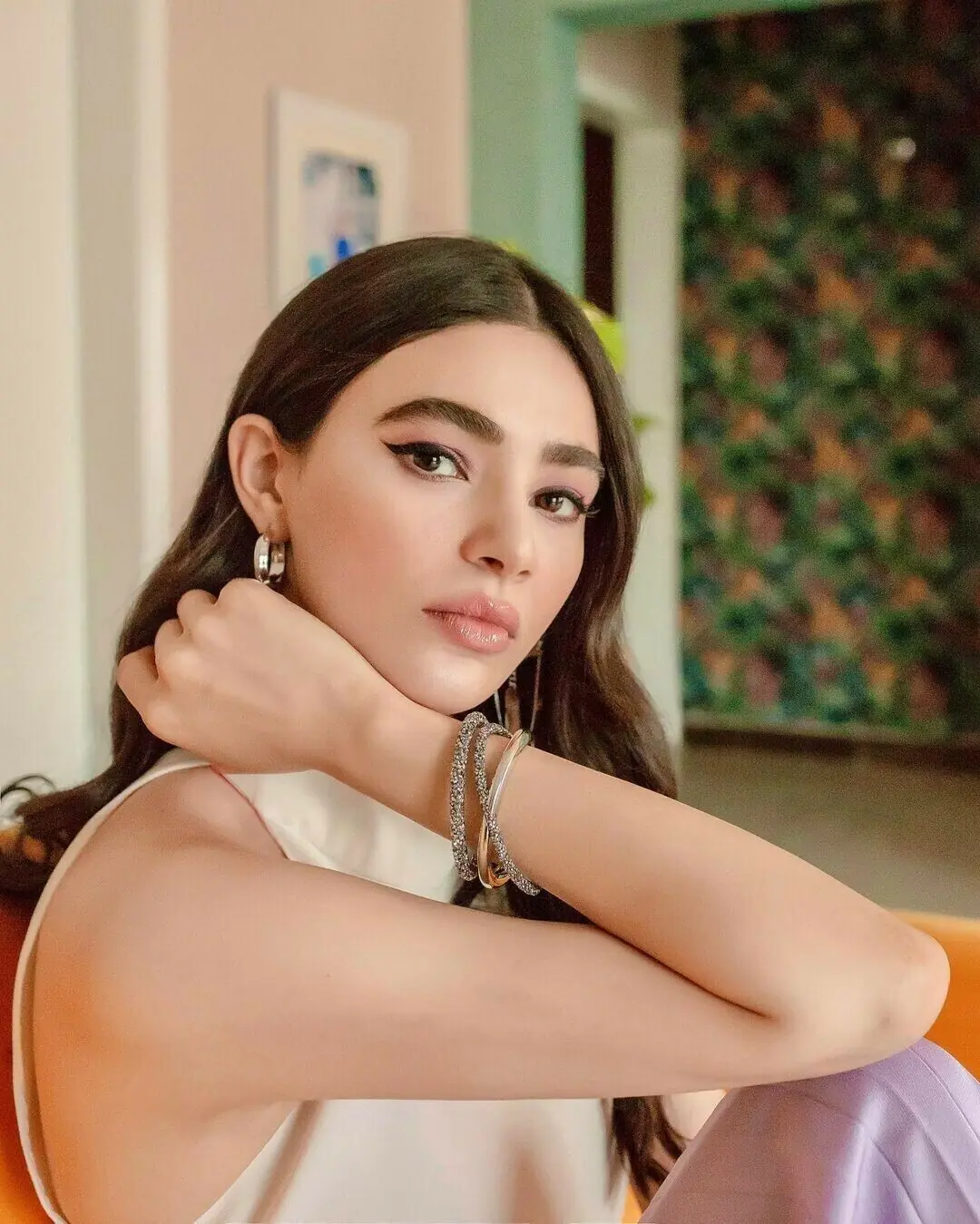
As Bridal Couture Week sparks backlash, Saheefa Jabbar Khattak backs influencers on the runway
Model and actor Saheefa Jabbar Khattak has entered the increasingly polarised conversation around influencers on fashion runways — and she’s firmly siding with the content creators.
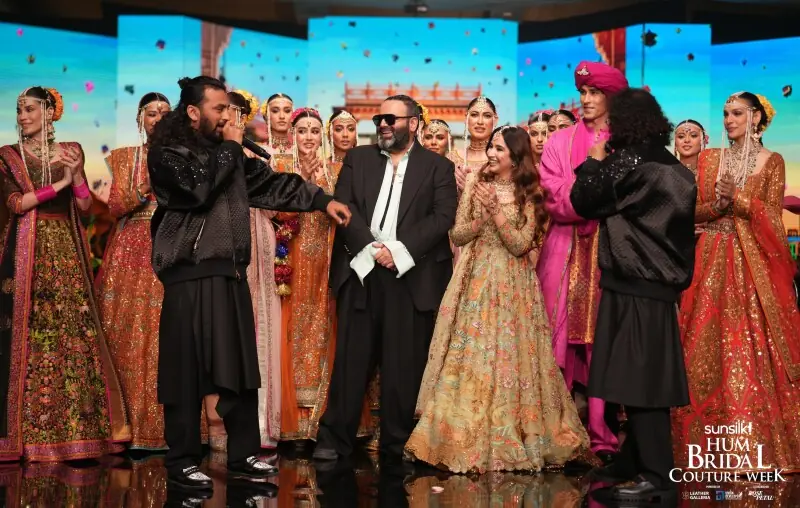
As backlash mounted against content creators and TikTok stars who walked the ramp at the 23rd Bridal Couture Week (BCW) in Lahore this past weekend, Khattak took to Instagram to push back against the outrage. Sharing a video by influencer Manhoor (noor.mood2), she argued that the shift was not only inevitable but “completely valid” — and one that deserved to be “respectfully accepted”.
Khattak admitted she hadn’t always been open to the influencer economy herself. But time, she said, had forced a rethink.
“I wasn’t very accepting of this space initially,” she noted, “but over time I’ve realised how deeply demanding, time-consuming and challenging their work truly is.”
The video she shared on her Instagram story laid out a blunt truth many in fashion hesitate to acknowledge: influencers aren’t cast to model clothes, they’re cast to grab attention. Their purpose on the runway, Manhoor argued, is visibility, conversation and reach. Clothes are remembered because people are talking — not necessarily because of the walk.
Examples of dancer Fatima Amjad and actor Saba Qamar were cited as proof that celebrity presence on the ramp has long been less about technique and more about attention. Khattak agreed, adding that content creation is far from an effortless hustle.
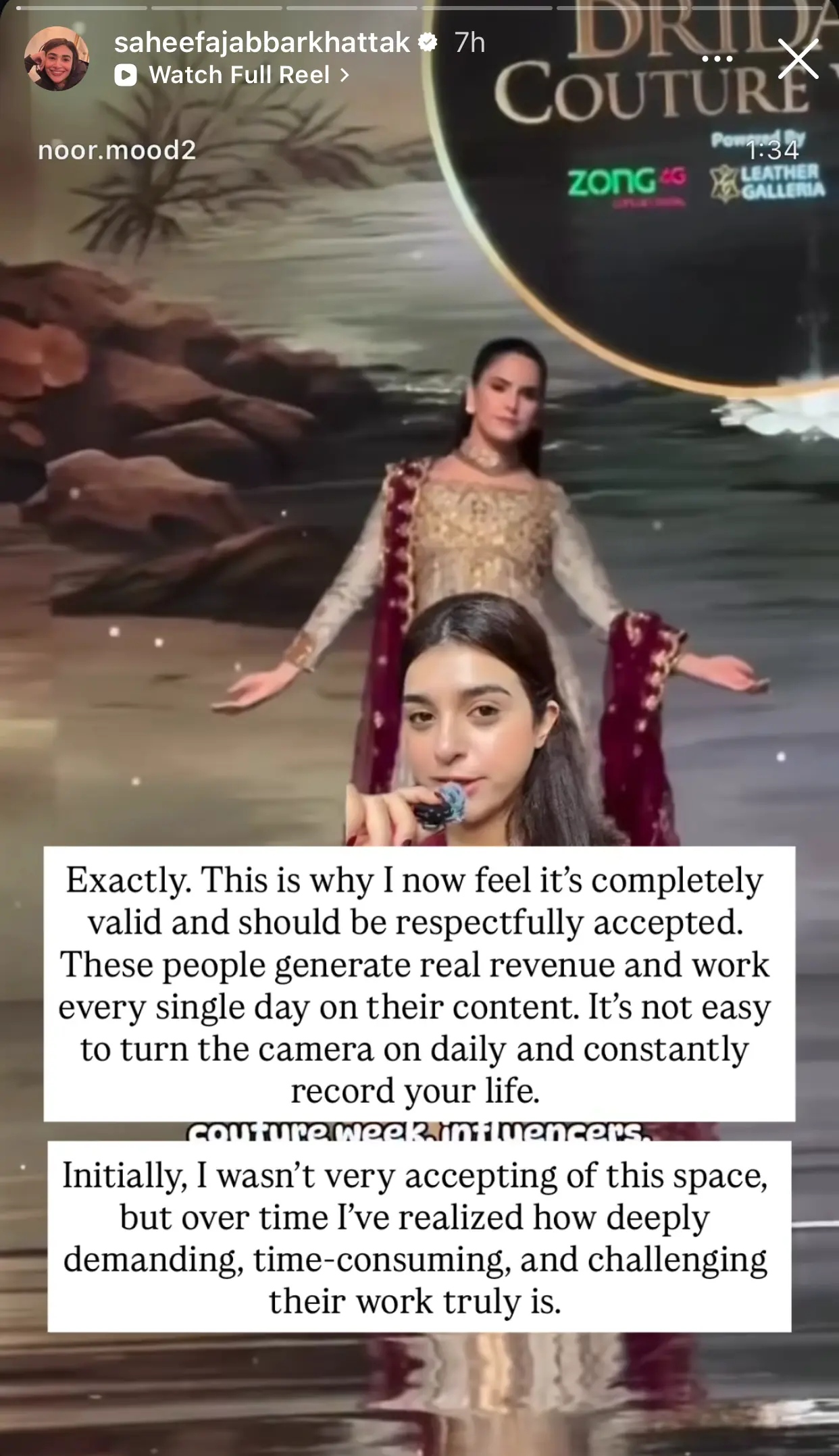
“These people generate real revenue and work every single day on their content. It’s not easy to constantly turn the camera on and record your life,” she said.
The debate, however, has intensified as BCW visuals continue to flood social media. A significant portion of criticism has been directed at TikTok stars and content creators who lack traditional runway training — including viral couple Hemayal and Ali Aizat, who walked for Ali Xeeshan, and TikTok star-turned-model Jannat Mirza, who was the show stopper for HSY.
Mirza, in particular, faced harsh scrutiny over her walk and expressions. When she later admitted the experience was tougher than expected — citing lighting issues and pressure — critics doubled down, accusing TikTok stars of relying on filters rather than skill.
Khattak responded by zooming out. This, she pointed out, isn’t a uniquely Pakistani phenomenon.
“Internationally, content creators are now being cast in films, late-night shows, Netflix series, and are becoming the faces of major global brands,” she said, naming Khaby Lame, Mikayla Nogueira, Jeffree Star and the D’Amelio sisters as examples. “What people often forget is that all of them are entrepreneurs in their own right, they’ve built brands, businesses, and long-term careers.”
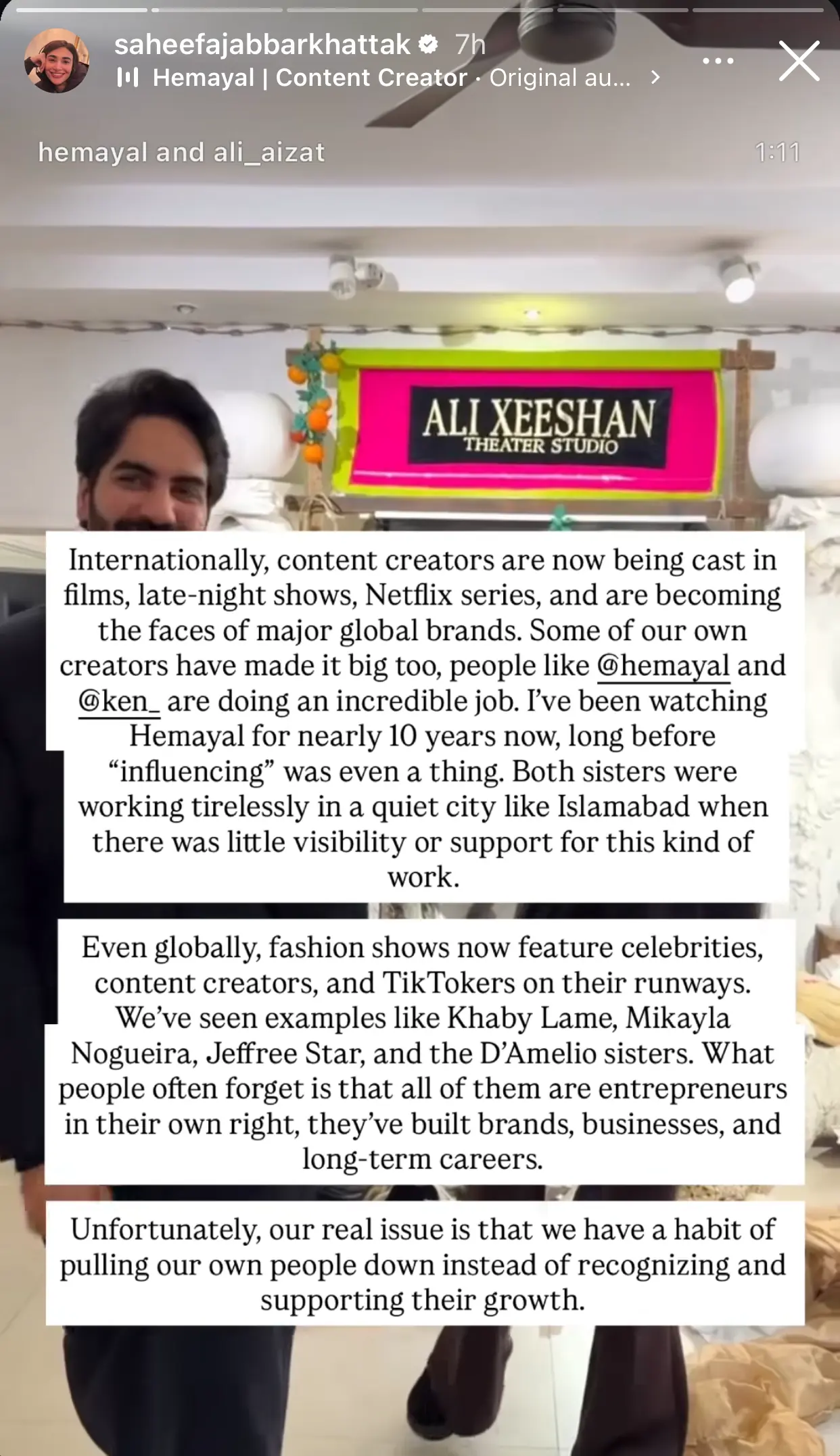
She also highlighted Pakistani creators making global inroads, including Hemayal and Ken Doll, arguing that influence today is a measurable currency — not a vanity metric.
Still, Khattak didn’t shy away from calling out what she sees as the “real issue”. The problem, she suggested, isn’t who’s walking the ramp — it’s how quickly audiences are willing to tear down their own, while quietly consuming the same global influencer culture without protest.
BCW is a highly anticipated fashion extravaganza, always a blend of glamour and creativity, with actors, musicians and famous personalities adding their own flair to the event — its strength always being the celebrity quotient. With times changing, and in this era of content creators, influencers are no less than celebrities when it comes to bringing numbers to the table.
Not everyone agreed.
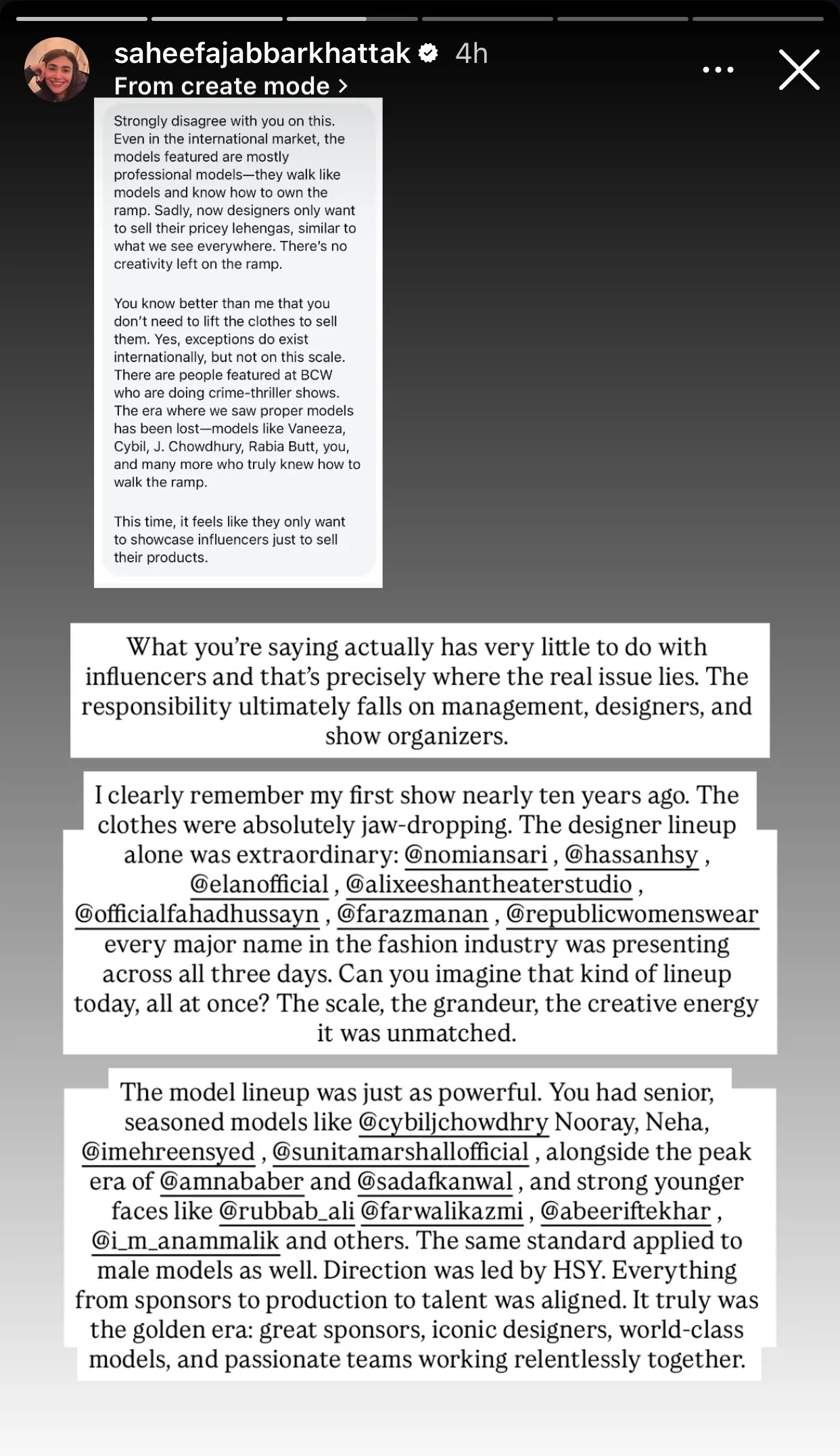
One follower pushed back on Khattak’s statement, arguing that even internationally, runways are dominated by trained professionals who “know how to own the ramp”. The real loss, they said, was creativity.
“Sadly, now designers only want to sell their pricey lehengas, similar to what we see everywhere. There’s no creativity left on the ramp,” they wrote, lamenting the disappearance of an era defined by icons such as Vaneeza, Cybil, Rabia Butt, Sunita Marshall and Khattak herself.
Khattak didn’t dismiss the criticism. Instead, she redirected it.
“What you’re describing has very little to do with influencers,” she replied. “The responsibility ultimately lies with management, designers and show organisers.”
Looking back a decade, she reminisced about a time when BCW felt untouchable — when lineups boasted Nomi Ansari, HSY, Fahad Hussayn and Faraz Manan; when shows were directed with vision; when models, sponsors and production teams moved in sync.
“The scale, the grandeur, the creative energy — it was unmatched,” she said.
“Everything from sponsors to production to talent was aligned. It truly was the golden era: great sponsors, iconic designers, world-class models, and passionate teams working relentlessly together,” she noted.
But nostalgia, Khattak argued, doesn’t pay bills.
Fashion weeks, she explained, are no longer sustainable in their old form. Long hours, poor working conditions, underpayment and burnout pushed many — including herself — away. As designers pivoted towards lawn, bridal and commercial lines, couture inevitably took a backseat.
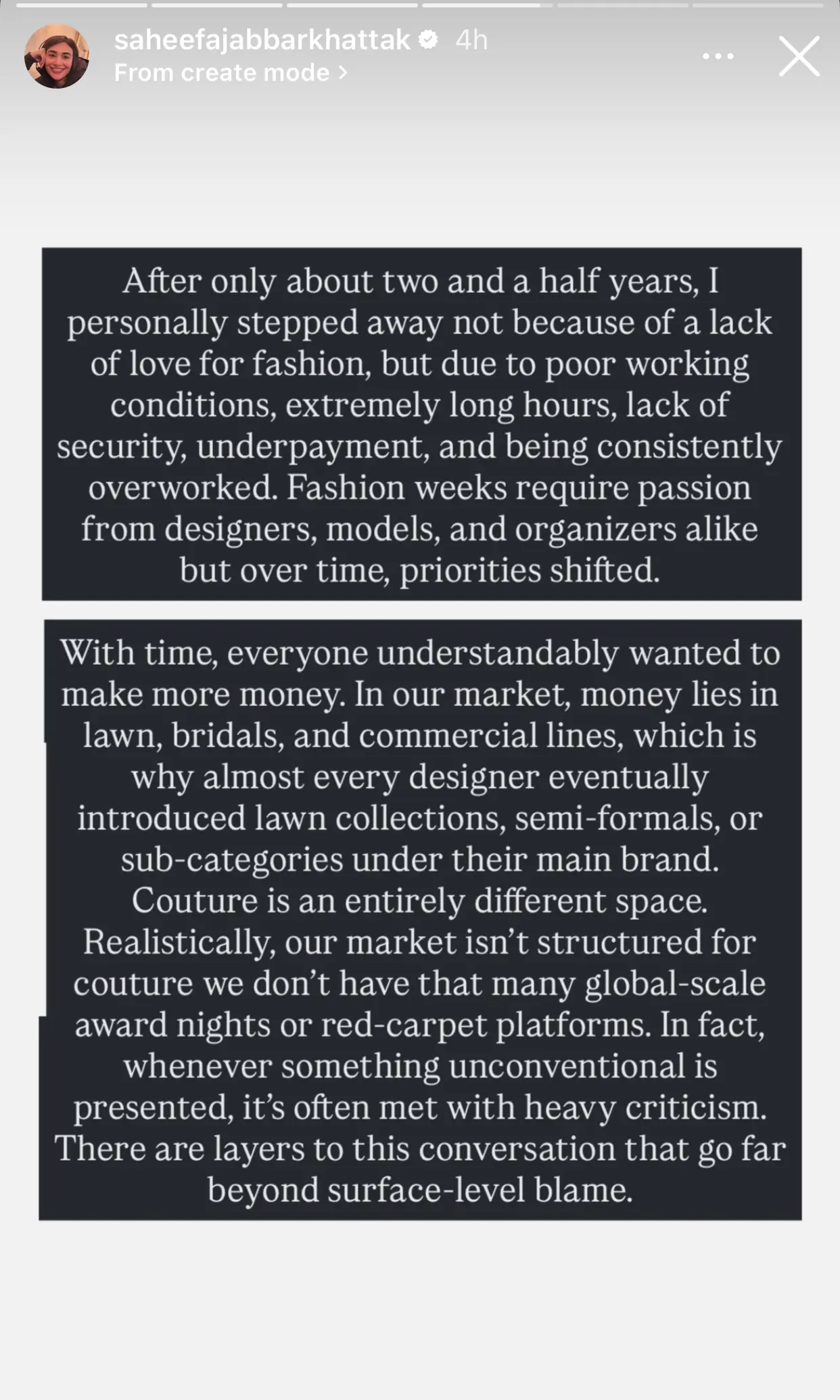
“After only about two and half years, I personally stepped away not because of a lack of love for fashion, but due to poor working conditions, extremely long hours, lack of security, underpayment, and being consistently overworked. Fashion weeks require passion from designers, models, and organisers alike, but over time, priorities shifted,” she wrote.
“Couture is an entirely different space,” she wrote. “Realistically, our market isn’t structured for couture, we don’t have that many global-scale award nights or red-carpet platforms. In fact, whenever something unconventional is presented, it’s often met with heavy criticism. There are layers to this conversation that go far beyond surface-level blame.”
Her conclusion was simple — and difficult to refute.
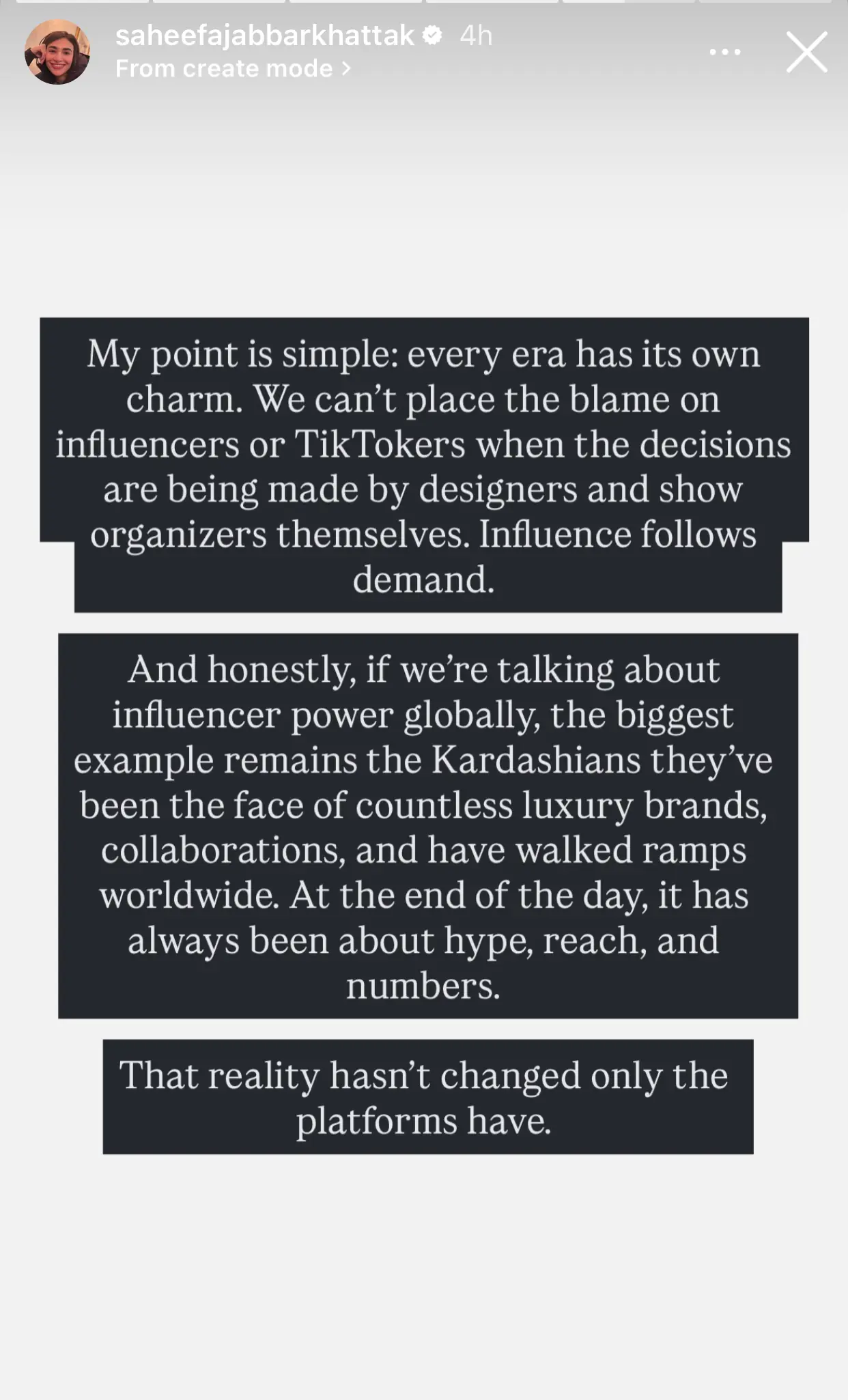
“My point is this: every era has its own charm. We can’t place the blame on influencers or TikTokers when the decisions are being made by designers and show organisers themselves. Influence follows demand.”
In an industry now driven by metrics, reach and virality, the ramp has become less about perfection — and more about power. And whether we like it or not, the numbers decide who gets to walk.
Khattak sealed her argument with a reality check using global practices as an example.
“The biggest example remains the Kardashians; they’ve been the face of countless luxury brands’ collaborations and have walked ramps worldwide. At the end of the day, it has always been about hype, reach, and numbers. That reality hasn’t changed, only the platforms have.”


Comments