
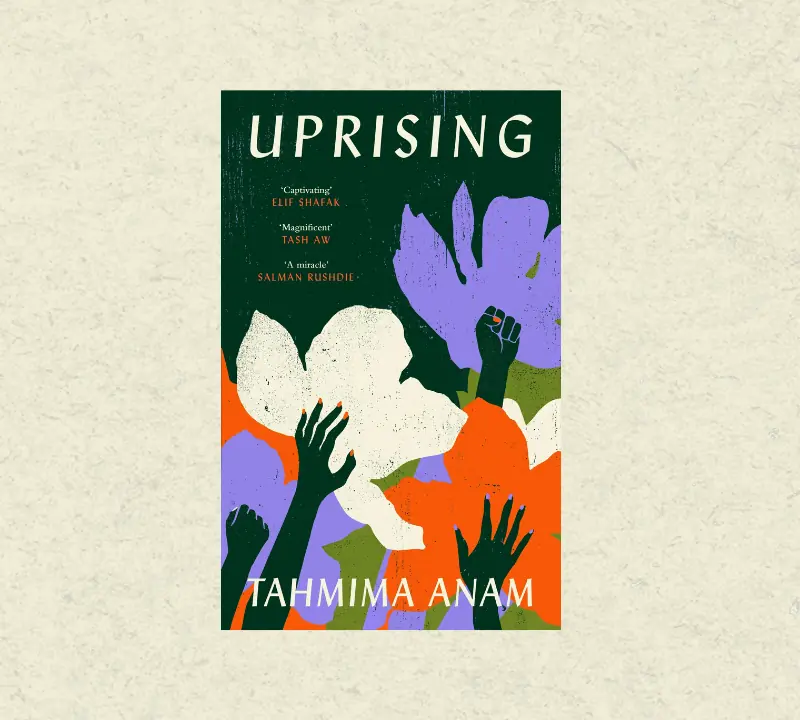
Review: Tahmima Anam's Uprising connects the exploitation of women's bodies with exploitation of the land
There is an island in southern Bangladesh that is 20 huts long and four huts wide, and every year the river eats a little more of it. Tahmima Anam’s fifth novel, Uprising, opens inside this shrinking strip of mud on the Pashur, a licensed brothel modelled on Banishanta, where some 150 women and their children live outside the protections of law, family and God.
The opening pages, narrated by the children, announce the terms of the book with chilling clarity: “We did not go to school because we already knew everything there was to know.” What they know is the work. They know the sounds and smells of it, “the false notes of pleasure,” and they know that the men who buy their mothers are, somewhere among them, their fathers, though “he never made himself known, never said, you are mine.”
This is the moral architecture of Uprising, and the source of its incantatory power. The chorus of daughters, girls who raise one another while their mothers sleep off the night, are at once unbearably frail and prematurely wise. Anam gives them small, piercing happinesses — lice coveted because delousing forces a mother to touch her child, rice passed hand to hand, 10 taka for sweets — surrounded by a horror the children narrate in the flat, rhythmic grammar of the inevitable.
Their chant of self-knowledge, “we were chorer-bacha… Soon to be our mothers,” lands like a sentence passed before a crime has been committed. Readers root for these girls because the novel refuses them innocence yet grants them perception; their seeing becomes the book’s engine of revolt.
Into this world arrives Kusum Khan, kidnapped and drugged in the aftermath of the protests that toppled Bangladesh’s dictator. She comes ashore screaming her own name like a cursed refrain, “Kusum Khan! Kusum Khan! I’ve been kidnapped!” and bites off a piece of a man’s penis in her first days.
Anam excavates her past in a chapter of unbearable economy: a fruit seller’s daughter with a voice “touched by God,” who loses her sister Pyara to a police bullet at a protest and is sold by her own parents to the man who promises her work abroad. Her telephone call home is the novel’s quietest devastation. Her mother asks the price of her freedom, repeats the figure, and hangs up with the words: “We told you to get married.”
That betrayal is the first lesson of the island, the children tell us: “No one was coming for them.” Kusum learns it and then refuses it. Her resistance begins with a green slate and two hours of school, teaching letters and sums to girls who have been told their lives are written on their foreheads. When a child asks why the river floods, Kusum answers with the novel’s quietest weaving of climate into fate: “The waters are rising everywhere… in all the countries and all the rivers and all the oceans.”
The drowning island and the used-up women are the same event at different scales: shrimp farms salting Farid’s fields, a cyclone shelter that turns the brothel’s children away, coal that heats the air that swells the river that eats the shore. Anam never lectures. Climate arrives as weather, as debt, as the slow violence that preys on those already marked for use.
Standing over everything is Amma, one of the great villains of recent fiction, rendered without caricature. She keeps her books, feeds the women pills to fatten and forget them, beats them and cradles their heads, and tells Kusum on arrival: “Everyone you know is dead… You are shit.” Yet Anam grants even Amma a biography of damage, and the novel’s most disturbing insight is that the women half-love her, the only mother who ever stayed.
When Lopa, born on the island and raised on Amma’s milk, finally confronts her, the question she asks undoes the whole economy of the place: “If I was your blood, is this the life you would give me?” Amma’s answer arrives later, from Kusum’s own mother, who sold her daughter for 30,000 taka to pay debts and bury Pyara.
The uprising builds with the patience of a tide. Kusum converts the women from selling their bodies to selling photographs of them, teaching camera angles and lighting while the children press their faces to the bamboo walls, scandalised. There is school now, and “Amar Sonar Bangla,” and sweet water from a new tube well driven deep enough that “even a cyclone could not uproot it”.
Anam understands that rebellion is made of such boring miracles: clean sheets, boiled water, afternoon naps, the key to the medicine cabinet withheld. “Potita noy, protirodh,” the women chant at the jetty. Protest, not prostitution. Then Amma returns with 30 men, and the novel detonates into its most brutal sequence, a night of sanctioned rape and burning huts that only a miraculous, furious rain arrests.
What follows is the novel’s boldest risk, and its triumph — rather than barricades, Kusum orders filth: no washing, matted hair, menstrual blood smeared on foreheads, a contagion of deliberate dirt so total that policemen fear to land. “What they hate is what they fear,” Kusum reasons, “and what they fear is that we are dirty.” The women stab a cloth man stuffed with their rapists’ names and discover the names were inside them all along: husbands, fathers, captors, sons. The scene risks absurdity and becomes liturgy instead, “We are the power!” shouted by women who were never once asked to say no.
Threaded through everything is Bon Bibi, the daughter of the forest raised by a doe after her mother abandons her, the guardian spirit of the Sundarbans whom the children invoke until myth and woman merge: Kusum, with her “hands soft, voice loud,” her skin “dusted with gold,” refusing at the end to go home with the mother who sold her. “Because of you,” she says, “I am these women.” The final storm, which swallows the island as the survivors escape on Mridul’s boat, is told twice: once as fact, once as legend in which Kusum sings the island under and “spread her wings and flew away”.
Anam earns this surrealism precisely because the realism around it is so exact; the myth is not an escape from the story but its destination, the shape a true story takes when carried by those it saved.
The author’s achievement is not simply that she gives exploited women a voice — it’s that she changes the scale at which their exploitation can be understood: from an isolated brothel to a system connecting patriarchy, family, state power, poverty and ecological destruction. Yet the novel’s movement from realism toward myth occasionally simplifies the very human complexity that makes its early sections so powerful.
Uprising is at its strongest when it refuses the consolations that usually accompany stories of extreme suffering. It does not rescue the women with sentiment, does not prettify their suffering, and does not let readers off with the easy villainy of one madam, though Amma is monstrous enough.
The family sold Kusum, “but it was also the whole world of men,” all of whom prefer a girl on an island to a girl causing trouble among them. That sentence indicts an order economic, climatic and patriarchal at once; the novel’s final gift is showing it crack, one island, one tube well, one alphabet at a time. That the crack is small and the sea still rising is what makes this book necessary rather than merely admirable. It ends as it began, with children who know everything, except now they know something else: that they were never the dirt, that the dirt was always the world, and that a girl with a voice can sink an island and still be singing.








Comments