
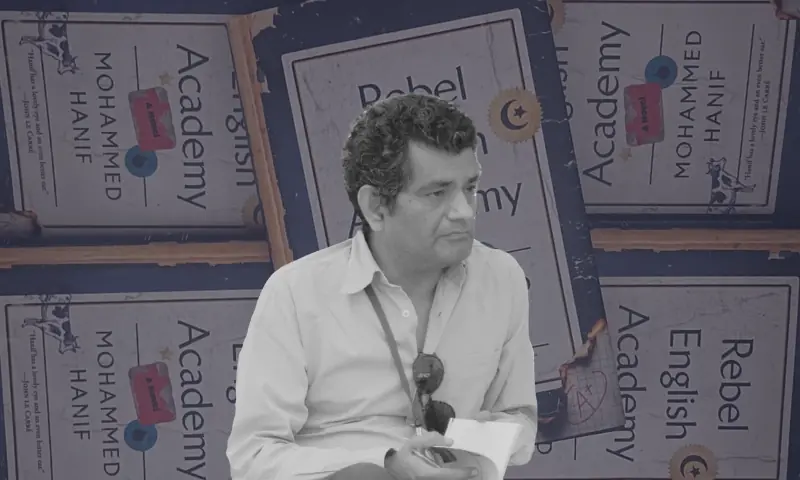
Mohammed Hanif’s upcoming novel Rebel English Academy begins on the night of Bhutto’s hanging
After the confiscation of the Urdu translation of his novel A Case of Exploding Mangoes, one might have thought that Mohammed Hanif would stay away from anything political, especially on a subject that may touch some nerves of the powers-that-be in Pakistan but Hanif, being Hanif, has bounced back with another book that may ruffle some feathers. His new novel, Rebel English Academy, is slated to hit bookstores next week and while Gen Zia was at the centre of Exploding Mangoes, the new novel kicks off with the former dictator’s political nemesis.
An army officer serves as an important character in the book.
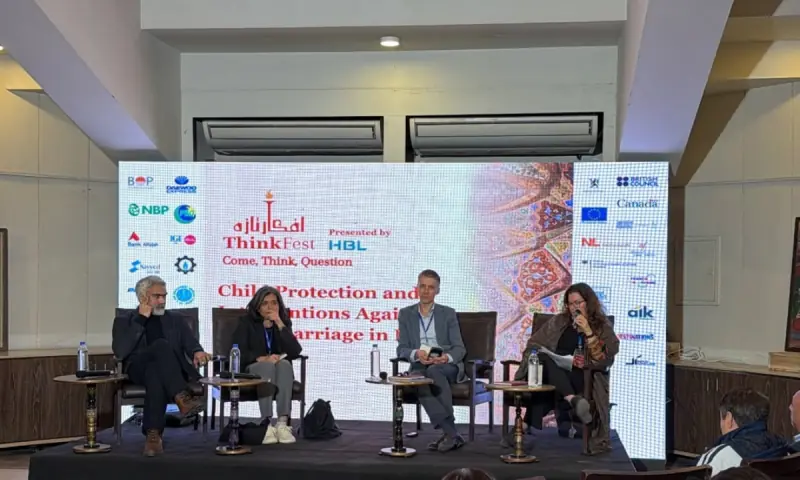
“The book starts on a certain night the people of my generation might remember. There is a famous hanging in our history,” he said in a session on the third day of the Afkar-e-Taza ThinkFest at Lahore’s Alhamra. The session was moderated by Dur e Aziz Amna.
Hanif read out an excerpt from the novel titled On the Night of the Hanging, the very first chapter.
“On the night of the hanging, everything was as calm as it should be in a jail, devoted to the safety and care of one very important man. All prisoners but one are asleep in their cells, restless, dreaming of their victims who are their loved ones which, in most cases, are the same people.” This is the opening sentence. The passage goes on to describe the atmosphere in Rawalpindi that night while the prisoner asked for a safety razor, claiming he did not want to look like a ‘mullah’ at his death. He also asked for a cigar and his Shalimar perfume.
Anyone with even the slightest bit of knowledge of the country’s political history can easily recognise the man who is going to be hanged — Zulfikar Ali Bhutto.
Hanif recalled that he must have been in sixth or seventh grade when he and his classmates were locked in the examination hall for three or four hours after finishing their paper, not knowing what was happening outside.
“We came out and the city was dead. The streets, the people were scared but strangely excited as well. I wanted to somehow capture that adolescence when you don’t really know how the world around you works, who is the prime minister and why he is being hanged.”
The novelist said there was widespread disbelief — many believed Bhutto could not possibly have been hanged and that they were being lied to. The rest of the book, he said, is set after the hanging.
Hanif confessed that he was a lazy writer, and he had started this novel about seven years ago.
“So by the time I finished, another famous man is in prison and again there is a lot of uncertainty and rumours about what’s going to happen to that man,” he said, quickly clarifying that he was not in fact talking about “the man” the audience were thinking about, eliciting laughter.
Hanif has a habit in both his speech and writing of interjecting humour when the subject is gloomy and serious. From laughter or smiles, he pulls his readers or audience back to a serious topic. He did the same during the session when he spoke about “the young man, Junaid Safdar, who was a medical student here. Sorry, the other Junaid, Junaid Hafeez”.
He said Hafeez was on his mind because he was a bright and hardworking young man, adding that he had been halfway through his degree when he started reading books and poetry, got a Fulbright scholarship, and then returned to Pakistan. According to Hanif, Hafeez was teaching at Bahauddin Zakariya University, doing his MPhil, when he said something in his classroom — nobody was actually sure what he said — and then he was sentenced to death.
“For the last 13 years, he has been in solitary confinement and no judge is ready to listen to his appeal, and his lawyer was shot dead. Sympathetic journalists are told if you write or report about him or talk about him then he would be in further danger,” he said. Hafeez was already on death row, he said, pondering what else could happen to him.
City of Okara and the language question
During the session, Hanif was asked about OK Town, the city mentioned in the novel that was modelled off Okara, his own hometown. He said people who leave home at an early age often grow very nostalgic about it, but they are also very scared to go back to preserve their home the way it was. It never is.
“I was not born and raised in Okara, [I] grew up in a village outside Okara. The city was a place of fascination and confusion where things were done differently, which you visit once a year to buy new school books at the end of the year. It was completely fascinating; there were people who called their mother and father Mummy and Daddy, they spoke Urdu and they had drawingrooms and doorbells and stuff like that.”
Hanif said he completed his primary schooling in his village and then went to the city for high school, which was a cultural shock. The boys there would make fun of you if you told them you had three buffaloes that lived with you, he recalled. The author said he was called “Paindu Production” by one of the city boys.
“There is another thing which is always fascinating — the problem of language. I went to an Urdu-medium public school where teachers taught Urdu in Punjabi. Then there was high school where I started learning English and they taught us English in Urdu.”
Hanif said the students would go to this little tuition centre to learn English, adding that the most brilliant boys could not finish high school because they never got their heads around learning English. He spoke of the privileges of the English language.
He read out an excerpt from the novel featuring an intelligence officer, Captain Gul, who was assigned a photography detail duty on “the night of the hanging,” which he messed up and was transferred to OK Town as punishment.
The author said he was a working journalist and if he was asked to do something in Urdu, he did it in Urdu. If I am asked to do it in English, I do it in English, he said. “The people of my generation who went through public schooling had this dilemma that at home, you speak Punjabi, everybody speaks Punjabi, by the time you are five or six you have enough vocabulary. Then suddenly you go to school where the medium [of instruction] is Urdu and all the knowledge about the world you have becomes redundant and by the time you pick up Urdu, then education starts in English in college etc. That happened to almost everyone.”
He said it was fascinating to switch gears because of cultural references in Urdu and Punjabi, however, he has been accused of catering to different audiences in different languages for sales.
Rebel English Academy is being published by Maktaba-i-Danyal.
Originally published in Dawn, January 26th, 2026







Comments