
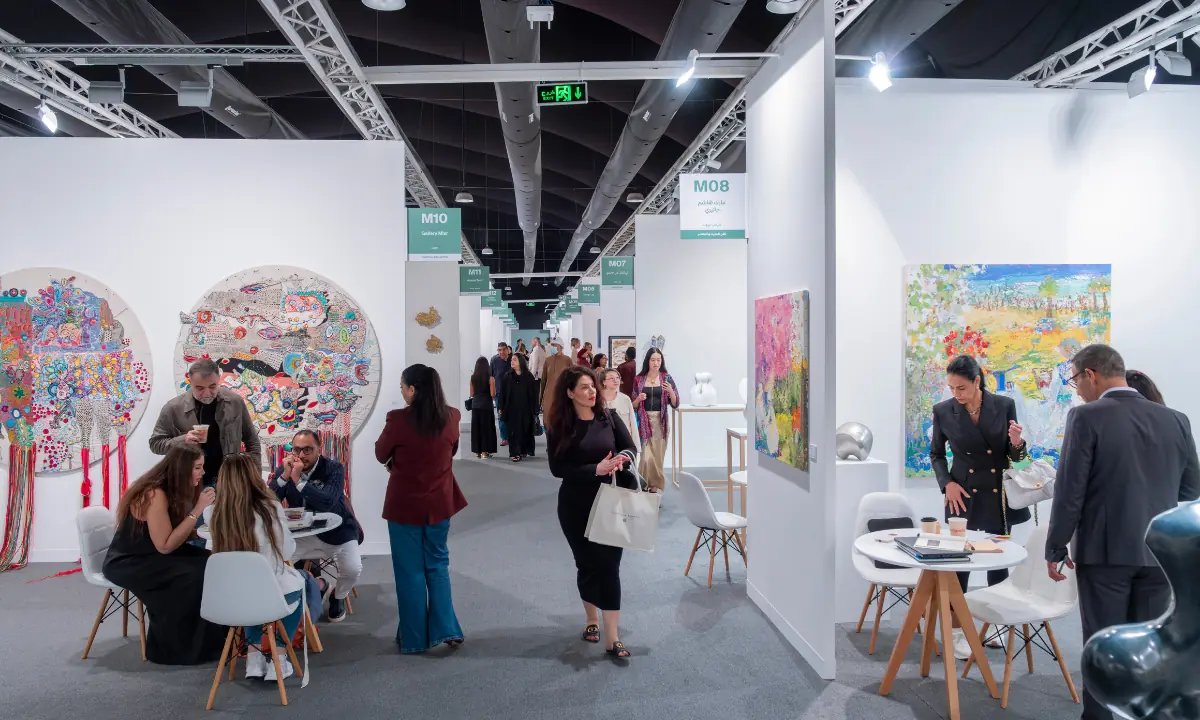
Exploring the sights and sounds of the Abu Dhabi Art Fair 2025
When I turn to look for Francesca and Meryem, I find them in a corner as they unceremoniously slip out of their flats and don their high-heels with the seasoned virtuosity of a pair of pro athletes. This opening reception for the Abu Dhabi Art Fair 2025 clearly isn’t their first rodeo.
After all, Francesca’s an ever-present fixture in Milan’s art scene, and Meryem is the editor of the Casablanca-based art magazine Diptyk — so they know a thing or two about attending snazzy openings. So do most of the other dozen in our pack of internationally assembled art writers.
As we approach the entrance of the art venue Manarat Al Saadiyat, which is hosting the 17th incarnation of the Abu Dhabi Art Fair, there’s a palpable sense of anticipation amongst us all. Snaking past the cavalcade of green lights that are illuminating not just the building but the entire block on Saadiyat Island, I can’t help but think that the heterogeneity found in our little press group is a microcosm of the spirit this art fair embodies.
Within its labyrinthine layout, Abu Dhabi Art Fair 2025 houses displays by more than 140 galleries from 34 countries. The questions being asked and themes being explored through these works are just as expansive as the fair itself.

Under the stewardship of its director Dyala Nusseibeh, the fair attempts to use Abu Dhabi as a hub where artists, galleries and cultural traditions from across the world intersect, while still preserving and amplifying Emirati and Gulf-region perspectives. As a result, Arab modernism is a running through-line here, with the fair’s feet firmly planted in the Gulf’s evolving art practices. Concurrently, Nigeria and Turkey are given a special spotlight, encouraging conversations around national identity, tradition and evolution.
After just a few days in this city, it is evident to me that this initiative by Abu Dhabi’s Department of Culture and Tourism, and many other such projects across the city and beyond, are emblematic of a broader cultural strategy at play in the UAE. In fact, you could argue it’s at play across much of the Gulf.
The region’s arts and culture calendar till the first quarter of next year is jam-packed. In fact, some members of our little troupe here are either coming from or will be soon jetting to other art events in the region. One of them is on her way to the opening of the MF Husain Museum in Doha. I ask her if she can wrangle an invite for me.
Now, I must admit, I am not at this fair to deliberately seek out art from ‘my part of the world’. I find doing that to be a bit like someone travelling abroad yet insisting on dining at a desi restaurant there. Rather defeats the whole point.

But I suppose it’s because I’m chatting with Sana Krishna that we invariably arrive at an Indian gallery’s display, as if Sana’s internal compass organically drew her to it. Sana herself is a gallerist from Mumbai. Her mum is a Parsi, so I ask Sana if she’s in touch with the Parsis in Pakistan. “Pakistan still has Parsis?” she asks, rather flummoxed. “Of course,” I retort, “My class back in school alone had four Parsis!”
That conversation is cut short as we cross paths with Ashwin Thadani, who’s decked out in a plush Nehru jacket, blue-tinted glasses and moves like a rock-and-roller from the 70s. Thadani is the founder of the Mumbai-based Galerie Isa, which is participating in the fair.
Notably, Galerie Isa’s collection here features artworks by the National College of Arts (NCA), Lahore graduate Eeman Masood. Her hypnotic miniature paintings, with their ethereal foliage, are like the shadowy, mystical forest from Midsummer Night’s Dream come to life. And, amusingly enough, miniature painting seems to be a running theme amongst many of the artworks on display at the fair.
The Pakistani SM Khayyam’s ‘Whispers of the Deewan’, on display here as part of the Kent Antiques section, is a vibrant work that takes the Mughal miniature tradition and retrofits it with an almost pop-art sensibility. The result is a scene from a Mughal court presented with a visual language that feels blisteringly current. In a similar vein, the Indian miniature artists Jaggu Prasad and Mahaweer Swami use their hyper-realistic miniature techniques to beautiful effect in their renderings of birds and flora.

One of the centrepieces of the fair is the exhibition Seeds of Memory: Migration as Ceremony, Survival and Renewal, which probes migration — personal, cultural, ecological — as a source of memory, identity, loss and rebirth. This curatorial framework brings together artists from a wide spectrum of geographies and identities, chief amongst whom is Leila Shirazi. Shirazi’s work draws on miniature traditions, both Persian and Mughal, to examine how nature is shaped, often violently, by industrial and colonial processes.
I’m reminded now of a conversation I had over dinner last night with Mana, a British-Iranian member of our little contingent. Her insight into Iranian life, and the mixed emotions with which the Iranian diaspora now views their homeland, was quite illuminating.
With her words still in my mind, I make my way to the Tehran and Mahshahr-based SARAI Gallery’s presentation of contemporary Iranian artists, including Moslem Khezri and Orkideh Torabi, whose deeply evocative works here offer a textured portrait of modern Iranian life — both private and public. This window into Iran is fascinating, as Torabi’s characters are animated and leap off the canvas, whereas Khezri’s work is far more subdued, almost melancholic.
As if on cue, the singer by the bar concludes his set, letting us all know that it’s time to call it a night. I make my way towards the exit alongside Sunmin, an elfin South Korean who works at W Magazine in Seoul. The two of us step out into the cool night air, talking about how Abu Dhabi, once peripheral in the global art circuits, is reimagining itself as a cultural crossroads. It’s indeed an exciting time for the arts in the Middle East. Sunmin asks me if the same can be said for Pakistan. I tell her she’s going to have to come and find out for herself.
Originally published in Dawn, December 1st, 2025.
Cover photo courtesy the Abu Dhabi Art Fair 2025
Comments