
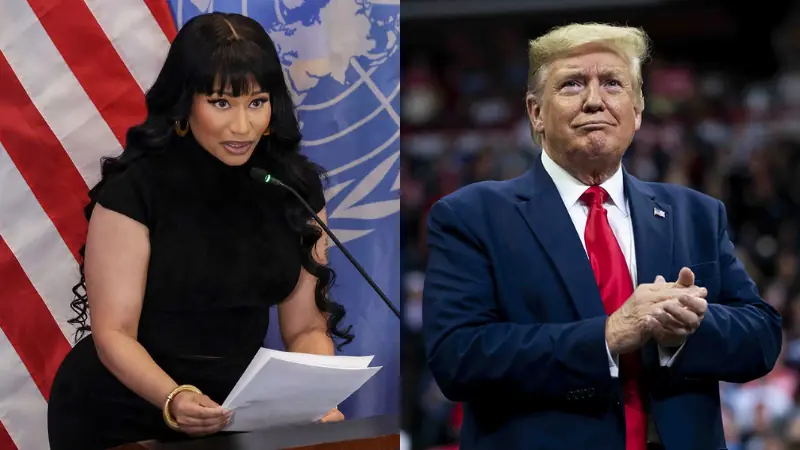
Nicki Minaj becomes the unlikely face of Trump’s Nigeria narrative at UN event
Nicki Minaj has weathered her fair share of controversies in pop culture — feuds, arrests, bizarre livestreams, stan-wars. But on Tuesday, the rapper stepped into far more serious territory, becoming the celebrity face of a controversial foreign policy position pushed by US President Donald Trump.
Minaj appeared at a United Nations event in New York on behalf of the Trump administration to support the president’s misleading claim that Christians in Nigeria are being uniquely targeted for persecution — rhetoric that experts say oversimplifies a complex, decades-old conflict and risks fuelling dangerous misinformation.
As Rolling Stone reported, the rapper’s remarks at the event echoed Trump’s narrative almost word-for-word.
“I would like to thank President Trump for prioritising this issue,” she said. “Today, faith is under attack in way too many places in Nigeria. Christians are being targeted… communities live in fear constantly simply because of how they pray.”
The magazine noted that Minaj, “like Trump and his conservative comrades,” was projecting a misconception that Christians in particular are being assailed in Nigeria, a framing increasingly popular within right-wing circles in the US and Europe.
Minaj doubled down, positioning her stance as an extension of her artistic ethos. “This is about standing up in the face of injustice,” she said. “I will care if anyone anywhere is being persecuted for their beliefs.”
How did Minaj end up here?
The lead-up to the event had already raised eyebrows. TMZ reported on Monday that Minaj would appear at the UN alongside Mike Waltz, the United States ambassador to the UN. Waltz publicly praised her on X, calling her “arguably the greatest female recording artist” and “a principled individual who refuses to remain silent in the face of injustice”.
Minaj responded with gratitude: “I am so grateful to be entrusted with an opportunity of this magnitude.”
Waltz later confirmed he’d be joining her for discussions moderated by Fox News host Harris Faulkner, centred on “President Trump’s priority to combat religious violence and the killing of Christians in Nigeria”.
What’s actually happening in Nigeria?
Nigeria, Africa’s most populous nation, split between a mostly Christian south and a Muslim-majority north, is home to multiple overlapping conflicts. Experts have long maintained that the violence is not a religious crusade but a mix of ethnic, political, environmental, and economic tensions that kill Christians and Muslims alike.
Earlier this month, Nigerians across faiths pushed back on Trump’s escalating rhetoric, which included publicly threatening military intervention. On social media, Trump claimed Christians were being killed “in very large numbers” and suggested he had asked the Pentagon to map out potential military plans.
When pressed by AFP aboard Air Force One about deploying US troops or launching airstrikes, Trump responded: “Could be… I envisage a lot of things.”
Local leaders say this narrative cherry-picks one side of a brutal and complicated reality. “Christians are being killed — we can’t deny the fact that Muslims are (also) being killed,” Danjuma Dickson Auta, a Christian community leader from Plateau state, told AFP. Plateau, which has seen repeated cycles of violence since the early 2000s, sits in Nigeria’s volatile “Middle Belt,” where clashes between mostly Christian farmers and Fulani Muslim herders often stem from dwindling land and resources.
Entire villages have been destroyed in farmer-herder clashes; in retaliation, ethnic Fulanis and their cattle have been attacked as well. While the violence sometimes falls along religious lines, experts say it is rooted less in faith and more in governance failures, land mismanagement, and a chronic lack of policing in rural areas.
Despite this, words like “genocide” have been weaponised by various groups, often for political gain. Recently, separatist movements in Nigeria’s southeast have pushed claims of a “Christian genocide,” bolstered by US-based lobbying firms like Moran Global Strategies, which has advised American lawmakers using similar language.
Minaj attaching her global celebrity to Trump’s framing, especially on an international platform like the UN, risks distorting public understanding and inflaming already sensitive political dynamics in Nigeria.


Comments