

The World Culture Festival is what happens when Karachi decides to go global
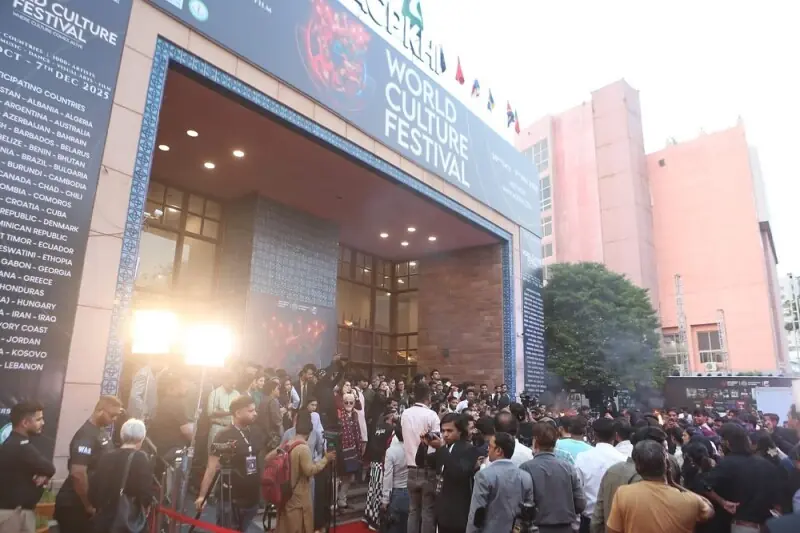
Like a great big engine tuned up and raring to go, the second edition of the World Culture Festival (WCF) started with a roar on October 31. This edition brings over 1,100 artists and technicians from 142 countries to the Arts Council of Pakistan Karachi (ACPK).
As far as cultural events go, this is it — a celebration of the arts with unmatched scale and ambition. There are painting exhibitions, dance and acting workshops, talks, film screenings, theatre performances and concerts. And in case you’re wondering what happens and when, it’s best to consult the ACPK’s website, because the schedule provided to the media runs over six pages, in a font so small it could double as fine print!
The WCF will run daily until December 7, from midday into the night. From what Icon has learned so far, what one looks forward to the most may disappoint, and what one doesn’t expect to wow will be mind-blowing (as you’ll read below).
Most events are free, although a few — such as concerts and workshops — may cost up to Rs 1,500.
For the past six months, if not more, Ahmed Shah — president of the ACPK and the perennial man-with-a-plan (whom Icon interviewed in July) — has been fine-tuning this mother-of-all events with the kind of immaculate obsession usually reserved for clockmakers and mad scientists.
No matter how hard anyone tries — and why would one try in the first place — it is impossible to write about the WCF without mentioning Shah. From greeting dignitaries at the gates, charting schedules, managing the placement of posters, mingling with and directing volunteers, to addressing every journalist — no matter how obscure their publication — by name, Shah is the perfect host and admin of the event.
Micromanaging every aspect of the WCF — including shushing the audience and asking them, with a mix of politeness and sternness, to play by the rules of theatre by not storming the stage after the performances are over and turning off their phones (he really shouldn’t have to do this, but phones still rang), the president of the ACPK reconfirmed what everyone knows of him for so long: he has the memory of an elephant, and the finesse of a diplomat who is having the time of his life.
The WCF, like the institution’s other big events — Aalmi Urdu Conference, Pakistan Literature Festival, Women’s Conference — bears Shah’s unmistakable stamp: an appetite for scale, a taste for variety, an unshakable belief that Karachi, and that the ACPK in particular, should be hailed as the region’s beating cultural heart.
In one of our past meetings, Shah had mentioned that he wants the ACPK to be seen less as an elite arts venue and more as a vibrant venue — a place that thrives in perpetual rehearsal, and is open to everyone, whether they are rich, poor, a member or just a passerby whose imagination is caught by the bold posters on its pink walls. Such ambitions, naturally, carry high stakes. Hosting international artists is one thing, but doing so in Karachi — a city once infamous for volatility — makes security a paramount concern.
That is why, when you tilt your head up, you’ll see snipers and guards stationed atop the ACPK building, keeping an eagle eye on the crowd. On the ground, security remains visible but never intrusive, whose vigilance comes alive when dignitaries step into the compound.
A day before the WCF began, Commissioner Karachi Syed Hasan Naqvi announced that the police and all security agencies in Sindh have taken co-ownership of the event. Clearly, pulling off an event of this magnitude is a matter of national pride.
The WCF’s other major stakeholders include the Government of Sindh (GoS) and the Geo Network, the festival’s media partner — though that hasn’t stopped the event’s coverage in other publications and channels.

Surprisingly, during the three days I spent at the ACPK, I didn’t see any actors or celebrities attending the events. But then again, I suppose they don’t matter, because the real hero-celebrities of the WCF would be Sindh’s Chief Minister Murad Ali Shah and Minister for Arts, Culture and Tourism, Syed Zulfiqar Ali Shah — the festival’s star patrons.
The GoS’ annual funding has always sustained the ACPK’s operations — to the annoyance of a small number of Sindhi arts factions. In fact, during the two sessions I attended, Sindhi journalists voiced their concerns about their culture’s visibility at the WCF. Ahmed Shah, in his calm but blunt way, reminded everyone that the festival represents all of Pakistan — including Sindh, Punjab, Balochistan, KP and Kashmir.
Such pre-emptive complaints seem premature, especially when Sindhi musicians (such as Akbar Khamiso Khan) and short films (Rohi) are woven into a programme that is poised to run 10 times longer than most other cultural events. Besides, it’s only logical that the ACPK, based in Sindh and funded by the GoS, would feature Sindhi culture prominently, since that is one of the few proven ways to get the attention of those in the corridors of power. But I digress.
To accommodate the WCF, one assumes the annual allocation received a modest top-up. Shah clarifies that most of the funding offsets the ACPK’s salaries and running costs (the electricity bill alone is a whopper), and that no separate budget exists for events such as the WCF.
Still, a 39-day event doesn’t come cheap, especially with headliners such as Ustad Rahat Fateh Ali Khan (a WCF ambassador), Bilal Saeed, and Sajjad Ali sharing the stage with lesser-known international acts, a good number of whom are young and upcoming stars.

Shah’s professional fondness for the youth remains evident. At a Q&A, he called out volunteers by name — some returning, some new, some from other cities.
Earlier this August in Hyderabad, the ACPK’s youth appeal was tested, drawing a 200,000-strong crowd to a mega musical night celebrating Marka-i-Haq and Pakistan’s 78th Independence Day. The concert, featuring Ustad Rahat Fateh Ali Khan, Sanam Marvi, Akhtar Chanal, Kaifi Khalil and Young Stunners, was organised in mere days. In contrast, the WCF was planned for nearly a year.
Between October 30 and November 1, young people were everywhere at the ACPK compound. Some were volunteers, many were journalists from networks — the loudest and most unruly of the lot — but a good number were simply curious visitors.
Amin Gulgee’s pre-opening act, The Game, was an unfortunate casualty of overcrowding. Wearing a mediaeval-inspired helmet, Gulgee smashed statues resembling symbolic visages of mankind near the main auditorium’s stairs. Behind him sang a veiled woman in black; another, with long golden nails, drifted in circles around him. It was as surreal as surreal could be — if only one could see it properly. Those near the stage could see little, thanks to Gulgee’s own media team blocking the view; the press’s incessant hoots didn’t help the experience.
The WCF opening ceremony, held an hour later inside the auditorium, was far more controlled. It featured excerpts from local and international performers: Shah Jo Faqir, Nepal’s Madan Gopal, Belgium’s Lucy Tasker on bass clarinet, Syria’s Ammar Ashkar with dholak player Irfan Ali, Akbar Khamisu Khan on an alghoza, France’s Zakaria Haffar on a santoor, Congo’s street dancers, the US dance troupe Ballet Beyond Borders, and Bangladeshi vocalist Shireen Jawad.
As far as inaugurations go, the night was grand. However, the true measure of the success of any festival is its day-to-day rhythm. It isn’t humanly impossible to attend every exhibition, workshop, talk, film screening and performance over the next 39 days, unless one camps out on the premises.
Thankfully, the first day offered a compact sampler.
The inaugural day, November 1, was a self-contained world, encompassing nearly every creative discipline the WCF promised to celebrate — a vibrant art exhibition, short films from across the globe, a participatory workshop, a theatre piece alive with metaphor and, as night fell, a concert that tied it all together in a rousing crescendo.
The day began a bit slow, though mostly on time (a rarity in Pakistan).

The first stop was the art exhibition Peace & Pieces, Vol 1. Among the collection, Argentinian artist Adrian Bojko’s acrylics and oils on canvas greeted visitors as soon as they entered the ACPK’s Ahmed Pervez Art Gallery. Bojko’s works are vivid abstracts, whose interpretations, he says, belong to the viewer.
“I just paint,” he told Icon, when asked about the details and inspiration for a particular painting called The Wild One that, to this writer, had a vibrant, alive silhouette of a woman surrounded by darkness. That was not what he had in mind when he painted it, Bojko said, clearly preferring the viewers’ imaginations to interpret his works as they see fit.
On the adjoining wall, the mood shifted from interpretive to specific. Yaz, an artist from Comoros, rendered people with the skilful precision of his blue ball-point pen. A few paces away from Serenity (a skilfully rendered portrait of a woman with her eyes closed), hung a small portrait of Ahmed Shah himself, immortalised in ink.
At the bend of a wall, the exhibition turned tactile. Niharika Momtaz — a jewellery and textile designer, curator and representative of Bangladesh’s creative works, showcased pieces from Bangladeshi artists Bubly Barna (whose works were inspired by her own motherhood), Shambhu Acharya and Soborna Morsheada. Also on display were the works of Sweden’s Domi Forest. The artworks will be displayed for a week before being replaced by Vol 2 of Peace and Pieces.
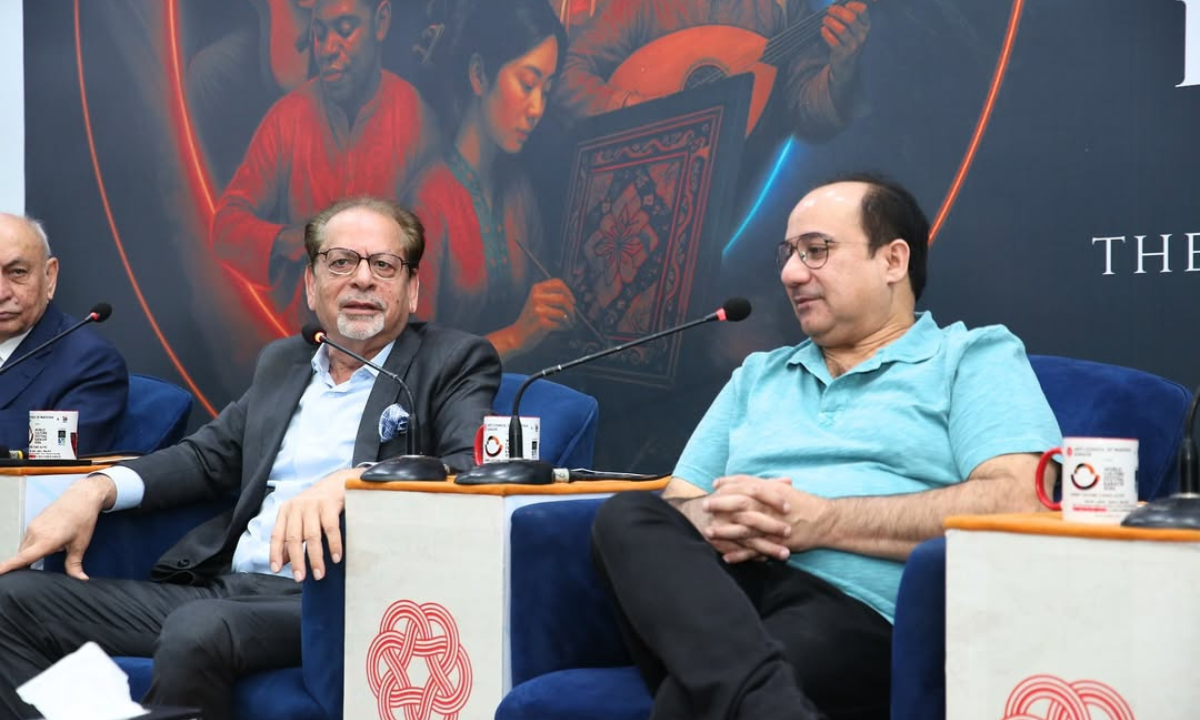
The second stop, the film screenings, dimmed the tempo. After the sensory sprawl of the art show, the cinema hall felt a little low in spirits. A pre-screening talk between Dr Omair Ahmed Khan and Nepal’s ambassador, Rita Dhital, explored cinema’s link with culture.
When the lights dimmed, The School’s Wall (directed by Nepali filmmaker Mohan Shrestha) unfolded with quiet restraint. The nearly silent film was about an impoverished boy who shines shoes for a living and takes care of his ailing father, but dreams of being educated. Tender, but without an impactful culmination, it set the tone for both the good and the bad aspects of the evening.
A Heart So Gentle, by Ayesham Haseeb, never made it past the projectionist’s struggle and, although the new projector was expensive and pristine, it was played via VLC player, which has a tendency to pixellate if not configured correctly.
Then came Rohi, a Sindhi language short documentary by Ghulam Abbas, which took the viewers to its eponymous sun-parched desert. Its imagery and message, about the arid state of Rohi and the plight of its people, were emotional, but the editing and pace were rushed (the colour grade was a tad overdone as well).
Rasm-i-Doori by Omar Bin Safia, a silent short about a college girl haunted by her mother’s absence, was repetitive and amateurish. The Endless Night from Sri Lanka, a boy’s quiet witnessing of his family’s fracture when his father drives away his mother one night, was the best film of the night. However, it, too, lacked a substantial climax.
By the end, a pattern had emerged: the stories and their protagonists were steeped in silence and grief. Is that the only way to gain recognition in a film festival? When the lights turned on, the audience didn’t know whether they should sit or move on.
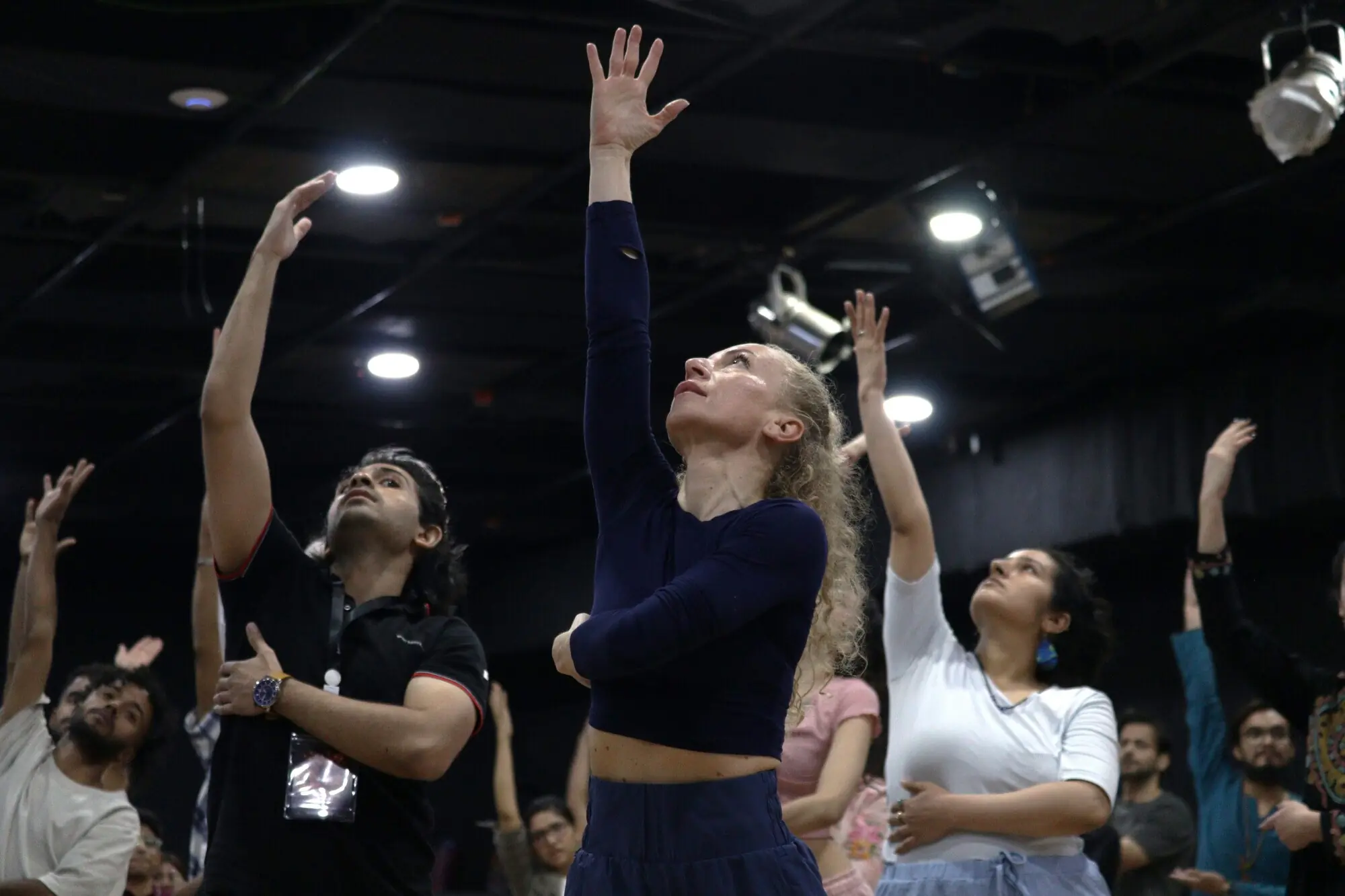
Thankfully, the momentum returned in full force at the ‘Ballet Beyond Borders’ workshop — a session on the fundamentals of contemporary dance. By the time I arrived, it was halfway through, but the room was alive with rhythm and motion. What struck me wasn’t just the discipline but the laughter and openness in the session. It felt less like class and more like a little community gathering.

The high carried into the next act: Te Turperuarit (Ashamed), an Albanian adaptation of Ayad Akhtar’s Pulitzer-winning American play Disgraced, about a Pakistani-American lawyer whose life unravels over one dinner party as identity, religion and resentment collide. Directed by Altin Basha, who couldn’t make it to Pakistan, the play starred the excellent and intense Adrian Morina, Blerta Syla Surrol, Aurita Agushi, Kushtrim Sheremeti and Endrit Ahmetal, who helped deliver a powerful climactic turn.
Morina, Surrol and Ahmetal, in particular, gave searing performances; fierce, wounded, conflicted, arrogant, pleading. The play’s themes of identity, assimilation, self-erasure (Morina’s character defied and hid his origin to fit in with Americans post-9/11), played out with such conviction that language itself became secondary (the performance was in Albanian with English subtitles that often were out of sync with the action on the stage).
The applause at the end was deafening and, at that moment, I thought the night couldn’t be topped. But the Mega Music Concert, which had been waiting for the play to end, brought a different level of excellence to the night.
I arrived late, after a brief dinner, missing Shireen Jawad and Madan Gopal’s sets, but not Zakaria Haffar’s vivid mastery of the santoor. Lucy Tasker followed with a mesmerising clarinet solo that one just didn’t want to end. Her clarinet later joined Akbar Khamiso Khan’s amazing alghoza in a spectacular fusion that ignited the courtyard, drawing Congo’s dancers into joyful improvisation at the footsteps of the stage.
Then Ammar Ashkar took over, moving through Le Tehajja, Ya Bu Rdayyen, Aal Rozana — the last two being Syrian folk pieces — before surprising everyone with a rendition of Aafreen Aafreen with Tasker.
Akhtar Chanal followed, his booming voice lifting the crowd into collective ecstasy — a semi-finale that gave way to Bilal Saeed’s big finish. The courtyard pulsed, lights strobed, and phones rose in the air, the screens flickering like fireflies. With dancers and performers vibing to the beat, one felt as if the world had come alive under one roof (or, to be precise, under the cloudless night sky of the ACPK compound).
To think, this was only day one of 39, where art did what it does best — erase borders, connect hearts and keep the world turning, one song, one performance, one story at a time.
Originally published in Dawn, ICON, November 9th, 2025

Comments