

An activist is taking the Pakistani government to court to declare period products tax-exempt essentials
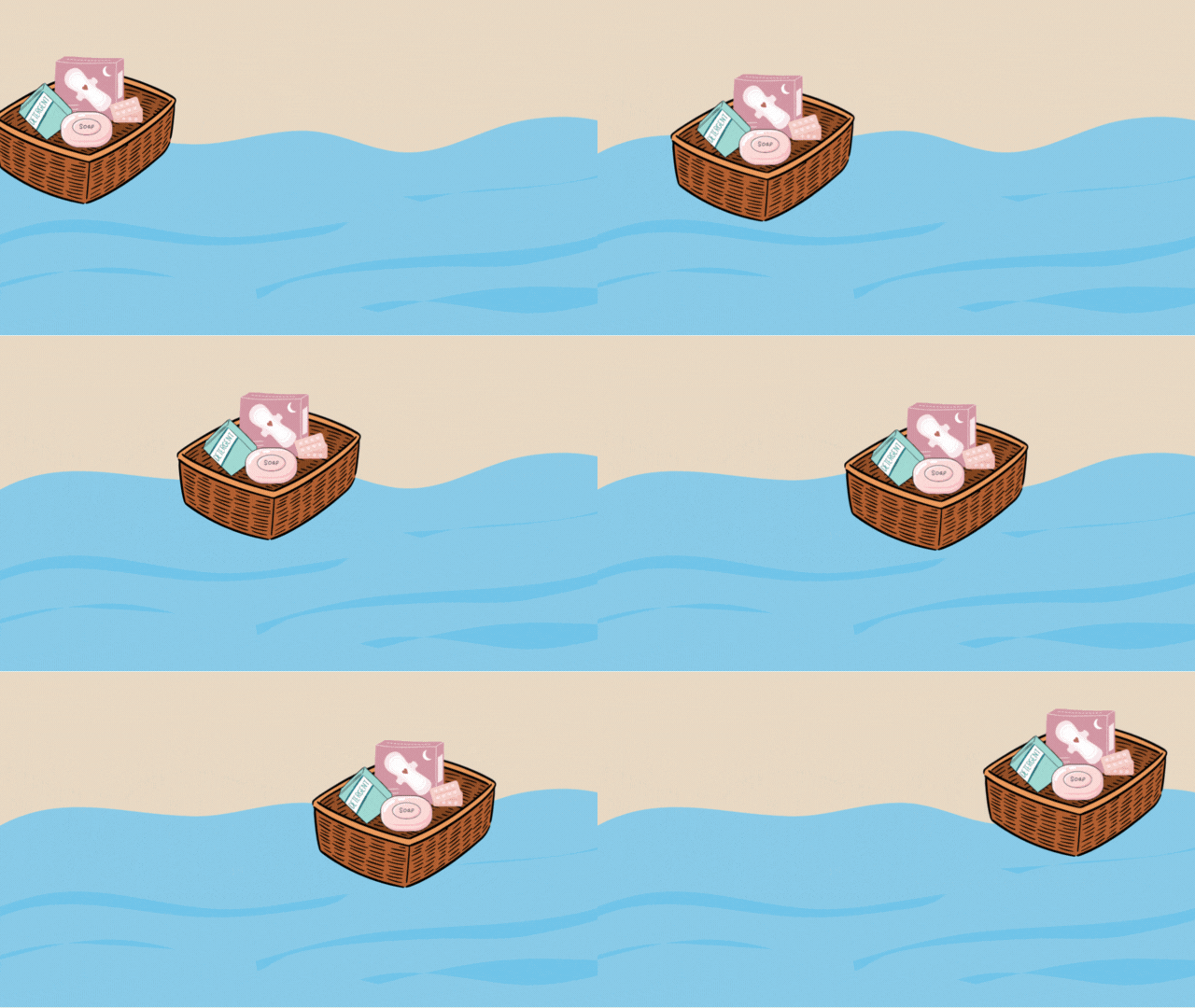
In a landmark case on the accessibility of feminine hygiene products in Pakistan, women’s rights activist Mahnoor Omer has filed a petition with the Lahore High Court’s Rawalpindi bench to have feminine sanitary products be declared essential goods and given tax-exempt status. The petition argues that taxes imposed on these products “disproportionately impact women” and penalise them for “a biological function over which they have no control”.
Omer has named the Federation of Pakistan, Ministry of Finance and Federal Board of Revenue as respondents, with the National Commission on the Status of Women, and National Commission for Human Rights being named as proforma respondents.
The petition quotes a Unicef policy brief saying taxes and duties levied on sanitary products and the raw materials used to produce them create a tax burden of Rs40 on every Rs100 spent, treating menstrual hygiene “as a luxury rather than a necessity [and] placing essential sanitary products in the same tax bracket and non-essential goods”. This, the petition claims, is “inherently discriminatory” and a violation or Articles 9 (Security of person), 14 (Inviolability of dignity), 25 (Equality of citizens) and 38 (Promotion of social and economic well being of the people) of the Constitution of Pakistan.
The petition said 48.51 per cent of Pakistan’s population was comprised of females, of which 62 million are of the age in which menstruation occurs. Quoting Unicef, the petition said only 12pc of these women use commercially available sanitary products. Period poverty — the lack of accessibility to hygiene, waste management and education relating menstruation — the petition claimed, is causing girls to miss school, making women stay out of the workforce and leading to increased instances to urinary tract infections in women.
It asks the court to order the classification of feminine sanitary products as essential items. The court has been requested to direct the authorities to place sanitary products and their raw materials in the Eighth Schedule in order to exempt them from taxation. Barring that, the petition asks for their inclusion in the Sixth Schedule, reducing the tax rates that apply on these goods. The petition said similar measures have been taken globally, submitting examples from the United Kingdom, India, Australia and Bangladesh, among others.
Speaking to Images, Advocate Ahsan Jehangir Khan, who filed the petition on behalf of Omer, said it was “nonsensical” that items such as cheese and flavoured yoghurt were considered essential goods when menstrual hygiene products were not. He said women were “being taxed for a biological process,” which he asserted was because our institutions “full of men are making tax policy”.
On September 15, the Lahore High Court issued notices to the respondents to respond within a fortnight, subject to the maintainability of the case. A further notice is to be issued to the Attorney General of Pakistan for his comments.




Comments