
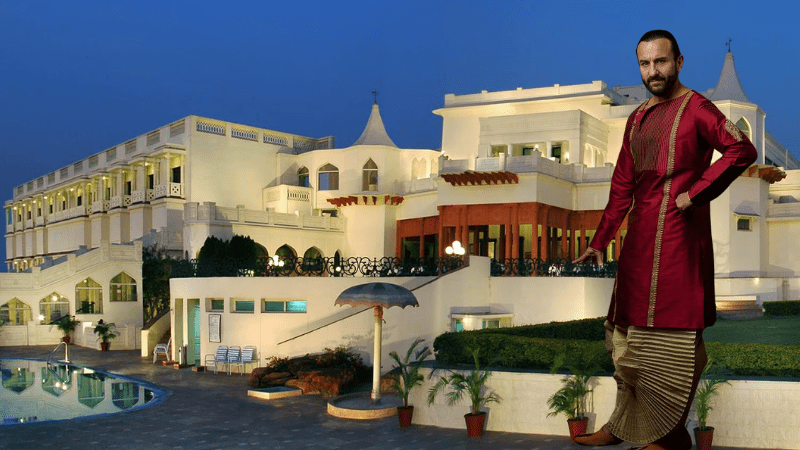
Is a Pakistani connection the roadblock between Saif Ali Khan and his ancestral properties?
An Indian high court has dismissed a 25-year-old trial court ruling that recognised Bollywood actor Saif Ali Khan’s family as heirs to the royal properties of Bhopal, and it’s all because of a Pakistani connection. The Indian government has now seized the property, worth INR150 billion or roughly Rs496 billion, which includes the luxury Noor-Us-Sabah Palace hotel and the Ahmedabad Palace. The trial court has been ordered to initiate fresh proceedings.
We’ve all heard of the properties and havelis, and vast courtyards and flourishing businesses our grandparents and great-grandparents ‘left behind’ when they migrated to Pakistan, and even wondered if we could go and somehow get them back. Well, when your entire family is in the limelight and known across the globe, you can do more than simply wonder, you can actually stake a claim to it.
But it isn’t so simple when you take into account the evolving legalities of the Enemy Property Act, which grants the Indian government the right to seize properties from those who migrated to Pakistan, and the descendants start filing lawsuits demanding their inheritance under the Shariat Law.
The Nawab of Bhopal, Hamidullah Khan, had three daughters: Abida Sultan, the intended heir to the throne, Sajida Sultan, Saif Ali Khan’s grandmother, and Rabia Sultan. After Abida migrated to Pakistan in 1950, 10 years before the demise of her father, Sajida was declared heir presumptive in the Nawab’s lifetime. After the Nawab’s demise, a government order dated January 12, 1962 recognised Sajida, an Indian citizen, as his successor.
But, Jagdish Chavan, a senior advocate who’s worked with the Pataudi family and closely followed this case, told The Print that he believes that according to the Succession Act, Abida should’ve inherited the estate and due to her relocation to Pakistan, it should’ve simply become “enemy property” and gone to the government. He implied that friendship and political influence had a role to play in why it went to Sajida instead, since she was married to Iftikhar Ali Khan, the Nawab of Pataudi, who had a friendship with Jawaharlal Nehru, the then prime minister of India.
The remaining heirs of the Nawab, the children of his third daughter, and his older brother, had little to no issue with the matter since they were still receiving the privy purse, a payment made to the ruling families of princely states as part of their merger with India. However, legal battles ensued when Indira Gandhi abolished it in 1971, discontinuing royal titles and their privileges. The other heirs now demanded inheritance under the Muslim Personal Law (Shariat).
In 2000, a district court in Bhopal passed a judgment on both suits, pronouncing that Sajida would remain the successor, relying on the precedent set by the State of Rampur Case. But that case has now been overruled, and the property ultimately got divided following the Shariat Law, thus nullifying the 2000 court order on the Bhopal property dispute as well.
Fast forward to June 30, 2025, when the Madhya Pradesh High Court ordered a fresh trial on the Bhopal “enemy properties” and seized them from Saif and his family. Lawyer Chavan thinks that the Bollywood star will now receive only two to three per cent of the property.
While this remains more of an internal dispute of the evolving legal interpretations in India, Pakistan naturally became a part of the conversation as well, with many netizens wondering about the late Shahryar Khan’s involvement in the legal claim. Shahryar was a former foreign secretary, former PCB chairman, and the son of Abida, and had given up his claims to the Bhopal estate in India. Many seem to be confusing the estates in India with Bhopal House, which is located in Karachi’s Clifton. It was bought by the Nawab in July 1947 as he anticipated his move to Karachi, as stated in a letter he addressed to the Quaid-i-Azam. That move never materialised.
Since then, there had been a dispute between Shahryar and the Pakistani government over ownership of Bhopal House. Abida did not stake her claim to the property until 32 years after her father’s death, and during those years, it was used by the Foreign Office and an intelligence agency. As of 2022, the ownership dispute has been pending adjudication for years.
To sum it up, Bhopal House in Clifton, and the Nawab’s assets in Bhopal are divided by over 1,000 kilometres of land, and Pakistan has virtually nothing to do with the seizure of the properties from Saif other than his great aunt migrating here.






Comments