
Sara Shakeel wants to help you love yourself, one sparkly artwork at a time

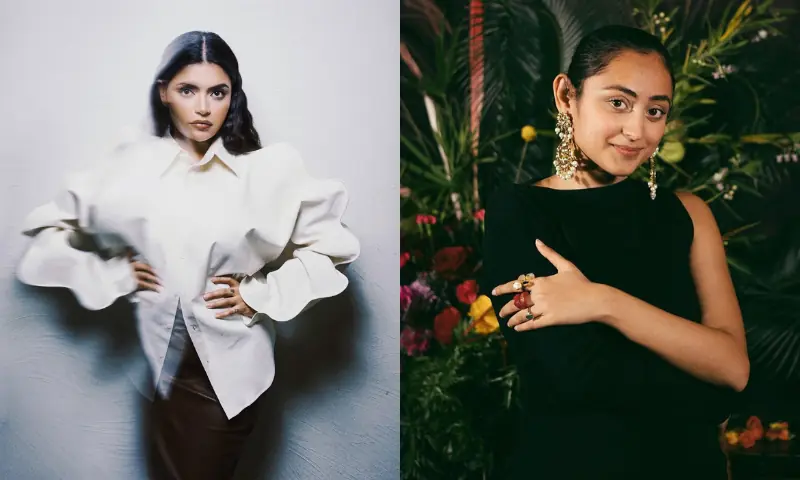
You could be forgiven for walking past Sara Shakeel without realising that she is a globally recognised, widely celebrated and award-winning multidisciplinary artist marking an immensely successful decade of carving out a sparkling niche in the art world.
Dressed in deceptively simple white, visually, she is the antithesis of the images she creates: quiet, humble and unassuming, with little about her suggesting the extroversion of her chosen creative language. And yet, crystals have come to define that language — first superimposed onto two-dimensional images, transforming the ordinary and imperfect into something luminous, and now taking physical form in elaborate sculptures and installations.
We meet at a dinner hosted by The Legend of Maula Jatt producer and art connoisseur Ammara Hikmat in Lahore, whose home, with its quirky interior, offers the perfect backdrop to creative conversations.
Shakeel is in Lahore for You Can See Through Me, an exhibition of her new work. We sit down to talk about her art, which is hugely feminist and intends to shape conversations around womanhood, body image and, tying it all in, spirituality.
Are you celebrating what we would conventionally call imperfections, or are you changing the perception of how we see things, I ask.
“The latter,” she responds without hesitation. “I think there is no such thing as an imperfection. For me, everything is beautiful in God’s eyes and if it was made that way, then who are we to say that it’s imperfect? I’m just kind of changing the way we should look at certain things.”
She speaks of her breakthrough collection, Glitter my Stretch Marks, the immediate success of which catapulted her career as a visionary artist almost a decade ago.
“The stretch marks artwork was the turning point for me,” she remembers, sharing a concept that has now become a very dynamic page. “I had done crystal lipsticks, my first work, and this kind of work was never done before. So I’m the first artist in the world who actually came up with superimposing crystals on 2D images.”
What inspired her to turn stretch marks into the subject for artwork?
I wanted to reinforce that in order to love anything else, you need to first start loving yourself. That is something that I like to show with figures, especially women figures. You cannot love anyone till you genuinely love yourself.
“I remember I was taking pictures of one of my friends, and she’s petite. She had stretch marks. I thought to myself, she’s so small, so why does she have stretch marks? I have stretch marks. I used to feel ashamed of them but when I saw hers, I saw them in a whole new light. Till then I felt maybe I’m the only one who has stretch marks, or maybe only big girls have them. And I filled them up with crystals. I posted the image on Instagram and it resonated with so many people. People started sending in their pictures with stretch marks, scars, burns, and all kinds of markings. There were people who had self-harmed and wanted to tell their story without revealing their identity.
“I wanted to reinforce that in order to love anything else, you need to first start loving yourself. That is something that I like to show with figures, especially women figures. You cannot love anyone till you genuinely love yourself.”
Originally pursuing a career in medicine, Shakeel’s transition from the world of science to art seemed almost instinctive.
“As a dentist, I was healing a physical pain. And I loved it. I generally like this process of giving. And art did a similar thing but with emotions, with feelings, with empathy and with human connection. It happened on a very spiritual level.”
Shakeel’s story is one of hope and dreams. She remembers how she started making collages before she even knew what the word meant.
“I had a broken laptop and I didn’t have the courage to ask my parents to buy me a new laptop. I had a Samsung Note 3 stylus pen and I started cutting and pasting a lot of images together. I remember I started posting on Instagram and someone commented and said, ‘This is the worst collage ever’. I was like, okay, I agree. But what is a collage?
“I did not even know what a collage was back then but I was making collages. I got 23 likes on the first collage I posted on Instagram and felt like I had made it!”
Her love for crystals came from her grandmother’s curio cabinet full of crystal figurines — the kind most millennials will remember from their childhood: the crystal rabbits and hedgehogs and deer that grandmothers loved to collect.
“It was so mesmerising to see them catch the light; the movement of light always caught my attention.”
As luck would have it, it also started catching the attention of some very famous people.
“I was in London, exhibiting my first installation, The Great Supper, when I got a message from him on Instagram,” she narrated her surprise interaction with Chance the Rapper. “He was like, Sara, I have been trying to find you for a very long time. He asked for my number and called me about a picture of a crystal disc I had made. He said he had been holding on to it for two months. He wanted me to design his whole album cover. He didn’t even know me, but he knew my work. And in God’s special way, he found me.”
Since then, her distinctive visual language has found a global audience, leading to collaborations with some of the world’s most recognisable names — from Lancôme, Bobbi Brown, La Mer and Victoria’s Secret to Jimmy Choo, Mercedes-Benz and Amazon.
Despite the maximalism of her artwork, Shakeel is a very private, quiet person. In this digital age, artists and creators consciously or subconsciously build profiles on Instagram and have very public personas, but this artist lets her work speak for her.
“I am a very private person in general,” she agrees. “I’m a very malang, a clumsy and relaxed person. I know that people have certain expectations from artists and celebrities but I kind of don’t care about that. I think people connect with my art more than me but when they meet me, they say the picture is complete. They say that meeting me helps make sense of everything that I make.”
She admits that her work is a fantasy, a bubble that she lives in that is protected from politics and the harshness of life. This resonates in various artworks. Particularly striking is the series of artworks she made on Ariana Grande.
“I’ve never met her and I don’t know her personally but her music is beautiful,” Shakeel says. “I noticed all the hate she was getting and didn’t like it. She’s so uplifting, every interview you get to see is so positive. How can you hate someone like that? This series was my special way of seeing her sparkling,” she explains.
“I like to see good in things in life and the good in people, no matter what the circumstances are. And I kind of want to share that light and hope with people through my art.”
Shakeel is very clear in her guiding light being Allah, and the spirituality that guides her through her life and work. She’s also very clear about the intention behind her work, which is to spread hope and positivity. In her world, there is no room for negativity and darkness.
“God made us beautiful in so many ways,” she says, “and through my work I do want to focus on the beauty of female bodies, female minds. I think we are more than just bodies. I think we are an extremely intelligent species that is hugely untapped. It’s not been fully explored. Women in general, I personally think, are always fighting. We are in fight mode. We are trying to prove ourselves. I think a calm woman has never been explored. I’m looking for that calmness.”
This ethos reflects in all her work, from the recreation of world flags to one of her most ambitious projects to date, The Jewel System, which took her work decisively from the digital into the physical realm. Commissioned by Swire Properties for Arts Month 2025 in Hong Kong, the installation reimagined the solar system through folklore and mythology, its vast planetary forms embellished with 3.9 million crystals and some 40 million hand-embroidered stitches. Instead of outsourcing the embroideries, Shakeel worked for three months with a team of 80 artisans in Pakistan, bringing centuries-old techniques traditionally associated with ornate textiles and bridal wear, into magnificent celestial sculptures.
“They now call me a phygital artist because I combine physical and digital worlds,” she laughs.
Is she at all worried about AI and its influence on art?
“Oh I love AI,” she says with utmost clarity. “People find technology scary but I personally consider it a friend, and a friend that has no ego and is willing to work with me in the middle of the night. For a person like me who has 500 ideas in one go, AI really helps me bring them together. Honestly, it’s about using it to your advantage and understanding that it’s not fulfilling anything completely. It’s just a part of the process.”


Comments