
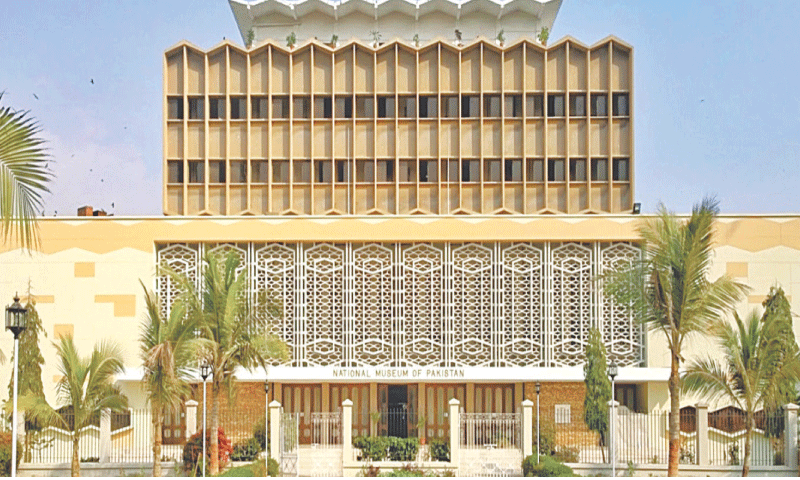
The National Museum of Pakistan may finally get the upgrade it deserves under new CAP-AKU collaboration
The Citizens Archive of Pakistan (CAP) and Aga Khan University (AKU) have signed a Memorandum of Understanding to collaborate on the upgradation of the National Museum of Pakistan, one of the country’s principal institutions dedicated to preserving cultural, historical and artistic heritage.
The MoU was signed on February 16 in Karachi and outlines a framework for strengthening the museum’s infrastructure, exhibition design, visitor engagement and educational outreach. In other words, the aim is not just to freshen up the walls, but to reconsider how the museum functions as a public space.
Established in 1950, the National Museum of Pakistan houses everything from Gandhara sculptures to rare manuscripts and ethnographic collections. But as museum practices evolve globally — with interactive displays, community-centred programming and research-driven curation becoming the norm — many of Pakistan’s institutions risk feeling frozen in time.
This collaboration appears to acknowledge that gap.
Under the agreement, AKU will provide technical guidance and institutional coordination for the upgradation process, drawing on its academic and research expertise. CAP, known for its work in oral history documentation and exhibition development, will bring experience in archival research and community engagement.
The initiative is also being undertaken with support from the federal government’s National Heritage and Culture Division.
CAP’s Patron-in-Chief, filmmaker Sharmeen Obaid-Chinoy, said the museum has the potential to be “far more than a repository of artefacts”, describing it instead as a space that could actively engage young people and encourage dialogue about shared histories.
CAP President Ahsan Najmi echoed that sentiment, emphasising the organisation’s focus on participatory storytelling and documenting lived experiences. The idea, he suggested, is to make the museum experience more reflective of the diverse voices that shape Pakistan.
For AKU, the collaboration also carries an academic dimension. Vice Provost Anjum Halai noted that museums play an important role in education and said faculty and students from the university’s newly launched Faculty of Arts and Sciences will be involved in the project.
Whether this MoU translates into a visibly transformed museum — one that draws in school groups, university students and families not out of obligation but curiosity — remains to be seen. But at a time when cultural spaces often struggle for attention and funding, a partnership that combines academic research, archival expertise and government backing could be a meaningful step.
If done right, the National Museum of Pakistan might finally begin to feel less like a quiet storage room for the past and more like a space that invites people to question, learn, and participate.
Cover image via White Star / File.




Comments