
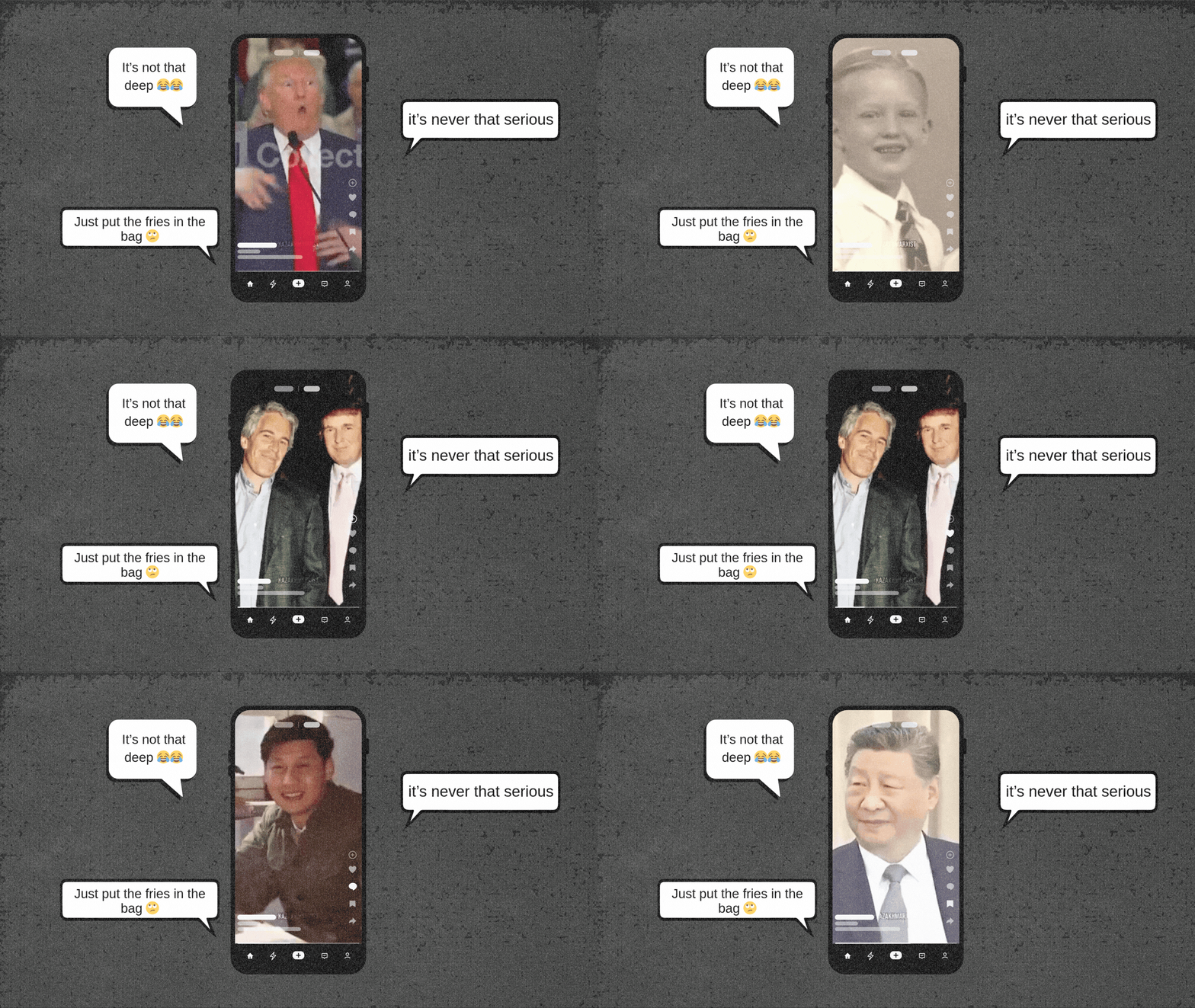
What’s a guy got to do to have a meaningful conversation around here?
In October 2025, fresh out of college and disillusioned by the impossibility of meaningful social discourse, I stumbled upon Neil Postman’s Amusing Ourselves to Death (1985), a prescient 200-page book examining the profound cultural shift from the Typographic Age to the Television Age. A civilisation’s dominant medium, he asserts, shapes not merely what we think about, but how we think. Far from being neutral, the medium “classifies the world for us, sequences it, frames it, enlarges it, reduces it”.
While Postman did not live long enough to witness the birth of Instagram and TikTok, his ideas most certainly did. And in the muddied lake of the new age, the Social Media Age, I believe, lies at least part of the answer to a question I’ve been wrestling with: “why does it feel impossible to engage in meaningful social discourse?”
A deep dive into it, however, is an exercise in futility without first revisiting the transition from the Typographic Age to the Television Age. In the Typographic Age, the primary medium of public discourse was the printed word. Its form — sequential, detached from a speaker’s physical presence — necessitated a rational, contextual, and sustained cognitive mode, where authority was derived from the logical architecture of an idea rather than the charisma of its deliverer.
This is not to say the Typographic Age was a utopia of truth; it yielded everything from extreme propaganda to yellow journalism. Yet, due to the medium’s very nature, even the most ignoble arguments required a line of thought for the reader to follow, inhabiting a space of logic and continuity. The Television Age, contrarily, dictated by rigid 30-minute and one-hour slots, prioritised immediate impact, one-liners, and emotional gratification. With ad breaks integrated into its very form, tremendous financial incentive existed in keeping us glued to the tube.
Entertainment, therefore, trumped rationality and depth across our entire cultural landscape from politics and news to religion and education.
The medium also normalised discontinuity. One minute, you’d be horrified by the grim details of a double homicide; the next, you’d be watching a woman passionately exclaim: “Yeh bik gayi hai gormint.”
TV classified our world as a series of disjointed, entertaining episodes. Now think of the Social Media Age as the TV age but on steroids, ie, a hundredfold worse.
Allow me to assert that meaningful discourse requires time, attention, and a willingness to acknowledge complex ideas and positions that do not necessarily conform to our own. But what if I told you that our attention span, according to Dr Gloria Mark’s two-decade-long study on digital distraction, has plummeted from 150 seconds in 2004 to a mere 47 seconds in recent years?
On any given day, you’re likely spending at least two and a half hours on social media. And why shouldn’t you? It has everything: news, politics, edutainment, memes, conspiracies, cat videos, all curated to your specific tastes by the Zuckerbergs and Musks of the world.
Who has time for books? Dante’s The Divine Comedy has been gathering dust on my bookshelf since November. Why? It’s 800 pages! Why’d I buy it? Let’s move on.
Who even has time for films? Sure, we’ll all spare a few hours for the Barbies, Oppenheimers, and The Legend of Maula Jatts, but a regular film? No, thank you. Every time I’m recommended a film, my reflex is to Google its runtime. Ninety minutes? Awesome. Two hours? Only if the rating is top-notch. Anything above that? Not unless it’s Once Upon A Time In Hollywood.
Honestly, regardless of the runtime, I will almost certainly be pausing every 15 minutes for a five-minute scroll.
Perhaps I’m cooked. Perhaps I’m not the only one. Last week, I saw Terry Gilliam’s retro-futuristic, 1984-inspired film Brazil. Although I thoroughly enjoyed its over-the-top, nightmarish, satirical tone, I believe our world today is closer to Aldous Huxley’s vision of the future in Brave New World.
“Orwell feared that the truth would be concealed from us. Huxley feared the truth would be drowned in a sea of irrelevance,” wrote Postman. With well over 2.5 quintillion bytes of data — photos, videos, pins, tweets, snaps — being created and consumed every single day, we are inundated with short-form, discontinuous, fragmented, and decontextualised information: novel, fascinating, immediately gratifying, yet largely irrelevant, explaining our ever-shrinking attention spans.
Ask any social media creator and they’ll echo the sentiment the shorter, the better. “Ten to 30 seconds is the sweet spot,” I’ve repeatedly heard. Why? Millions of creators are fighting for our attention.
Without the storytelling prowess of Irfan Junejo, there’s no point exceeding the 30-second mark. If you’re slow, goodbye. If you’re dense, goodbye. An infinite scroll of boundless possibilities awaits.
Much like the Mind Flayer’s vines enveloping the Upside Down, today’s dominant medium has every pillar of our culture in a chokehold.
“Me waking up every day and changing my political stance based on the political leader edit my feed shows me,” was a comment liked by over 4,000 people under a 12-second video where Xi Jinping ‘mogs’ Donald Trump.
Politicians, of course, have realised this, which explains why they’re pumping millions into their online presence, prioritising aesthetics and ‘gotcha’ moments over substance. They know that understanding a manifesto is long, laborious work we no longer care for.
Surprisingly, religion, too, has been repackaged. Once, it required sustained focus for the parsing of dense, centuries-old scriptures and the slow, often painful work of spiritual struggle. Today, it is an aesthetic, optimised with cinematic colour grades and uplifting scores to solve popular spiritual crises in 30-second reels. It is no longer about the Divine; it is about us, and the ‘relatable’ snippet that makes us feel righteous for a heartbeat before the next scroll.
In schools, teachers are fighting a losing battle with the For You page. Without killer copywriting, trending music, and high-end production value, do they even stand a chance? Kubrick’s 2001: A Space Odyssey, one of the greatest films of all time, with its sprawling, meditative, and largely wordless sequences, would be labelled ‘unwatchable’ in a world that requires a hook within the first three seconds. Our obsession with short and sweet has created a world that no longer has time for the much-needed long-form.
On platforms designed for instant gratification, people want exactly that: heavy-handed, bite-sized emotional payoffs. And if the entire population demands candy, why wouldn’t the manufacturers produce more?
But you know what can’t be shrink-wrapped into easily consumable, colourful candy? The oligarchy’s unchecked, politically-backed exploitation of our country; the institutional failures behind the tragedy at Gul Plaza; the ongoing genocide in Palestine by US-backed Israel, and the 27th Constitutional Amendment. If you gave the smartest, most eloquent person on Earth just 45 seconds to paint a comprehensive picture of any one of these issues, they would fail. Our world is painfully complex and if our dominant medium refuses to permit the discussion of that complexity, how are we supposed to recognise our own chains, let alone unionise against them?
Time for a breathing break.
Before we continue, let’s indulge in the sweet, mindless delight of a Skibidi Toilet video. Make sure it’s a split-screen with Subway Surfers on the bottom — just to keep the dopamine levels up.
All too often, in the openly bigoted comment sections of posts, especially those attempting to talk about anything remotely important, I see the same refrains: “Sybau,” “It’s not that deep,” or “Just put the fries in the bag”. Comfortable in the warmth of our curated echo chambers, we are physically repulsed by viewpoints that contradict our own. Dismantling a belief system is a Herculean task because beliefs, like puzzle pieces, are highly interconnected — remove one, and the entire structure of the self feels like it’s falling apart. It is risky, effortful work, but ultimately an essential step in becoming what Paulo Freire, in his seminal Pedagogy of the Oppressed, calls “more fully human”.
Our new, dopamine-hungry, algorithmically-rewired brains now expect to be similarly stimulated in our living rooms and baithaks. We strive to provide one another with the same bite-sized emotional highs we’re accustomed to receiving online: cool one-liners, hot takes, and tea. We no longer talk; we entertain. Within this performance, we often find ‘loud Kirks’ confidently purveying snippets of pseudo-intellectualism mined from a 30-second reel as if they are profound truths.
To speak with nuance, to pause, or hold a thought for longer than 60 seconds now feels like a social transgression — for in the logic of the scroll, it is simply ‘weak content’. We have permitted our social lives to become a collection of trivia.Don’t get me wrong, I love trivia, but to quote David Foster Wallace from the film The End of the Tour: “That’s fine, in low doses, but if it’s the basic main staple of your diet, you’re going to die.”
Has it been 47 seconds since our break? I’m running out of steam, so I’ll conclude.
Social discourse is a non-negotiable component of a healthy, well-functioning democracy. Our dominant medium, however, significantly hinders our ability to deeply and meaningfully engage in it. I’m no pessimist. I believe in the wonders of neuroplasticity — the brain’s capacity to rewire itself despite the damage done. It would be unfair not to acknowledge the fruits of our medium: the connectivity, the laughter, and the livelihoods it sustains. I believe, however, that we can no longer afford to use this all-consuming, attention-commodifying medium uncritically.
Our first act of love for humanity can be the simple act of observation. Until your eyes, ears, and hearts verify my words, they, too, will be lost in the endless digital sea. Only then can we perhaps talk in long-form, without being interrupted by the urge to entertain. Only then can we begin the painful journey toward liberation.
Cover video via yousif.aka_313/Instagram
Comments