
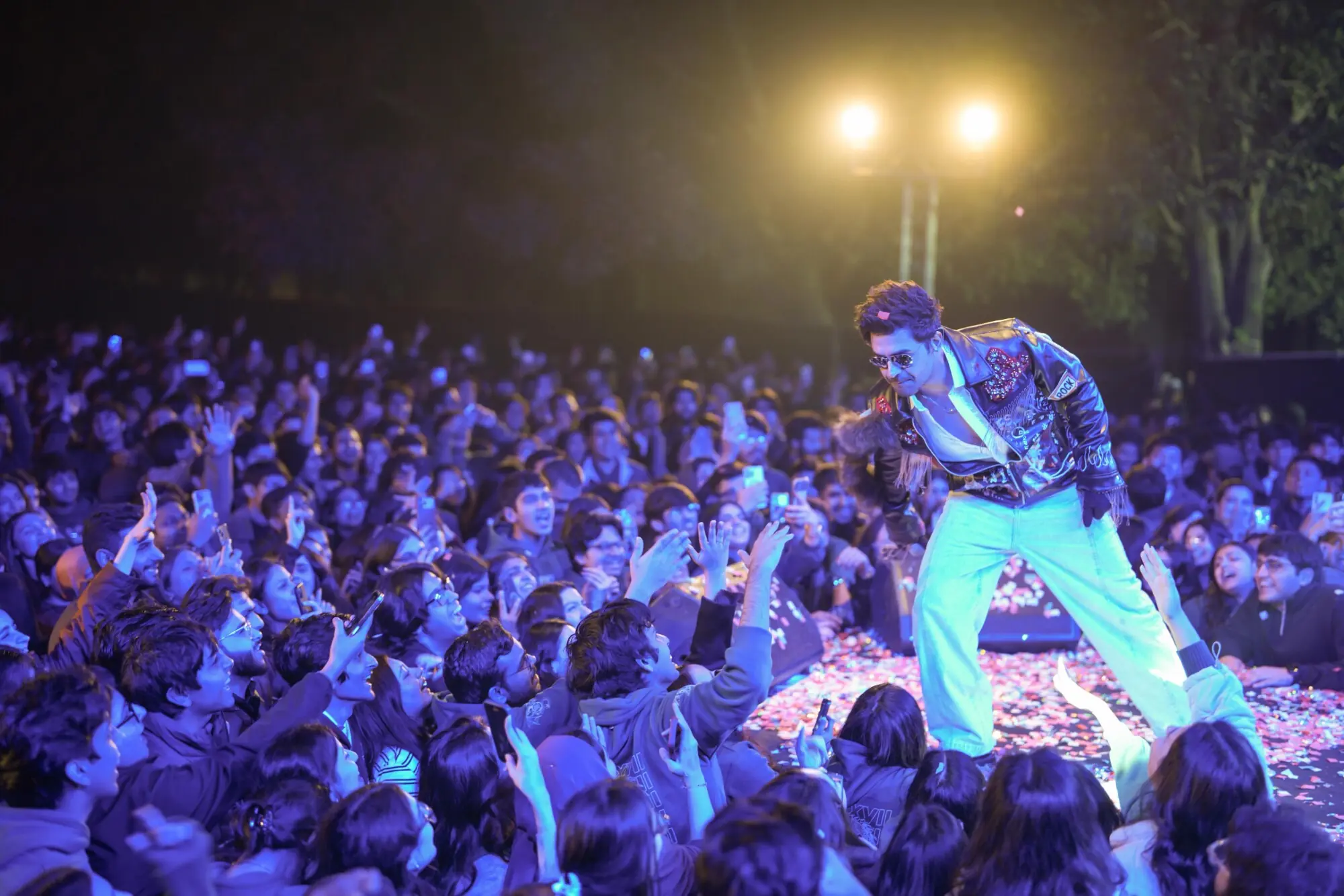
Farhan Saeed on music, fame, and why ‘a musician’s home is the album’
When an interview of a singer takes place right before the release of their new song or album, you can always hope for a live mini-concert.
Farhan Saeed sits opposite me and casually props a snazzy-looking guitar behind him. And I know that I will be listening to some unplugged singing after — or during — the interview.
Conversations with Farhan are always insightful, peppered with honest anecdotes and a few revelations here and there. There is also always a lot to talk about, as his career constantly boomerangs between music, film and TV. Hearing him sing live is the icing on the cake.
As we talk, I occasionally request him to sing certain songs. I am treated to quite literally the ‘Best of’ from his musical oeuvre: the hit ‘Suno Chanda’, the soundtrack of the drama of the same name, which he also acted in and which indubitably began the Ramzan drama fad; the sentimental ‘Thorri Daer’, sung with Sunidhi Chauhan for a Bollywood film, and the romantic ‘Pee Jaoon’. Farhan also sings ‘Khat’, the first track from his album of the same name.
‘A musician’s home is the album’
This new song is quintessential Farhan Saeed: melodious and sentimental, simply a love song to play during a long drive. Farhan agrees: “‘Khat’ is what people know me for, like a ‘Pee Jaoon’. I was sure I wanted the video for the song to have the ‘feel’ of a band, since I started my career in a band. I didn’t want a typical music video, where the storyboard revolves around a romance between a boy and a girl.”
Following ‘Khat’ is ‘Manzar’, a sweet ballad with its video including unseen footage from Farhan’s wedding with actor Urwa Hocane; it was released around the same time as the couple’s ninth wedding anniversary.
“Surprisingly, it hadn’t even occurred to me that I could use footage from my wedding in a music video,” he tells me. “I was in Dubai, meeting my album’s distributors at Warner Music, and I was playing for them. I mentioned that the album had different types of songs, including one ideal for weddings.
“I played ‘Manzar’ for them right after I said this and, although I was referring to another number, they started imagining ‘Manzar’s’ video in a shaadi setting. One of the women at the meeting even asked me if I had footage of my own wedding that could be used in the song’s video. This got me thinking.”
He adds: “I showed my wedding video footage to the video director, Fahad Noor, and asked him if we could do something with it. He said that it would make a great music video. Interestingly, Urwa and I had never seen our own wedding video till then. Our wedding was covered so extensively on social media that, by the time it wrapped up, we were done seeing so much content! When we saw the video of ‘Manzar’, Urwa started crying. On another note, I had always considered ‘Manzar’ to be the most romantic song in the album, and I told Urwa that I had dedicated it to her.”
Will he be releasing the rest of his album’s singles one by one as well? “I had considered doing this, but then I realised that it would be too difficult,” he answers. “I am also working in a drama and performing in concerts regularly. It won’t be possible for me to release one song at a time, promote it and give interviews about it. I plan to release the next single along with the rest of the album.”
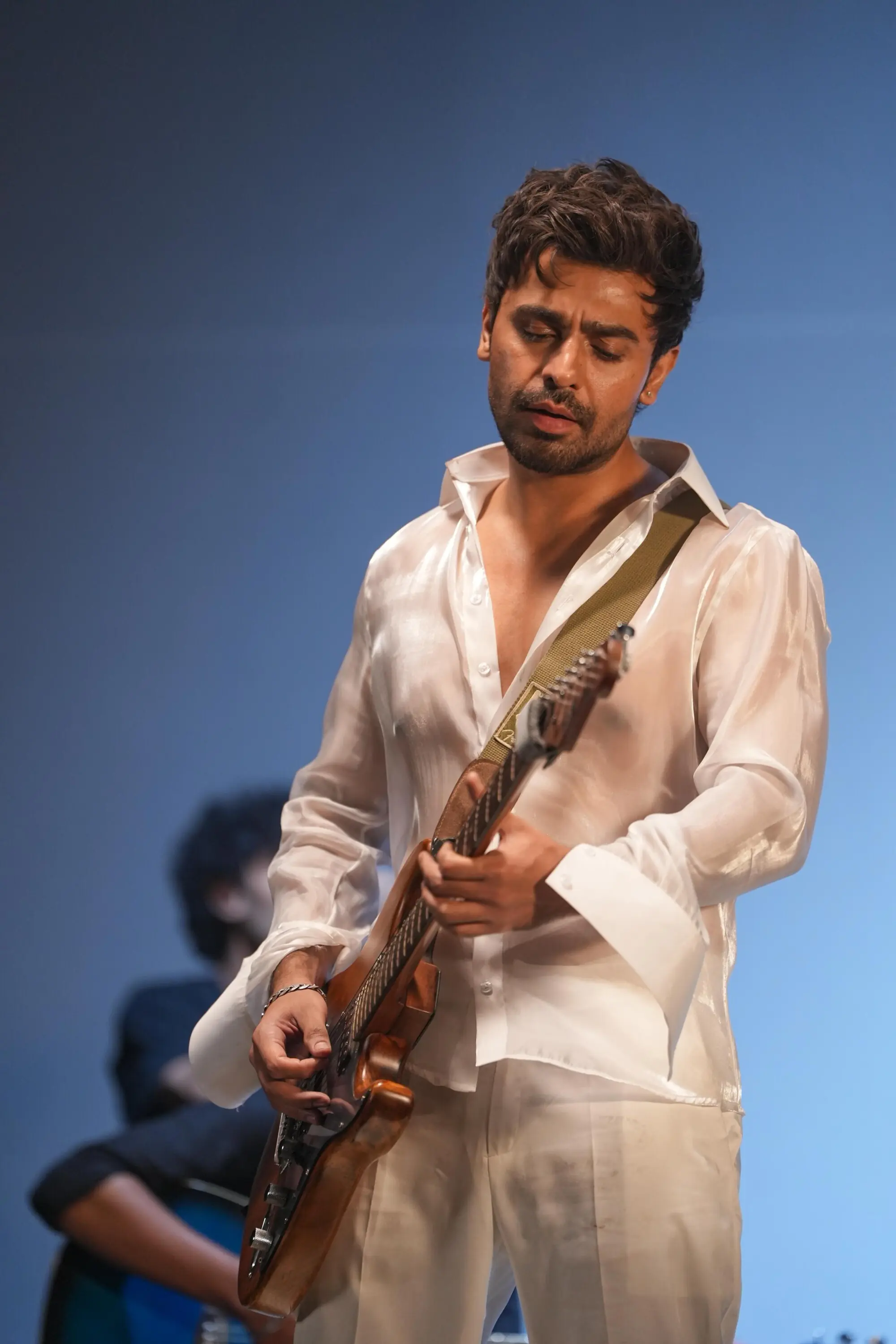
Farhan’s career spans more than two decades. Surprisingly, Khat will be his first solo album. “Yes, it is my first album as a solo artist,” he confirms. “I have a couple of albums to my name from the time when I was part of a band [Jal], but then, around the time we disbanded in 2011, YouTube was banned. This hampered the growth of Pakistan’s music industry to a large extent. I still continued to release singles — I don’t remember anyone else doing so at the time, and then, even when the ban on YouTube was removed, musicians would just release singles.”
He elaborates, “Honestly, it was easy to just come up with a good song, make one video and then do concerts. Albums take a lot of time and effort but, having said that, a musician’s home is the album. You give a piece of yourself to the world when you go back to the studio and put together an album in a span of three to four months.”
And does he think that now, albums — rather than just singles — are making a comeback?
“I think they have already done so. I know of at least five other Pakistani musicians who have released albums or are releasing them over the next few months. It satisfies a musician’s inner yearning when they put together a collection of songs that reflect their vision. It is also a collection of different kinds of music which appeal to different audiences. So, you just release all these different variations, never knowing which song will work best.”
He continues: “In the albums that I released with the band, the song that we always thought would do the best was never as big a hit as another one.”
So, you never know? He widens his eyes and smiles. “You never know with songs. You never know with dramas.” You also never know with a film, I interject. “With a film, you never know at all!” he laughs.
This is something uniquely special about Farhan; he can talk as perceptively about music as he can about changing tides in TV and film. He performs regularly in concerts, has a slew of hit TV dramas to his credit, and made his cinematic debut in 2022’s Tich Button, which will be followed this year by the ARY Films’ Eid release Luv Di Saun.
‘So many of my dramas have been global hits’
Our conversation steers towards dramas and I ask him if, when he is shooting for a drama, whether he can tell when scenes begin to feel repetitive or long-winded? Can’t he tell that the audience is likely to get restless if the narrative gets too long, which was the case with his recent drama, Shirin Farhad?
He pauses before answering. “Later, in hindsight,you can say a lot of things, and on any drama set, the cast and crew do, whether they think that the story is losing its grip. We can tell — at least I can — although it might be more difficult for the director to be objective when they are so deeply involved in the process.”
Referring to Shirin Farhad, he says, “It’s difficult making a period play. After 10 to 12 days, the production houses run out of money. So many details have to be looked into: the cars being used, the wardrobe. It’s not easy. In my case, especially, the drama that I think will do well doesn’t. I really respect the understanding that production content heads have of the audience.
“In the case of Mere Humsafar, Nadeem Baig and Sanam Mehdi at Six Sigma were sure that the drama would do really well. I, on the other hand, would keep asking the director, Qasim Ali Mureed, what was happening, given that Hania’s character was crying all the time. We laugh about it now.”
He goes on to talk about another drama that was close to his heart. “At that time, I was simultaneously shooting another drama, Badshah Begum, and I was so excited about it that I would cut down on Mere Humsafar’s dates for it. Everyone involved in Badshah Begum believed it would set new benchmarks in the TV industry. We would all be in Larkana for 20-day spells, working very hard while enjoying the process. It just didn’t translate, while Mere Humsafar became a global hit. Similarly, in the same way, I never thought that Suno Chanda would become such a sensation.”
Farhan is currently shooting a new drama for ARY Digital, directed by Qasim Ali Mureed, co-starring Sana Javed. This leads us to the inevitable question: singing, acting in TV dramas and acting in films — what does he enjoy more?
“I enjoy being creative, so everything!” he retorts with a laugh. “I enjoy switching roles. Tonight, I have a concert in Karachi, and tomorrow I am performing in Lahore, but for the last four days, I have been on a drama set. It’s great because life never gets monotonous.”
He adds, “But it isn’t easy. Tonight, I will be performing for an hour. I will arrive at the concert venue 10 minutes before my performance is scheduled to begin. And I never opt for lip-syncing. I love singing live. But yesterday, while on a drama set, I had to wait for my scenes to be shot. It can get difficult, although I still enjoy it and have the temperament for it, which is why I do it.”
There is a particular reason why waiting during a shoot for a drama is particularly tedious for him. “I am very different now compared to how I was when I first started out or even in 2024, before my daughter was born. I was very restless then, hosting after-parties at my home, always wanting to be in the thick of things. I have become much more balanced, and I just want to go home and spend time with my daughter.
“So now, when I am at work, and things aren’t getting done, I get anxious, because I have left something very important behind to be there. That’s why whatever I am working on has to be worthy of my time and effort.”
He adds: “I work in dramas because I like to do so, but music is far more lucrative.”
But doesn’t he think working in dramas has made him more popular with the general public? He agrees. “It does increase the number of people coming to your concerts and widens the age bracket of your fans.”
Farhan has always stood by every one of his projects, promoting them sincerely. Despite this, does he think that he is underrated?
“No, I don’t think so,” he says, “I don’t know how many dramas I have done, but I was just starting out when I worked in Udaari [2016]. It did really well, although I wasn’t at my best in it — I think Ahsan Khan, Bushra Ansari and Urwa Hocane were really good. Then came Suno Chanda, and I won four awards for it at an awards ceremony. The other four awards that night were given to Naumaan Ijaz. After this, Mere Humsafar happened. So many of my dramas have been global hits.”
‘On social media, I just write from the heart’
These dramas also have a considerable fan base in India. Farhan, in fact, has often spoken fondly about his Indian fans. This did not deter him from posting patriotic messages when war broke out between India and Pakistan last year.
“My social media following suffered a lot because I had so many fans in India. But if my country is at war and people think that I will not say ‘Pakistan zindabad’, then they are wrong. This doesn’t mean that I hate India or any other country. I am just standing by my own country.
“Some of the best people that I have met are from India, and I have so many friends there. But I can’t stay silent while their media curses my country and uses constant fake propaganda. My social media following in India may have decreased and, of course, I feel bad about it, but I won’t prioritise my fan-following over my country.”
The messages that he posted on Instagram during the Pakistan-India conflict were very heartfelt. In fact, Farhan’s opinions on social media often seem to be spontaneous, written on the spur of the moment. He laughs.
“I just decide to write something within minutes. I don’t even check the spelling — I am sure that there are grammatical errors! I don’t need to spend time thinking about what I want to write, because my heart is in the right place. I never write because I am hating on someone. I am just expressing what I feel.
“What I don’t like is how so many people use social media to spread negativity and gain a bit of fame,” he adds. “It’s disgusting when, during a podcast, people ridicule someone’s appearance or disregard their extensive body of work. They are very obviously doing this just to get attention and, ideally, they should be ignored.”
This comment reminds me of a social media controversy from not too long ago, when his former Jal bandmate, Goher Mumtaz, said during an interview that Farhan sang out of tune. Did he feel hurt by Goher’s comment?
“More than hurt, I was surprised and shocked!” Farhan admits. “By speaking about me in this way, he probably hurt the feelings of Jal’s many fans who had grown up listening to the band’s songs. Jal wasn’t a one-hit wonder. For a decade, we released hits and were very popular. Goher was probably in a bad place when he made that statement, but he shouldn’t have done it. In my case, it worked in my favour, with people springing to my defence.”
Coming back to Luv Di Saun, he says with a smile, “I hope people like it.” But you never know, do you? “You never know,” he agrees with a shrug and a grin.
What one does know is that when you see Farhan Saeed’s name in the credits — be it on a music album, a TV drama or a film — he’ll be making a sincere effort to entertain you. And that’s always good to know.
Originally published in Dawn, ICON, January 25th, 2026
Comments