
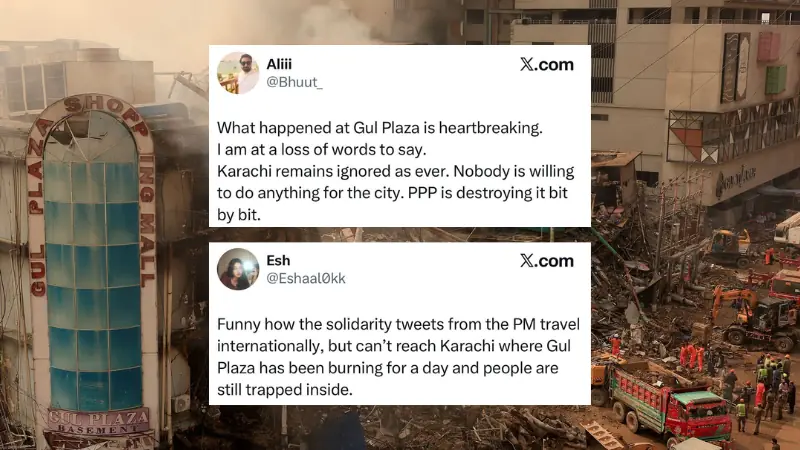
‘Karachi deserves accountability’: X accuses govt of administrative failure as city counts its dead in Gul Plaza fire
Karachi is still counting its dead, and possibly will be for days.
Rescue efforts continued on Tuesday at Gul Plaza on MA Jinnah Road after a fire that broke out late Saturday night tore through the shopping centre, collapsing parts of the structure and trapping dozens inside. While officials say the blaze was brought under control on Sunday, firefighting had to resume on Monday when flames reignited from smouldering debris. By late Monday night, at least 23 bodies had been recovered, some in fragments, according to police and Rescue 1122 officials, with more than 70 people still reported missing.
The building itself tells a familiar Karachi story. A ground-plus-three commercial plaza with around 1,200 shops spread over 8,000 square yards, packed with traders, workers and customers, and — according to multiple reports — lacking basic fire safety infrastructure and adequate emergency exits. Despite heavy daily foot traffic and its location in the heart of the city, it had continued to operate for decades.
Karachi Mayor Murtaza Wahab has stated that rescue teams are clearing debris and assessing various parts of the building, while an inquiry committee has been established to determine responsibility. He has also acknowledged that “over the years, naturally, problems emerged which need to be investigated for negligence”, while maintaining that assigning blame is not the priority right now. The Sindh government has announced Rs10 million in compensation for each victim’s family and promised forensic verification, investigations and rehabilitation for affected traders.
But online, patience for official assurances appears thin.
Many are blaming the local government and the administration, arguing that the disaster was not the result of bad luck but of “criminal misgovernance”. In contrast, others opine that Karachiites should not be praised for their “resilience” as they have “normalised suffering”.
“The tragedy that has unfolded at Gul Plaza with 100s of ppl missing, most likely burnt alive & 1200 shops destroyed with goods worth billions, would bring a normal city to a standstill, but Karachi is functioning normally not [because] we’re resilient, but we have normalised suffering,” one user wrote.
Another user said that “anyone shedding tears over the incident without mentioning the incompetence” of the Sindh government was just milking the incident.
Many questioned how a fire of this scale could rage for hours in an area with fire stations nearby, yet still be met with water shortages, access issues and chaotic crowd control.
Others pushed back against calling it a “tragedy” at all. “Stop calling it a tragedy; call it a failure,” read one widely shared post, pointing to Karachi’s entrenched culture of chalta hai, where safety codes exist on paper and enforcement is optional.
That framing is difficult to dispute. Fires, factory collapses, manhole deaths and dumper accidents are not freak events in this city; they are recurring features of urban life in a place where regulators are weak, politically interfered with or simply absent. The question is not whether a short circuit sparked the blaze, but why a structure with known safety deficiencies was allowed to function, uncorrected, for years.
Then there is the anger directed at the Centre.
Several users noted the silence — at least in the early days — from the federal government, contrasting the prime minister’s “silence” with his frequent international statements of solidarity. “A tweet for Karachi wouldn’t have hurt,” one user wrote.
On Sunday, PM Shehbaz phoned Sindh Chief Minister Murad Ali Shah, offering “all-out support on behalf of the centre” to deal with the tragedy. But for the citizens, frustrated with repeated incidents of fire in the city coupled with losses of life and property, lip service didn’t seem to be enough.
Amid the tragedy, however, the country’s attention appeared elsewhere, with many users calling out the nation’s “misplaced priorities” as images from high-profile weddings flooded social media. Posts began circulating calling out what they described as grotesque timing — glittering celebrations trending while shopkeepers were still missing under debris.
“Sometimes people are burned alive, sometimes they fall into manholes, sometimes dumpers kill them,” one post read. “The list goes on, but we’re busy talking about outfits.”
There were also stories too heavy to process in passing: alleged accounts of final voice notes sent by trapped shopkeepers, and claims of families already shattered by previous accidents now being asked to collect more bodies. Some of these stories remain unverified, but their emotional weight has travelled far because they fit into a pattern Karachi knows too well — loss stacked on loss.
Aside from the justifiable frustration and anger, one user also spoke about solutions, highlighting what should be done next.
What makes the Gul Plaza fire especially bitter is how predictable and peventable it appears in hindsight. Fire exits, ventilation systems, safety inspections, functioning hydrants, and rapid emergency response — none of these are luxuries. They are statutory requirements. Their absence is not an accident; it is the result of years of institutional decay, tolerated illegal construction, and regulators who either cannot or will not enforce the rules they are paid to uphold.
So while officials speak of committees and forensic reports, many Karachiites are asking a far simpler question: will anything change this time, or will Gul Plaza join the long list of places remembered briefly, mourned loudly, and then quietly forgotten?
Calling it a tragedy may be generous. What Karachi is living through looks far more like a system working exactly as it has been allowed to — at the cost of people who were simply at work, in a market, in the middle of an ordinary day that ended in fire.
Comments