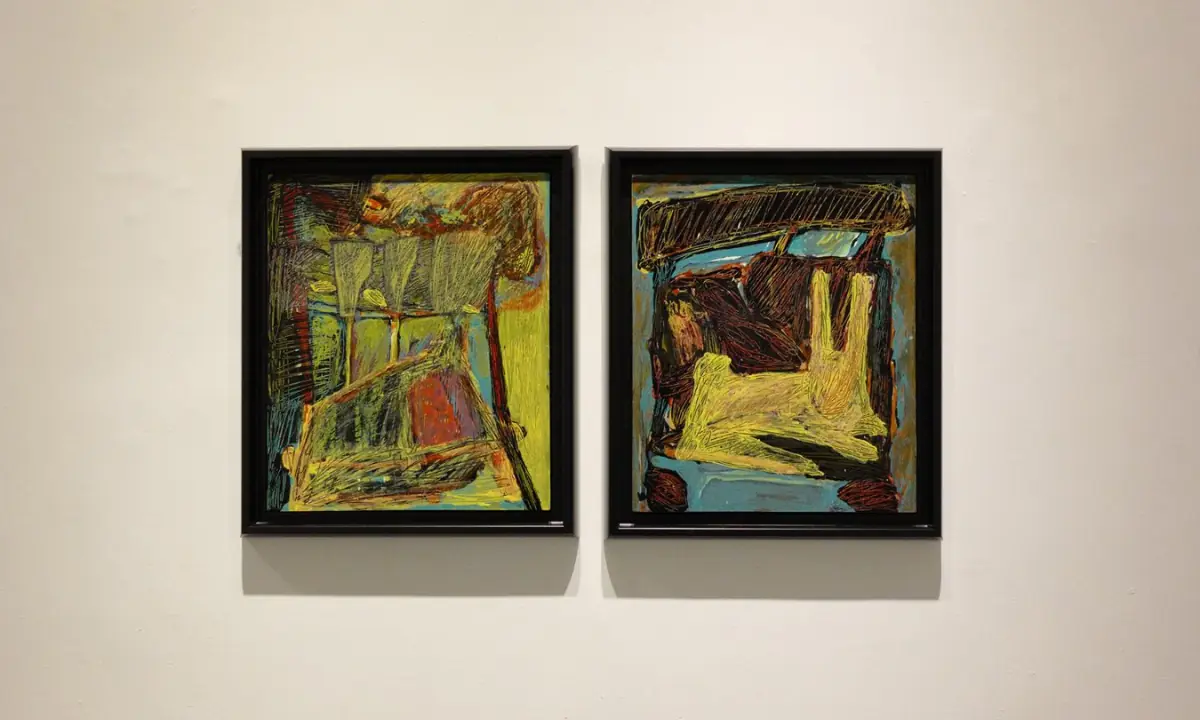
Rabeya Jalil’s Lines and Language asks the art world a question: what is ‘sophisticated’?
There are exhibitions that simply present artworks, and then there are those that make you question the very act of looking.
Lines and Language, Rabeya Jalil’s solo exhibition at Canvas Gallery, is firmly of the latter kind. It draws viewers into an active engagement with how we read, misread and internalise visual information. Spirited yet thoughtful, intuitive yet analytical, this body of work examines mark-making not merely as expression, but as a system that can be dismantled and rebuilt with new intent.
The curatorial statement notes that the show “critiques a visual language system, identifying connections and challenging the binaries of the serious and the satirical, of high and low art, and of the values associated with cultivated and uncultivated taste.” Jalil uses these binaries only to undo them. Her works mingle the playful with the rigorous, the spontaneous with the structured, the academic with the everyday. In dissolving hierarchies of taste, she raises the question: who decides what is ‘sophisticated’, and what is dismissed as ‘naïve’ or ‘uncultivated’?
Her explorations here echo the impulses seen in her 2018 solo exhibition at Koel Gallery, where I described her work as infused with “raw energy” and a desire “to move towards abstraction.” That exhibition, with its tense figures, fragmented anatomies and nervy lines, revealed an artist already questioning conventional modes of representation. In Lines and Language, those earlier instincts are refined into a more deliberate, layered inquiry that is still bold, but now anchored in a clearer structural logic.
Jalil’s sensibility is inseparable from her dual role as artist and educator. Currently Head of Painting at the National College of Arts in Lahore and co-founder of the Journal of Art and Design Education Pakistan, she consistently advocates for widening the discourse of art in Pakistan. This exhibition, too, extends that commitment: it invites a broader, more democratic understanding of how visual languages operate.
Stepping into Lines and Language feels like entering a landscape built from marks. Jalil’s lines loop, hesitate, collide and sometimes dissolve entirely. They echo chalkboards, children’s drawings, proto-symbols and modernist abstraction. Many works carry the atmosphere of a learning space: responses, corrections, erasures.
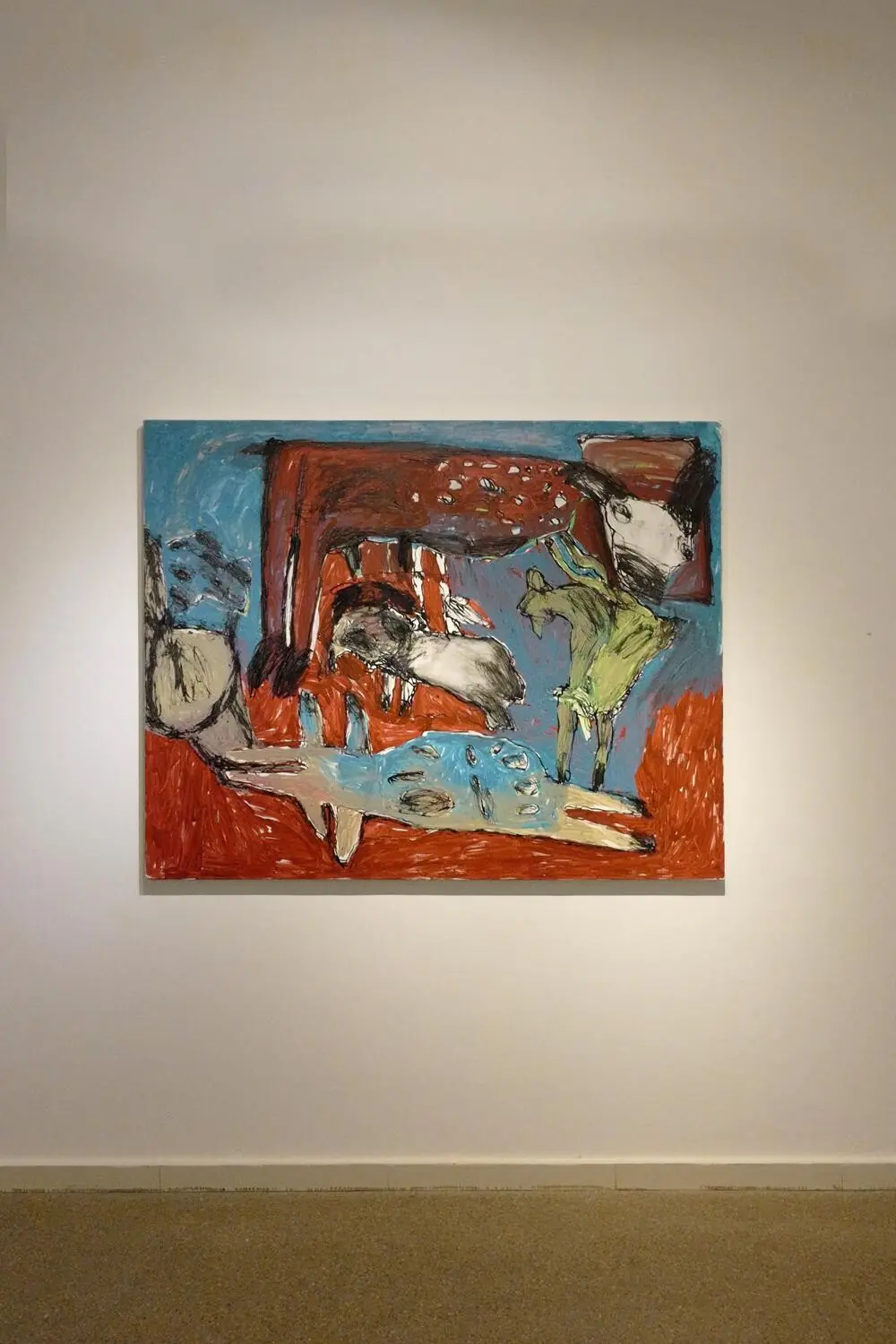
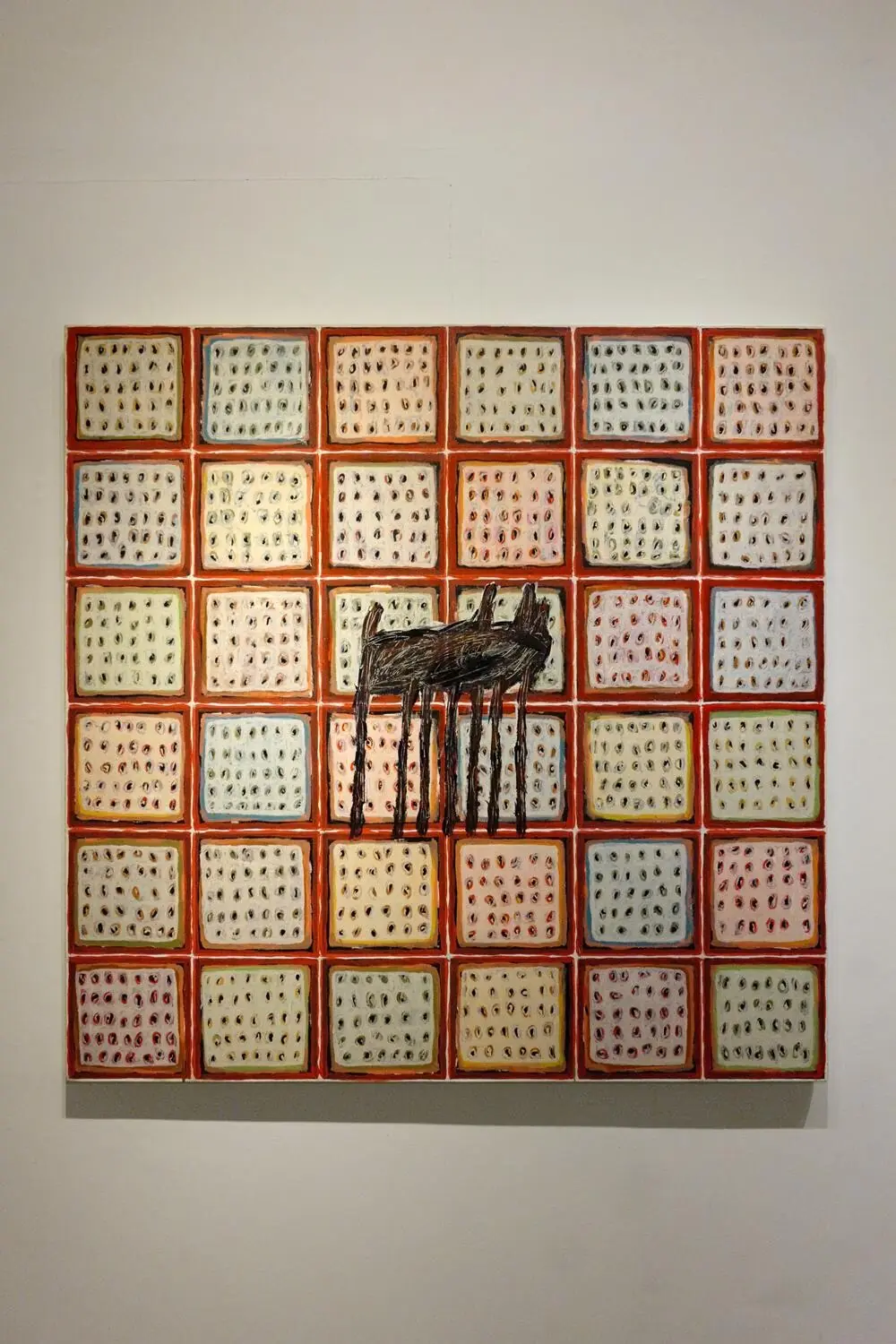
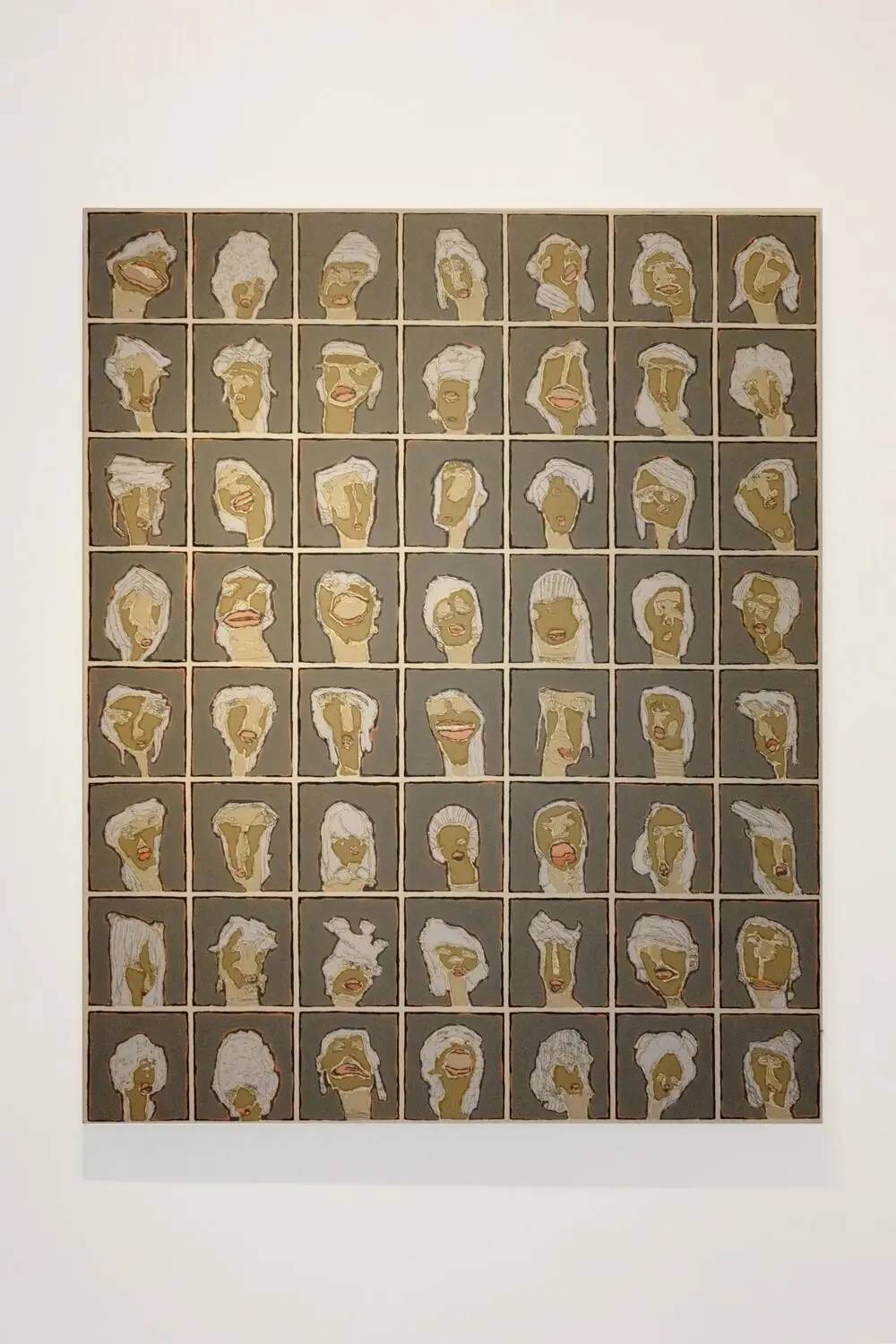
‘Animal Play’ pulses with this energy. Its creatures, drawn in swift, restless strokes, occupy a space between innocence and instinct. Conversely, ‘Fifty-Six Cousins’, a grid of distorted faces, becomes a catalogue of fleeting emotions. Each square is a quick study, imperfect and expressive. Taken together, they form a fragmented community of human feeling.
Colour provides another grammar in Jalil’s visual language. Bold fields, sharp contrasts and assertive blocks of pigment guide the viewer across layers of interpretation. Grids and repeated motifs establish order, while sudden gestural interruptions break that order apart.
A quieter but striking work, ‘Lipsticks’, operates like an archaeological surface of everyday gestures. Each tile carries an imprint of use and routine and the title nudges the viewer to consider femininity as a coded language, constructed from repeated, ordinary actions that accumulate into meaning.
Humour also threads gently through the exhibition. It appears not as exaggeration but as subtle subversion — visual puns, sideways gestures and moments of intentional awkwardness that puncture the solemnity often associated with contemporary art. Jalil approaches visual systems with affection but also with irreverence, reminding viewers that such systems, however authoritative, are human-made and always open to reinterpretation.
Ultimately, this exhibition is deeply concerned with learning and unlearning. The works often feel like pages from an unruly workbook, where lessons slip beyond boundaries and connections form unexpectedly. The viewer is encouraged to participate, to complete the thought and to reconsider what qualifies as ‘artistic’, ‘refined’ or ‘meaningful’.
Jalil repositions the line as gesture, as boundary, as idea and as a tool of inquiry and imagination. This is a timely, thoughtful exhibition from one of Pakistan’s most inquisitive artist-educators.
Lines and Language was on display at Canvas Gallery, Karachi from November 25-December 4, 2025.
Originally published in Dawn, EOS, December 28th, 2025.
Cover photo: Canvas Gallery.
Comments