
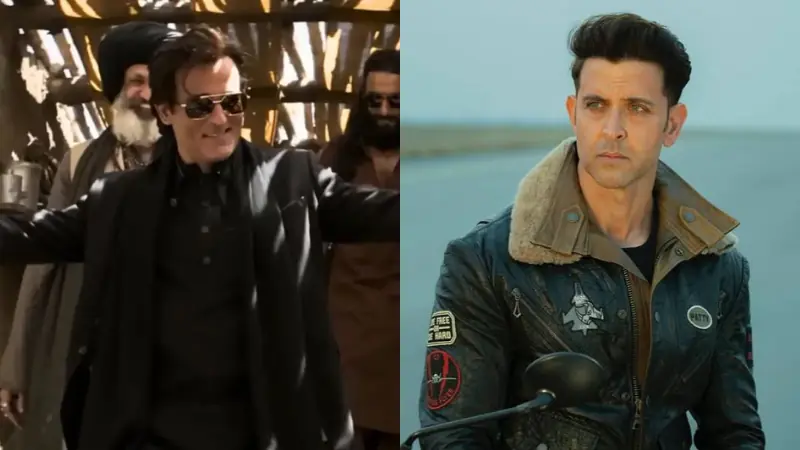
It’s rich of Fighter star Hrithik Roshan to say he ‘may disagree’ with Dhurandhar’s politics
Bollywood’s Hrithik Roshan — the face of Siddharth Anand’s Fighter, the 2024 jingoistic blockbuster centred on the 2019 Pulwama attack — appears to be having a moment of reflection over Dhurandhar, Hindi cinema’s latest high-octane, high-controversy release that dives into Karachi’s Lyari gang wars with an appetite for spectacle and a troubling grasp of geopolitics.
Taking to his Instagram stories on Wednesday, Roshan praised the film for its cinematic craft. “I love cinema,” he wrote. “I love people who climb into a vortex and let the story take control — spin them, shake them — until what they want to say is purged out of them onto that screen. Dhurandhar is an example of that. Loved the storytelling; it’s cinema.”
Then came the qualifier. “I may disagree with the politics of it,” he added, “and argue about the responsibilities we filmmakers should bear as citizens of the world. Nevertheless, can’t ignore how I loved and learnt from this one as a student of cinema. Amazing.”
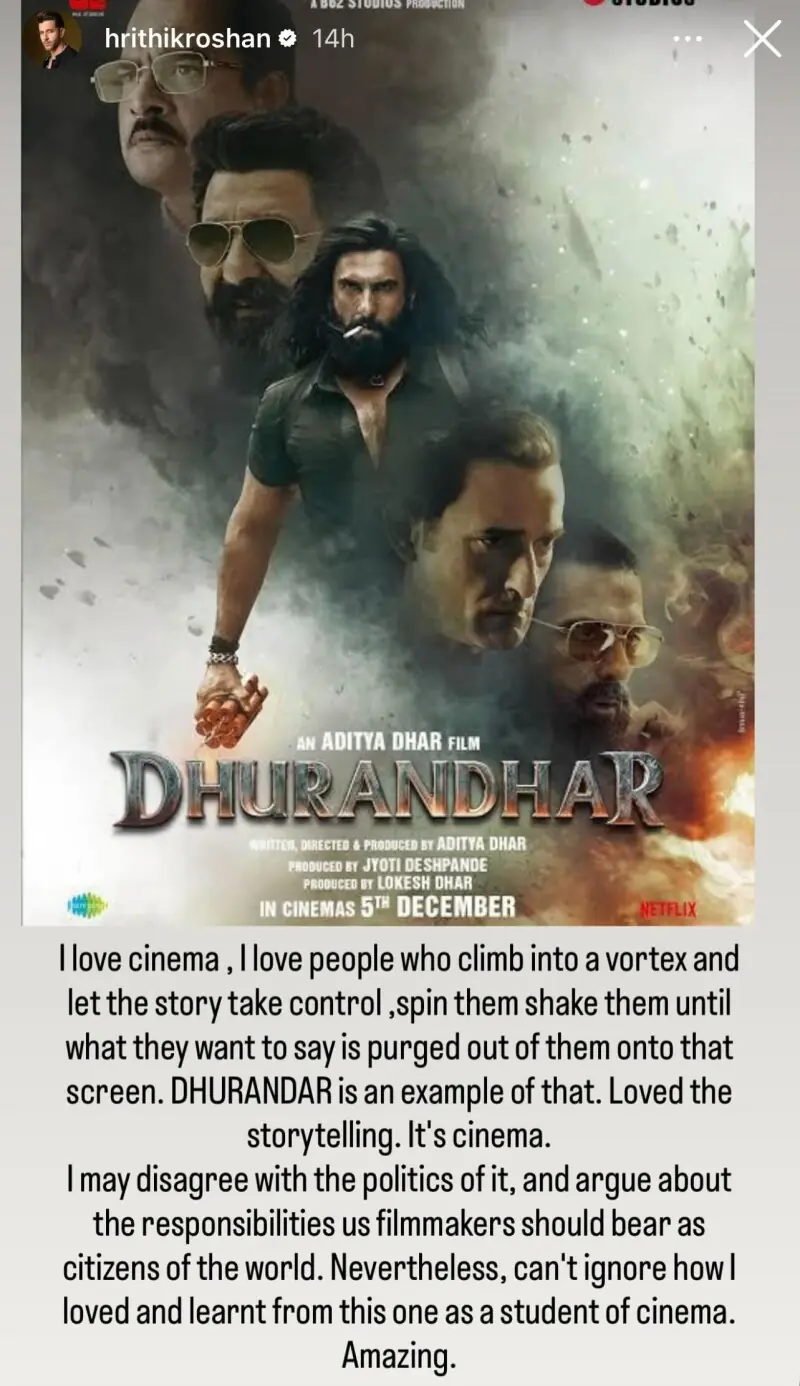
Roshan didn’t specify what “politics” he disagrees with — and that silence speaks louder than his carefully phrased admiration. Without that clarity, we can’t assume he recognises the film’s central problem: Bollywood’s persistent investment in painting Pakistan as a monolithic terrorist state, a trope that has become both commercially viable and politically convenient in Modi’s India.
Dhurandhar arrived at a particularly volatile moment. Relations between Pakistan and India, already frayed, were pushed to the brink earlier this year. The two nuclear-armed neighbours narrowly avoided escalation in May after the April 22 attack in India-occupied Kashmir’s Pahalgam — an assault India blamed on Pakistan and a claim Pakistan has consistently rejected. The attack was reportedly claimed by the little-known group The Resistance Front (TRF).
Against this backdrop, another film reinforcing stereotypes of Pakistani violence isn’t “creative expression”; it is tinder for a flame that’s been growing for years.
Roshan also didn’t elaborate on what “responsibilities” he believes filmmakers carry. But perhaps we should. Cinema is not created in a vacuum, especially not mass-market Indian cinema, whose reach extends across continents and communities. Films shape sentiment. They can build bridges or deepen divides. And when the stakes involve real-world hostility, human lives, and two nations with a shared and painful history, the consequences of dehumanising narratives can be chillingly tangible.
It’s worth remembering that when Fighter was released, even at a time when tensions weren’t this heightened, Roshan and the film’s makers were criticised for indulging in hate-mongering and nationalism-lite. The pattern is not new. Bollywood has increasingly leaned into anti-Pakistan and anti-Muslim tropes, a trend buoyed by films such as The Kashmir Files, Mission Majnu, The Kerala Story, and, yes, Fighter, all of which have garnered applause from right-wing circles and condemnation from those weary of the industry’s propaganda pivot.
Many of the stars, writers and producers associated with such projects haven’t merely participated in these narratives — they’ve endorsed them, actively or implicitly. Anupam Kher’s cheerleading of The Kashmir Files, Siddharth Malhotra’s role in Mission Majnu, and Roshan’s own positioning in Fighter have all raised questions about where Bollywood’s creative choices end and its political alignments begin.
So, where does this leave Roshan’s musings on Dhurandhar? Did the backlash to Fighter prompt some introspection? Has he genuinely developed a more critical eye toward the politics embedded in his own industry’s storytelling? Or is this simply a diplomatic balancing act — praise the craft, gently distance from the content, avoid offending either side?
Without a clearer stance, we’re left guessing. But what is clear is this: if Roshan truly believes filmmakers bear a responsibility “as citizens of the world,” then that responsibility can’t begin and end on Instagram stories. It must extend to the roles he chooses, the narratives he endorses, and the cinema he helps shape, especially in a country of over a billion people, where stories don’t just reflect reality, they manufacture it.




Comments