
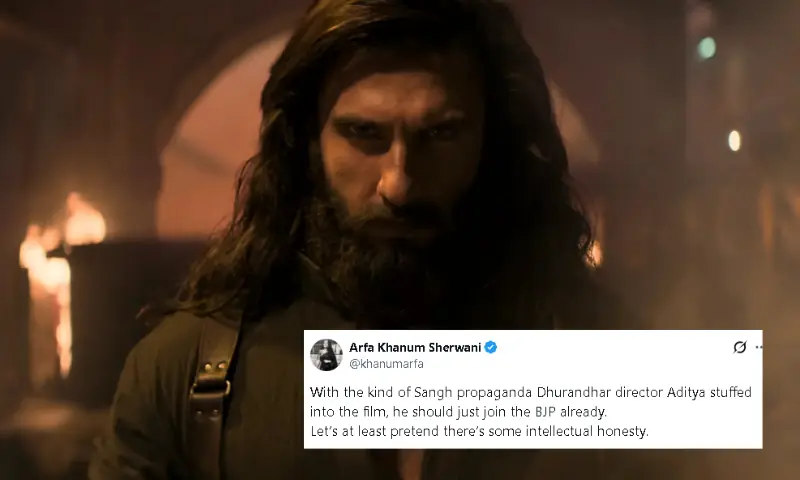
Ranveer Singh’s Dhurandhar is out and audiences on both sides of the border are divided
Indian spy thriller Dhurandhar released on December 5, taking audiences from neighbours India and Pakistan by storm. Loosely based on the Lyari gang war, with some good old fashioned Bollywood propaganda thrown in, the film received mixed reactions. Some loved it, while others didn’t, but what stood out is that — for once — the divide isn’t between the two countries. This time, audiences on both sides of the border are split among themselves.
While Pakistanis fully recognised Dhurandhar as a propaganda film, some were disappointed at our own entertainment industry for refusing to claim the stories that belong to us.
Content creator Bilal Hassan, better known by his handle @mystapaki, summed up that conflicted reaction in a review of the film on his Instagram stories. “It is very, very well-made, action sequences fantastic, Akshay Khanna’s acting was very, I wanted to be upset at it, but I couldn’t be upset at it, songs are really good,” he said.
Referring to some anti-Pakistan dialogue towards the end of the film, Hassan said, “If that isn’t propaganda, I don’t know what it is,” adding that what surprised him was how much the propaganda had evolved.
He noted that Pakistani politicians were shown as corrupt — “which they are” — and their links to characters inspired by Rehman Dakait–type figures portrayed as plausible — “which they are”. None of that, he emphasised, offended him. Even the Chaudhry Aslam character, played by Sanjay Dutt, was “well done”.
But the real sting, he said, wasn’t the propaganda. It was ownership — or rather, Pakistan’s refusal to take any.
“I grew up seeing the Lyari gang wars… Chaudhry Aslam’s house was in front of my school. When there was a bomb blast on top of his house, my school’s windows broke. That’s how close to home this story was for me.”
And that’s precisely why he resented it.
“We won’t tell this story. Why? Because our politicians will get dirty. Our government will get dirty. So instead, we choose to just greenlight shitty scripts like Love Guru.”
His sentiments were echoed by some online. Author Muneeb Qadir called it on X, “Very gripping, excellent music and propaganda with a capital ‘P’.”
Journalist Javera Siddique noted that Dhurandhar — propaganda or not — managed to give Baloch culture a level of visibility that Pakistani TV rarely extends beyond stereotypes, even capturing a Baloch dance sequence with a kind of care our own dramas seldom make room for.
Sumeta Afzal Syed, spokesperson for the Sindh government, condemned the “unlawful” use of former prime minister Benazir Bhutto’s pictures in the film while showing PPP rallies, calling it a disgraceful attempt to portray the PPP as “sympathetic to terrorists”.
Many, however, challenged her condemnation, highlighting members of her party’s purported ties to the gang war.
Many users, however, were critical of fellow Pakistanis for easily embracing Indian content despite frequent bans, boycotts and erasure of Pakistani artists across the border.
Especially after everyone lost their minds over Akshay Khanna’s — who plays Rehman Dakait in the film — entry song, ‘Sher-E-Baloch’, originally called ‘FA9LA’, sung by a Bahraini rapper, Hussam Aseem, also known as Flipperachi.
It seems Indian fans, on the other hand, can smell propaganda from afar now — and they are not shying away from calling it out.
Perhaps the stellar performances and production are not a good enough mask for the propaganda.
Indian journalist Arfa Khanum Sherwani also weighed in — calling out Dhurandhar for what she described as heavy-handed political messaging. She criticised the director for packing the film with “Sangh propaganda”, adding that he might as well “join the BJP,” if even the pretence of intellectual honesty was being abandoned.
Film critic and author Anupama Chopra didn’t hold back in her assessment of Dhurandhar either. In a review, she later took down she described the film as an “exhausting” watch packed with “too much testosterone, shrill nationalism and inflammatory anti-Pakistan narratives”.
Some users said the film is the natural evolution of the many other propaganda films produced in recent years, but “when propaganda starts looking like a spy blockbuster with catchy songs, people forget to question it”.
But many warned their fellow Indians against drinking the Kool-aid and accepting the irrevocable damage to the cultural landscape this film was causing.
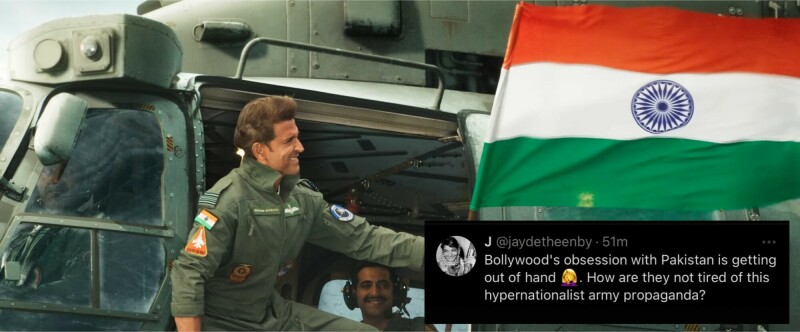
Propaganda in Bollywood films has become somewhat de rigueur — something that is infused in so many films that it’s par for the course now. The propaganda in Dhurandhar appears blatant and unmissable, but it certainly has reignited the conversation on our side of the border on why Pakistanis aren’t making films on issues our country has faced and leaving it to Indians to do it with a heavy dose of jingoism and disinformation.





Comments