

What is the 16 Days of Activism Against Gender-Based Violence campaign?
16 Days of Activism Against Gender-Based Violence started on Monday with International Day for the Elimination of Violence Against Women, kicking off a global campaign to raise awareness about violence experienced by women and girls. The annual campaign runs from November 25 to December 10, International Human Rights Day, creating a symbolic link to show that women rights are one and the same.
Several international days of commemoration and awareness fall between Nov 25 and Dec 10, including International Women Human Rights Defenders Day (Nov 29), World AIDS Day (Dec 1), International Day of Persons with Disabilities (Dec 3) and Volunteer Day for Economic and Social Development (Dec 5), highlighting some of the causes linked to the struggle for human rights globally.
The 16 Days of Activism campaign was started in 1991 by activists at the Centre for Women’s Global Leadership in the United States and has since grown into a global movement backed by the United Nations (UN).
Every year, the UN Committee for the Status of Women sets a theme for its 16 Days of Activism campaign, past themes have included: Invest to Prevent Violence against Women & Girls (2023), Orange the World: Fund, Respond, Prevent, Collect (2020) and Orange the World: Generation Equality Stands against Rape (2019).
This year’s theme is to “end digital violence against all women and girls”. This aligns with the rise of artificial intelligence (AI) technology, which is increasingly being used to mislead and deceive others through catfishing and image manipulation. It also aims to address an atmosphere of misogyny which has built up in some parts of the internet over the past few years, where men have become increasingly hostile towards women.
While the campaign provides guidelines on what needs to be done, a lot of the work is done independently by governments, community organisations and locals. Last year, as part of the campaign, UN Women Pakistan drove a theatre on wheels across the country, telling stories and sparking conversations on gender-based violence, seminars and talks were also held on the subject by other stakeholders.
This year’s activities in Pakistan began on Monday with the launch of a report on digital violence and a compendium of derogatory terms used against women in Urdu and Punjabi by the Uks Research Centre
Abuse in numbers
According to estimates published by the UN, 30 per cent of women and girls aged 15 and over have experienced physical and or sexual violence at least once in their lives — not including sexual harassment. This figure has stayed largely unchanged over two decades.
In 2024, 50,000 out of 83,000 female homicides globally — around 60pc — were committed by intimate partners or other family members. That’s roughly 137 women every single day. The same figure for men amounts to 11pc, meaning women are significantly less safe at home.
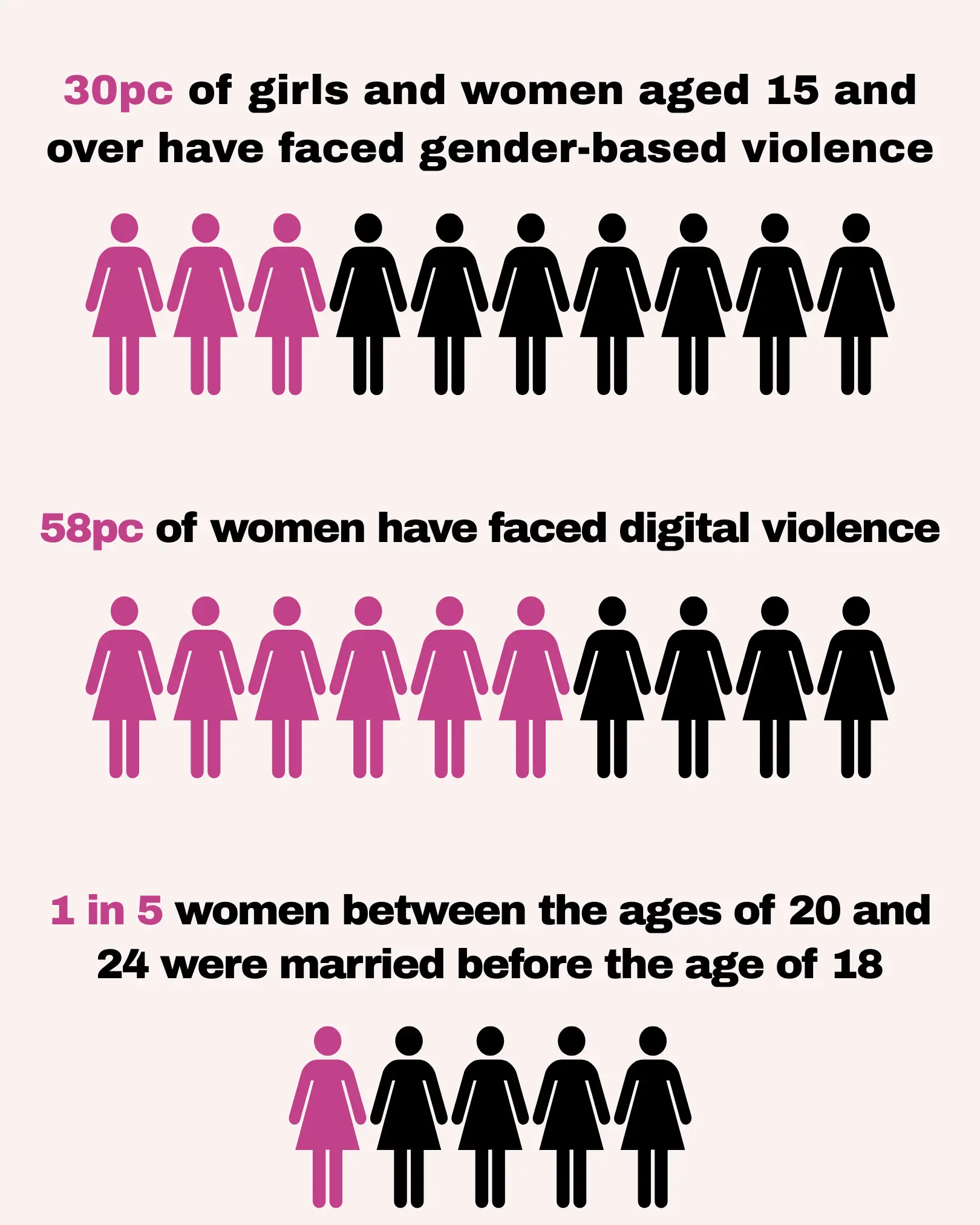
Child marriage also remained prevalent, with 2024 figures suggesting 19pc of girls aged 20 to 24 were married off before they turned 18. This has decreased from 22pc in 2014.
Female genital mutilation is also still a problem, with 230 million girls falling victim to it in 2024, a 15pc increase from eight years ago, according to UN Women.
Digital abuse against women
A UN statement issued on Nov 24 quotes studies that say 58pc of women and 20pc of girls under 18 face some form of digital violence, with a disclaimer suggesting the true number may be much higher due to the underreporting of such crimes.
Forms of digital abuse include:
- Online harassment and cyberstalking: Repeated, unwanted messages, cyber-flashing, creepshots and surveillance such as tracking your location, or monitoring your activity.
- Image-based and deepfake abuse: Sharing private images without consent, or creating AI-generated sexual content through morphing, splicing, or superimposing photographs and videos to create deepfakes. This can sometimes also be called revenge porn.
- Violent pornography: Images of sexual aggression and gendered violence in pornography widely available on the internet which is normalising and perpetuating violence against women and girls.
- Trolling, threats, and blackmail: Abusive comments designed to silence or intimidate, gender-based hate speech, threatening to share personal information, photos or videos of someone.
- Digital dating abuse: Using apps or social media to control, pressure, or isolate a partner.
- Online grooming: Using digital platforms to build trust or a relationship with someone – often a minor – with the intention of sexual exploitation and trafficking.
- Doxxing: Publishing personal information online to endanger or intimidate.
- Identity theft: Impersonation and the creation of fake profiles.
- Control of access: Restricting or monitoring a woman’s access to shared devices, internet, or power sources.
An AI problem
The widespread use of AI tools has led to an increase in digital abuse against women, particularly the generation of explicit photorealistic images or deepfakes, which can then be used to blackmail or defame them — these account for 90pc to 95pc of all deepfakes.
AI has also fuelled a surge in child pornography, with verified AI-generated child sexual abuse material increasing almost four fold between 2023 and 2024.

Natural language models — complex AI systems built to mirror human speech — can also be used to obtain sensitive information and private images from girls and women that can then be used to threaten them. These models can also lure women into places and situations where they may be at increased risk of sexual abuse or kidnapping.
The ‘manosphere’
Another concern for women in the digital space is misogynistic content targeted towards boys and young men, which promotes an aggressive attitude towards women in the guise of ‘masculinity’. This is sometimes referred to as the ‘manosphere’.
While a myriad of different groups and influencers operate in the manosphere, according to the UN, many can be grouped into categories based on their brand of anti-women hate:
- Involuntary celibates (incels): Believe that men are entitled to sex, and women purposefully deprive them of it. Extremist incel culture promotes rape and assault and brings together other ideologies, including racism and homophobia. Incels have been linked to acts of mass violence.
- Men’s ‘rights’ activists: Often take an academic tone to claim that feminism and women’s rights – to vote, to education, to leadership positions – have disadvantaged men.
- Pick up artists: Teach members how to coerce women into sex and mock the idea of sexual consent.
- Men Going Their Own Way movement: Suggests society is rigged against men — and that it is best to avoid women, and even mainstream society, altogether.
A number of derogatory terms such as ‘feminoid’ — which suggests women are sub-human droids — and AWALT (all women are like that) have also been popularised by the space.
The manosphere doesn’t just endanger women, it hurts the men who take part in it as well. A survey by men’s mental health awareness group Movember found that young men who were part of these communities reported higher levels of worthlessness and nervousness, were more likely to take performance-enhancing supplements and were less likely to prioritise their mental health.
What can you do?
In a statement, UN Women called for governments, tech companies and other stakeholders to takes steps towards ending digital violence. These steps include:
- Ensure accountability for perpetrators of online and offline violence through robust, rights-based legislation aligned with digital governance frameworks;
- Strengthen law enforcement and justice systems with enhanced cross-sector and cross-border cooperation;
- Guarantee specialised support and comprehensive reparations for all victims and survivors;
- Protect and amplify women’s and girls’ voices and leadership online, and build digital literacy and resilience across all sectors;
- Embed safety, privacy, and security-by-design principles in all stages of technology development;
- Leverage digital tools to address misogyny and promote positive masculinities; and
- Secure sustained, flexible, and core funding for women’s and children’s rights organisations to strengthen digital resilience and advocacy efforts.
Being a civil society movement, 16 Days of Activism relies heavily on people getting together to bring positive changes to their communities. To do this, people can take the following steps to quicken the process:
- Push their governments into creating and enforcing laws that criminalise digital abuse and offer protection and justice to survivors,
- Pressure tech companies to stop the use of their products in digital abuse and create a safer digital space by making more women part of the development process for new technologies
- Support survivors by funding organisations working to protect women and girls
- Invest in prevention and culture change by supporting digital literacy and awareness programs that teach women and girls best practices on how to stay safe online.
There are other, smaller ways to help — be supportive towards women around you who are going through abuse of any kind, trying to stop it if you can and caring for survivors.
It is also important — especially for men — to be allies in the fight against digital abuse and gender-based violence. ‘Harmless’ jokes at the expense of women need to be shut down and ‘locker room talk’ called out. We all have a responsibility to create a safe, inclusive society that everyone can live in.
Comments