
Drama Jama Taqseem is every second person’s story
There’s the usual saas-bahu fare on TV — and then there’s Jama Taqseem.
The HUM TV Network drama, still in its initial phases, follows a narrative which is sadly very familiar. Navigating the toxicity that runs rampant in joint family systems, writer Sarwat Nazir has put together a motley crew of characters in a story that is well-paced and hard-hitting.
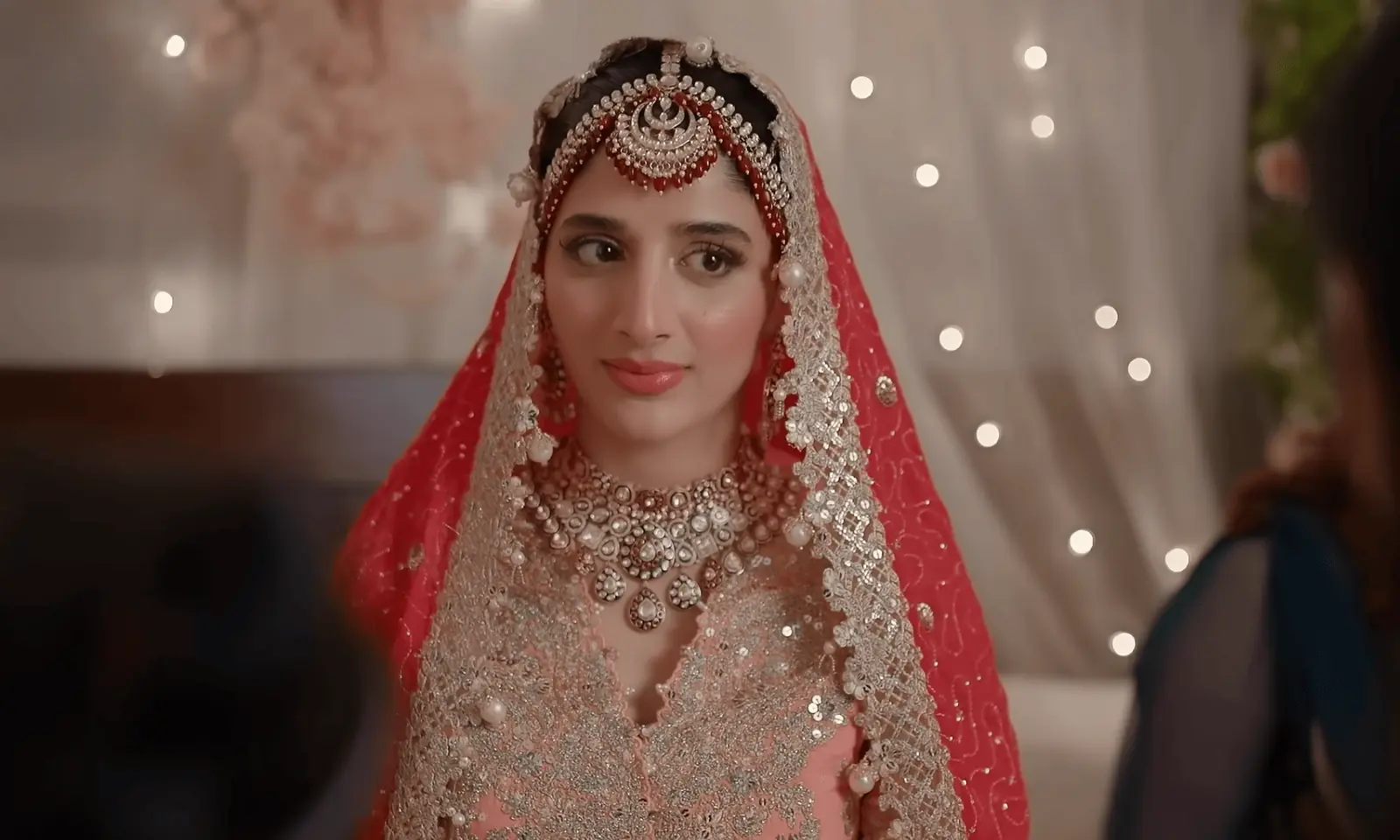
Talha Chahour and Mawra Hocane play a newly married couple — Qais and Laila respectively — and a bonanza of veteran actors play their family members. Javed Sheikh, Beo Raana Zafar, Hassan Ahmed, Madiha Rizvi, Amna Malik, Saad Azhar, Deepak Perwani and Tazeen Hussain, as well as some very talented child actors, come together to enact characters that wreak havoc in the lives of the newlyweds.
It’s a hard watch. But somehow the writer, along with director Ali Hassan and the actors, have put together a story that’s hitting a chord with quite a widespread audience. The toxicity is often very painful and, yet, a vast majority of people are watching Jama Taqseem because, sadly, it seems to be their own story.
When Mawra Hocane’s character, who does not know how to cook, is judged by her domestic capabilities in her new home, women in the comment section relate to it despondently. Her MBA degree is of no interest to her in-laws, who may be well-off but take great pride in the fact that their daughters-in-law cook the food in the house instead of the hired help.
Laila’s fumbling first steps in domesticity are watched with resignation; she is enlisted to make 40 rotis, figure out how to cook dinner and find her way around a washing machine. Any suggestion she makes — such as the purchase of an automatic washing machine — is looked upon as an act of rebellion. She is taunted about being disrespectful, of trying to break the family apart — and the audience nods in agreement. Been there, done that.
The story only gets worse, scene after scene. Favourite foods are hidden away in joint family systems so that others may not have access to them. Things that are purchased have to be snuck in so that the rest of the family may not see them. Even in an affluent home, like the one in this drama, tussles can take place over basic grocery items such as milk.
A husband cannot help his wife out with tasks at home because that is seen as going against his male stature. A daughter-in-law from a wealthier family is given preference over the other. Love marriages and women who aspire to work are looked upon with suspicion.
On an even darker note, cousins bunched together and perceived by elders to be part of one big, happy family may be hurting each other. Sexual harassment may be taking place in a home with no one even realising it!
It’s a big, toxic mess. And ever since Jama Taqseem started airing some weeks ago, scenes continue to be shared and reshared on popular social media platforms — Facebook, Instagram, X and YouTube — with viewers adding their own commentaries.
There are, sadly, many women across Pakistan who have been reduced to servitude with their personal ambitions dismissed because the elders in the home take pride in putting the daughters-in-law to work. There are entire clans sandwiched into small rooms in a single home just because it keeps the extended family ‘united’. There are many mothers, so burdened by domestic tasks, that they haven’t realised that their children are unhappy and are being bullied in their homes.
All across the country, it seems, there are women reduced to depression and married couples in distress due to the unrealistic demands of an overpowering, suffocating joint family system.
All of a sudden, sermons by renowned Islamic scholars have also started surfacing on social media, highlighting that, contrary to popular belief, living in a joint family is not a religious duty. It is, in fact, a norm that has become so ingrained in Pakistani society that young people choosing to live separately are looked upon as sinners.
Jama Taqseem has evidently triggered a lot of people — it is also making people think. But what is so different about this drama? Saas-bahu tussles are a dime-a-dozen on TV — they haul in reviews but never generate such avid commentaries.
For one, director Ali Hassan is making sure that the story doesn’t drag. Scenes and incidents keep changing and while a lot that is happening in each episode is extremely triggering, the pain is not prolonged.

So far, the drama has eschewed the usual painful tropes employed to prolong a serial in order to gain more viewing time and, thereby, profits. There have been few flashbacks and no long, melancholic scenes where the heroine only cries and the title track wails out interminably.
“I think the drama just resonated with a lot of people, which made me happy as a writer but it is also something that is unfortunate,” observes Sarwat Nazir, the drama’s writer. “A lot of the incidents included in the drama are true but, while writing it, I didn’t realise that so many people would see their own stories in what Laila goes through.”
She continues: “In our culture, a lot of times, the joint family system is romanticised and I deliberately set out to write this story, to show how sometimes it could also be very difficult. There is no point at which my characters are disrespectful towards their elders but, then, elders should also behave responsibly. A lot of couples are victims of the patriarchal mindset that is prevalent in such families, where control is exerted unnecessarily by elders, just to retain their power.
“There may be times when joint families are a source of comfort and the economic instability in our country often makes it necessary for large clans to live together. But it is important to also spread awareness about the negative impact such living arrangements can have, as it isn’t even a part of our religion!”
And what better medium than television, with its massive, all-pervasive reach, to send out a strong social message? Sarwat Nazir, of course, is a writer who is renowned for her socially relevant, nuanced narratives and Jama Taqseem is testament to that expertise.
But will the drama, hooking its audience with its first few episodes, continue to retain its viewership? This depends on its pace and overall treatment.
Should Laila’s travails get prolonged far too much, over 20 or so episodes, it is bound to turn off an anxiety-ridden audience. But if the story refrains from celebrating the miserable bits and moves on quickly to Laila taking a stand for herself, it will keep its audience interested.
As long as the heroine emerges strong, sooner rather than later, Jama Taqseem will set itself apart in the TV drama-scape. The message it gives out will also be more impactful, as long as the narrative remains watertight. It’s a tough watch — but it is well-directed, well-written, well-performed and, most importantly, it mirrors society, which is why the audience can’t stop watching.
Not that this is anything to be happy about.
Originally published in Dawn, ICON, October 12th, 2025
Comments