
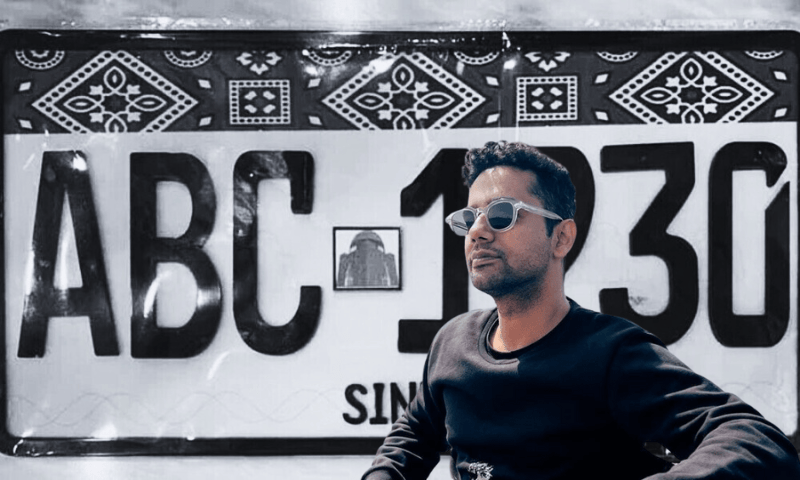
Ali Gul Pir doesn’t get the hate Sindh’s ajrak licence plates are getting — but it’s not about the ajrak


The past few months have seen a great buzz surrounding the Sindh government’s decision to introduce and mandate the use of a new vehicle number plate design, if you take buzz to mean overall disgruntlement. The plate, a white field with a strip of traditional ajrak pattern on the top for cars and on the upper left-hand corner for bikes, was introduced to ease vehicle registration and deter vehicle theft, as per the provincial minister for information, transport and mass transit.
The government mandated the use of these plates on all cars in December, with an April 3 deadline for the replacement of older number plates. Since then, protests, court cases and a backlog in the issuance of the plates have forced the government to extend the deadline, with all vehicle owners now required to acquire new plates by October 31.
Comedian and rapper Ali Gul Pir stepped in on Wednesday to ask why people had such a big problem with the ajrak-themed plates. Citing the use of number plate designs by US states that reflect their distinct identity, he asked on his Instagram story why people were “butt hurt” when it came to ajrak in Sindh. The singer said the design was part of Sindh’s cultural identity predating the independence of Pakistan, and people appreciated it when he wore the motif abroad.
Speaking about the older design of Sindh’s vehicle number plates, Pir asked whether anyone had questioned why they were “urine coloured”. He said the new design was better than the older one and that it would look good on cars. Lamenting the outrage surrounding the plates, the comedian said people and major publications were “[dividing people] over non-issues”. Gul Pir asked people to “get triggered by real issues, so people change, our government changes, rather than menial issues that we can celebrate and be happy about”.
Opposition parties in the province have called the mandating of the new plates ‘exploitative’ and decried the lack of public consultation in the decision-making process. In July, protesters from the Jamaat-i-Islami (JI) rode from Karachi’s Five Star Chowrangi in North Nazimabad till near Fresco Chowk, off Burns Road, to call out local law enforcement for using the imposition of the new plates as a guise for attempts to demand bribes from citizens. There were calls to revoke the additional fee demanded by the government to issue the new plates — Rs2,450 for cars and Rs1,850 for motorcycles and rickshaws — with a case being filed in the Sindh High Court for the plates to be provided for free.
People have also questioned the government’s focus on implementing measures related to the new plates when the province was facing far more serious issues. Speaking to the bike rally in July, JI’s Karachi chief Monem Zafar said, “Karachiites are facing multiple daily life crises. They are facing acute water shortage, the roads in the city are broken [and] garbage has become a big issue and [a] health risk in a large number of areas. There are only 400 buses for 35 million people, infrastructure has [deteriorated], load-shedding is still a problem in several towns, but the [provincial government] has chosen number plates to keep its focus on.”
MQM-Pakistan issued a similar statement in July, urging action from authorities as many people who had applied for new plates online had yet to receive them. The party’s central committee said citizens were being harassed by traffic police despite having proof of their registration and payment for the plates. They called for the facilitation of citizens in this matter, along with a fee review and rebates for anyone who had already paid the full fee.
In the face of heavy rains and urban flooding in Karachi on Tuesday, even rapper Talha Anjum joked, “Karachiites, don’t fear, the ajrak number plate won’t let your car or bike drown!”
We get it, the new plates look much better than the plain old yellow ones, and their security features may help alleviate the very serious problem of vehicle crime. Gul Pir also makes an excellent point on how we should embrace our heritage instead of using cultural symbols to push divisive and hateful talking points.
However, the implementation of this particular measure has been marred by mismanagement and inefficiency. It also speaks of misplaced priorities, especially as 14 people were killed and the provincial capital was brought to a halt this week because of the inadequacy of its drainage system in the face of monsoon rains.
Maybe now is the time for the government to focus on more immediate issues that can save lives and livelihoods in the near future, instead of expediting the imposition of a system that may eventually reduce vehicle crime. It’s not that the plates are an inherently bad idea; it’s just that there are bigger issues that need to be solved first.
As for Gul Pir’s statement, we agree that the celebration of cultural heritage should unite people, but we find it a little difficult to celebrate in the face of all the chaos around us. The outrage was never about ajrak; people just think ‘real issues’ should be addressed first before we all collectively beautify our cars and bikes.








Comments