
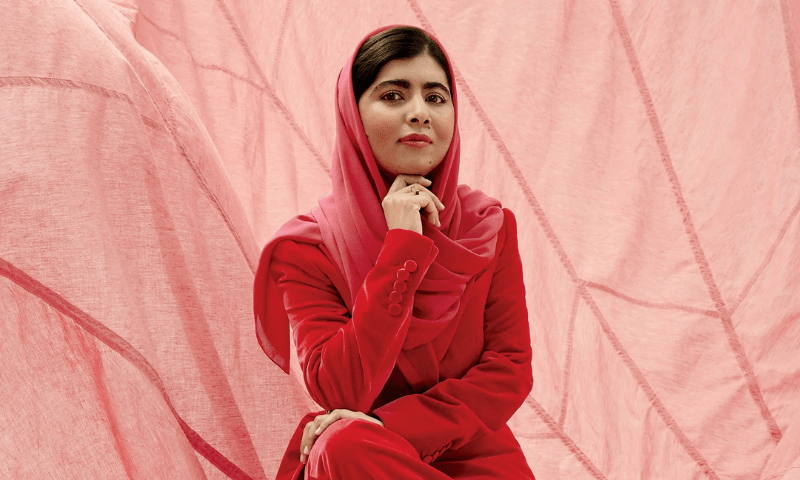
Malala, the girl who needs no introduction, just reintroduced herself


Nobel Laureate Malala Yousafzai is well known for her advocacy for female education. Now she’s letting us know she also forgets to pack socks, can’t cook, and once dreamed of being a mechanic. Her Instagram reintroduction says one thing clearly: she’s more than just her legacy.
When you’re someone like Malala, introductions aren’t necessary — everyone already knows your story, so that she felt the need to reintroduce herself is a bit surprising. She’s using social media to display her past fragility and build a bridge between her and the people of the world, particularly the younger generation, with a relatable Instagram post.
Whether it’s revelations about her mental health or announcing to the world that she’s part of the gymbro community, Malala had a lot to say while reintroducing herself.
“If you did a school project on me, you may know me as the 15-year-old who was shot by the Taliban for standing up for girls’ rights to education,” she started off, tracing her journey from Swat to Oxford University, where she learned a lot about herself but also struggled with other problems.
“I also struggled with my mental health in college, experiencing panic attacks for the first time. Going to therapy really helped me,” she revealed.
Her candid references to mental health and her very public display of emotional vulnerability isn’t quite what is traditionally expected from figures branded as ‘inspirational.’ At a time where many South Asians use AI as a mental health outlet rather than discussing their problems with people around them or getting professional help, Malala’s revelation that she went to therapy is a subtle but powerful challenge to the expectations of most modern South Asian communities.
Since marrying Asser Malik in 2021, she has been expanding her interests and now loves working out and playing competitive sports. “Asser calls me a gym bro.”
Perhaps one of the most relatable things she shared was that she can’t cook — at all. “My fridge is full of takeout boxes, but I love trying new restaurants and cuisines.” Despite her jet-setting schedule, Malala admits she’s hopeless at packing. “I love to travel, but I’m not great at trip prep. I throw my clothes in a suitcase 10 minutes before the airport… and always forget something important.
“I spend most of my time working on girls’ education issues around the world, in countries like Afghanistan, Brazil, Nigeria, and Pakistan,” she shared. And while a lot in her life has changed, her mission hasn’t: “My hope to see every girl in school able to pursue her dreams and choose her own future will never change.”
Looking back at her younger self, Malala reflected on how different her life turned out to be, mentioning how she wanted to be a car mechanic when she was a little girl, not knowing where life would lead her.
There is a certain power that a reintroduction holds; even someone who is as globally recognised and instantly identifiable felt the need to reintroduce herself. This interesting move signals that Malala has taken a big shift from being identified as a ‘symbol’ to a ‘person’ and that she is moving towards being known as a woman with her own little quirks, hobbies, struggles, and joys in life. Malala is now reclaiming her narrative from a trauma-based identity of just being “the girl who got shot” — she’s also a foodie, a wife, a graduate, and a gymbro.
She has often been viewed through the narrow lens of a victim-turned-symbol — this post punctures the overly serious or one-dimensional image many still hold of her. She often uses her Instagram as a buffer between her and the public, trying to use a lighter tone that’s often more funny and can resonate with the public, especially younger people who might have initially been introduced to her as a public figure.
She’s even poked fun at her mythical status, posting an Instagram reel about the Mandela effect associated with her — a humorous nod to how many Gen Zs weirdly wonder if she’s still alive. It’s a way of taking back the narrative and reminding people she’s not a distant symbol — she’s very much present, living, and online.
Her lighthearted, humorous tone, saying things like “I can’t cook,” is a stark contrast to how she’s usually portrayed in the media, where coverage tends to be solemn and reverent. Over the past decade, the Malala featured in the media is often in solemn tones; people view her as an activist and Nobel Laureate, but rarely as someone who has a life beyond activism. She’s pushing back against the saintly ‘one-note’ version of herself that the media helped construct, raising the question: can someone be an icon and a relatable 20-something-year-old at the same time?
She’s a Pakistani girl with a global life. While still rooted in Pakistan, she mentions how her life spans continents — educated at Oxford, working internationally, and travelling the world. She carries a dual identity as a girl from a remote valley and a global changemaker.
The reintroduction wasn’t a reinvention, but a reminder that the woman known as a girls’ education activist isn’t one-dimensional and goes far beyond just the Malala Foundation — not exactly shedding her legacy, but perhaps making it more digestible, approachable, and alive for younger audiences.
You can almost hear Jay-Z in the background (cue ‘Public Service Announcement’): “Allow me to reintroduce myself.”


Comments