
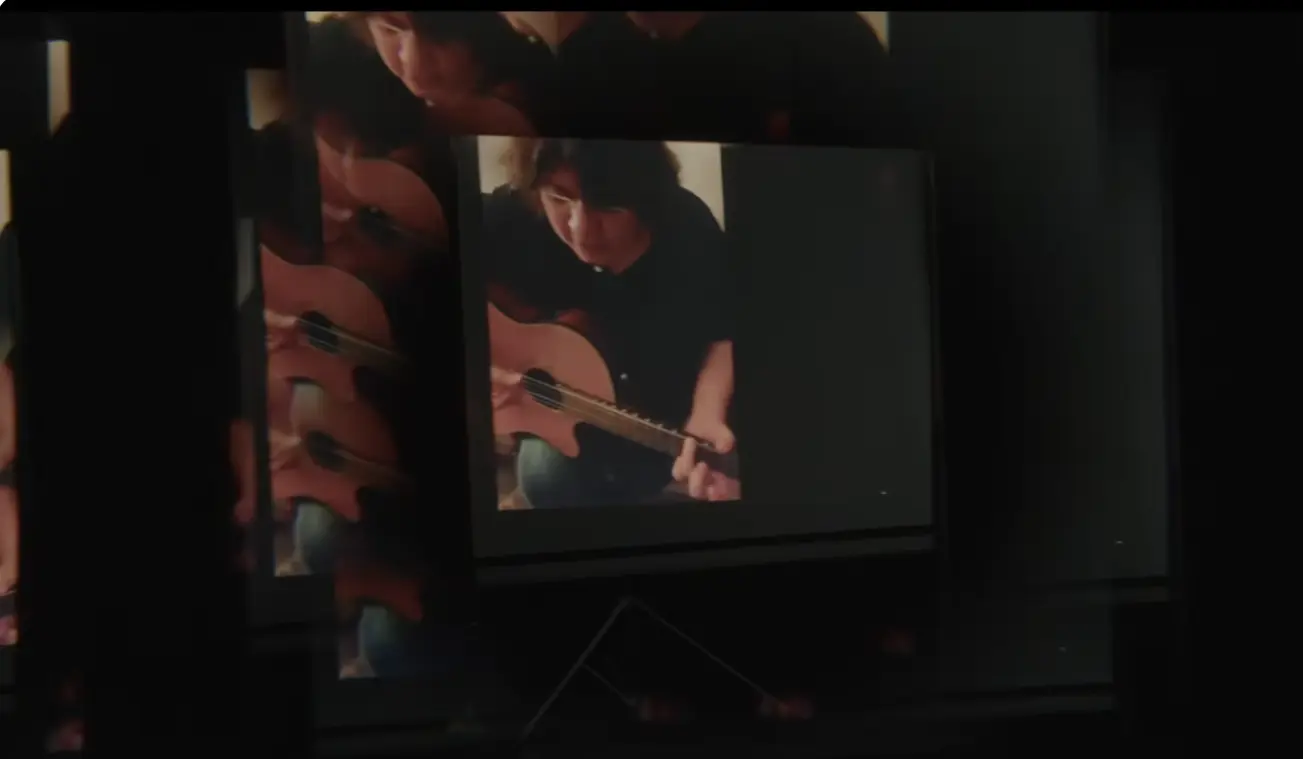
Late Haniya Aslam's haunting reinterpretation of Junoon's 'Ab To Jaag' for Zia Mohyeddin bio-doc released
The late musician and producer Haniya Aslam’s reinterpretation of the 1999 Junoon song ‘Ab To Jaag’ was released on Thursday as part of the soundtrack of the documentary film The Colour of My Heart about the legendary thespian and educator Zia Mohyeddin.
Considered to be one of the last songs Aslam worked on before her passing in August 2024, the track’s release coincides with the re-release of the documentary in select cinemas in Karachi, Lahore, Islamabad and Rawalpindi after it had a limited run earlier this year.
Aslam’s reinterpretation of the original track’s electric guitar and Junoon’s rockstar energy is lined with an intense piano riff and a deep bassline layered with the haunting, hypnotic vocals of Farheen Raza Jaffry, a student of the inimitable Ustaad Naseeruddin Saami.
Umar Riaz, the director of the film, first heard Jaffry at a collaborator’s home and was “immediately struck by the earthly beauty of her voice and the emotion in her delivery”. Her vocals, he said, provide the emotional thrust of the reinterpretation of ‘Ab To Jaag’.
The track meanders into a staccato tabla and a sarangi that meld with Jaffry’s ethereal voice as the lyrics, a centuries-old kalaam by the mystical Sufi poet Bulleh Shah, call on a traveller to rise from his slumber and seize the day.
Images spoke to Riaz and Salman Ahmed, founder of Junoon, to find out how the collaboration with Aslam came about, and a little bit about the history of the original track.
‘A call to power’
Umar Riaz’s love for Junoon had him playing their classics on repeat as he worked on the film. “Not only did they give me a sense of safety and comfort but also motivated me,” he told Images. It was at this time the idea came to him, and he contacted Aslam to produce a song for the closing of the film.
“She generously immediately agreed. We chose to reinterpret ‘Ab Tou Jaag’ as a call to action and power for people leaving the film at its conclusion,” he explained.
“We sought permission from Mr. Salman Ahmed who also, ever so generously, give us his permission and blessing immediately,” he added.
Salman Ahmed recalled coming on board without reservations. “When Umar asked permission to re-record my composition with sarangi and Haniya Aslam’s vocals, I had no hesitation. My respect for Zia sahib, and my affection for this family, made the answer immediate,” he told Images.
“Haniya completed the vocals before she passed away. I never got the opportunity to meet her, and that remains a sadness,” said Ahmed, who currently lives abroad. “You think there will be another visit. Another conversation. Another chance,” he said. “Then there isn’t.”
“That gives this recording a poignancy I could never have anticipated when I first composed the song.”
‘A family affair’
Riaz was editing the film in New York City, while Aslam was in Lahore working on production and recording for the track. She provided the synthesisers, acoustic guitar, and electric piano on the song.
“Unfortunately, her devastating untimely passing not only left us in the depths of grief and with our hearts shattered, we also now held the responsibility to finish what she had started,” Riaz said. “Knowing her and her commitment to her art, as well as her strong work ethic, she would have wanted us to.”
The release of the song is a testament to the strong bond that ties together everyone who worked to finish it.
When Aslam passed, her friend Danny — who played guitar on the track — helped transfer the unfinished song’s recordings to Riaz and the production team.
“The same team who worked on the film’s original score and all of whom who happened to be friends with Haniya, worked to finish the song,” Riaz explained.
Rakae Jamil, the film’s co-composer did the final mix and master, Riaz said, while the director himself added synthesisers and bass guitar — which had been left unfinished by Aslam — to the track.
After that, Mohyeddin’s son, Hassan, added a spirited tabla performance to the track, while Zohaib Hassan, who plays Sarangi in the film itself, lent his instrument to the song as well.
“The youngest member of our troupe which we call ‘Aen Rey and Company’, my nephew Zain Sheikh, interpreted the guitar lines on Junoon’s original and played them on the piano,” the director said.
He described the production of the final track as “a family affair”, with the close ties between blood and chosen family lending an air of intimacy to the final version. “For Haniya, who was and is family to us,” he added.
Salman Ahmed’s family is also linked to Mohyeddin, with both families having spent time in Ahmed’s ancestral hometown of Kasur, Punjab.
“So when Umar approached my son Sherjan and me about using ‘Ab To Jaag’ in his film, The Colour of My Heart, the connection was already there. It was personal before it was professional,” the musician said.
Ahmed said the connection between Mohyeddin and Junoon also ran deep; the senior artist had appreciated the band’s 1997 song ‘Sayonee’ and had even come to watch them record their album Parvaaz — the album ‘Ab To Jaag’ was originally on.
“Zia sahib devoted his life to making people listen: to language, to poetry, to the meaning carried by a pause. Whether he was performing or teaching, he reminded us that culture requires more than applause. It requires discipline, care and the willingness to pass something on,” Ahmed said.
So for Ahmed, the decision to allow the song to be used in a film about Mohyeddin was “natural”.
Poetry in connection
Touching on the impact Bulleh Shah — who is also intimately connected to Kasur — had on his music, Ahmed said, “I heard something ethereal in his poetry, but also something fiercely awake. He could illuminate the soul and unsettle its certainties in the same breath.”
“I chose his verses for three songs: ‘Ab To Jaag’, ‘Aleph’ and ‘Bulleya’. I wasn’t approaching them as museum pieces; these were living words. They questioned the identities we hide behind, the divisions we inherit and the distance between what we profess and how we live,” he explained.
The musician said the song began for him as an encounter with a mystic from his homeland, but has now come to connect him to his family, to loss and to the country he still carries within himself despite being thousands of miles away.
“Bulleh Shah’s words, my melody and Haniya’s voice now meet in Umar’s tribute to Zia sahib. Each arrives from a different life, yet somehow they belong in the same conversation,” the Junoon founder mused.
“I am grateful that Umar has made it possible for me to take part from afar. There is pain in being absent from home, but there is also consolation in knowing that a song can travel where you cannot,” he said.
The film, which is the first documentary to receive a nationwide theatrical release in Pakistan, had its time in cinemas cut short in February this year.
The Colour of My Heart, a project that spans 15 years in making, follows Mohyeddin’s remarkable career and life between the UK and Pakistan, intertwined with the revolutionary poetry of Faiz Ahmed Faiz.
It explores challenges faced by artists in the contemporary Muslim world, the erasure of indigenous languages and South Asian identity, and the implications of nationhood.
Presented by the human rights activist Dr Arfa Sayeda Zehra, the work is an ode to cultural giants and to the fallibility of a man whose influence on Pakistan’s cultural scene lives on through his work on stage, on screen and in the classroom.
The Colour of My Heart had its international debut in August at the 49th Asian American International Film Festival (AAIFF) in New York City. It won the Audience Award for Feature Documentaries at AAIFF and went on to play at festivals in Canada and Nepal.








Comments