
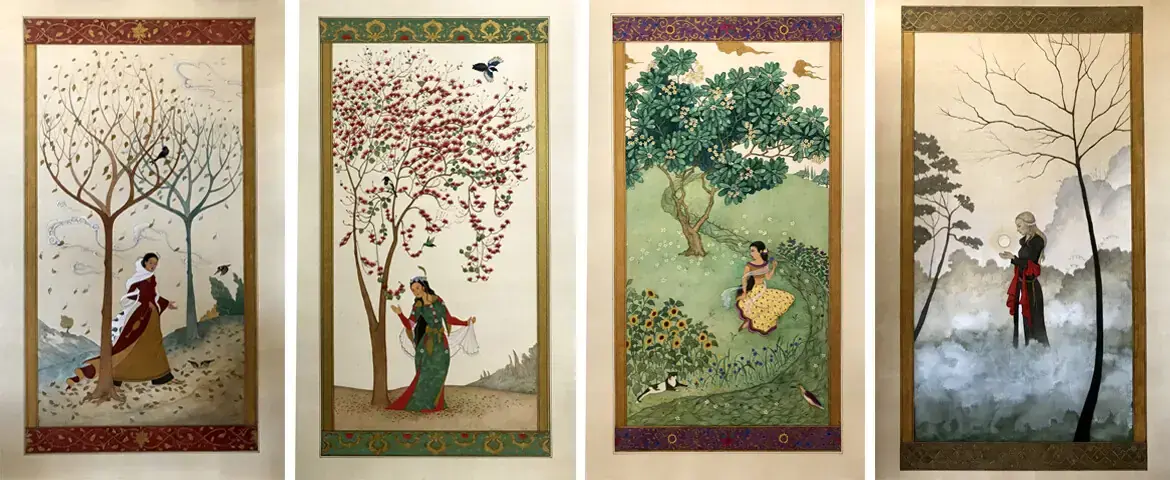
Michelle Farooqi turns her gaze to the shifting seasons of Lahore in exhibition Fair. Fierce. Fleeting.


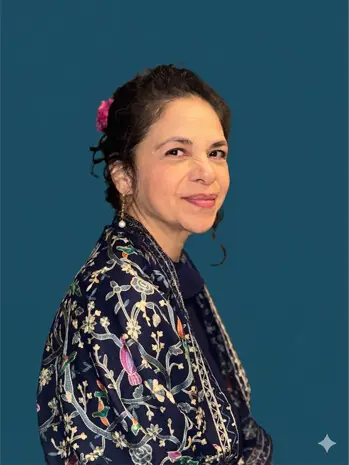
Soft spoken and ever smiling, I have found in Michelle Farooqi a quiet warmth that mirrors her paintings. In the exhibition ‘Fair. Fierce. Fleeting.’, Farooqi turns her observant gaze to the shifting seasons of Lahore. Her paintings are not simply observations of landscape: they reflect the movement of life itself — the gradual and sudden changes that shape memory, relationships and identity.
Although each work stands on its own, the four paintings were also conceived as part of a larger continuum. Together, they move through cycles of growth, intensity, reflection and stillness. Farooqi sees these moments both individually and as part of a larger current — one that keeps flowing and transforming over time.
Farooqi describes the seasons in Lahore as distinct and measurable, except for autumn, which can arrive suddenly and is often fleeting. These shifts became a way for her to think about the constant state of change that defines the human experience: moving cities, changing homes, forming new relationships and leaving others behind. In many ways, the paintings capture that sense of life always being in motion.
The exhibition’s title emerged organically from the work itself. Spring is fair and gentle, summer can be fierce and overpowering, and all seasons, like life, are fleeting. Farooqi wanted the title to reflect both the beauty and intensity of nature, while also hinting at the temporary nature of all experiences.
Four captivating artworks by Michelle Farooqi explore not only the changing seasons but also the gradual shaping of memory and identity
One of the most striking elements in the series is the recurring female figure that appears in every season. Farooqi explains that she initially imagined each figure as embodying the “spirit” of the season. To her, nature feels inherently feminine, and so the seasons naturally took the form of women. Over time, the idea evolved into something less literal, but the feminine essence remained. She also felt that the female form sat more comfortably within nature — less as a force acting upon the landscape and more as part of it.
Each painting approaches its season differently. Spring, the first work in the series, is intentionally sparse. Inspired by the Indian Coral tree, Farooqi focused on the striking contrast between its fiery blossoms and the relative emptiness of the surrounding landscape. Many trees in early spring are still bare, and she wanted the painting to hold onto that sense of emergence and anticipation.
Summer became the most visually dense and elaborate painting in the series. Farooqi describes Lahore’s summers as overwhelming — thick with humidity, greenery and intense light. She wanted to capture not only the heat but also the abundance of life that arrives with it. The painting is filled with lush vegetation, flowers and layered shades of green, reflecting what she calls the “almost suffocating burgeoning of the natural world.” Visitors to the exhibition are particularly drawn to this piece, perhaps because of its richness of colour and detail.
In contrast, Autumn reflects a quieter and more introspective mood. Lahore does not experience a dramatic autumn in the way colder countries do, but Farooqi associates the season with a brief period of relief after summer’s intensity. The cooler mornings, the falling leaves and the mild days before winter inspired a painting that feels thoughtful and transient. She sees autumn as a moment of pause — a time for reflection before another shift arrives.
Winter differs most clearly from the other works. Having grown up in Karachi, Farooqi is fascinated by Lahore’s foggy winters and the way mist transforms ordinary scenes into something ghostly and dreamlike. The female figure in this painting appears pale and almost ethereal, with light hair and softer features than the women in the other works. Farooqi explains that she wanted winter to feel less earthy and more fragile, like mist itself. The stark contrasts within the painting — pale skies against darker clothing and bare trees — were intended to echo winter’s particular beauty.
The paintings are accompanied by short written passages, which serve as emotional reflections on each season. Farooqi says that her paintings usually begin with visual imagery, and the writing comes later to articulate the feelings behind the work. The texts are not explanations so much as impressions — capturing what she felt while painting and what she still feels when looking back at each season.
Farooqi works in the Indian miniature tradition, using tea wash and watercolour on wasli, a handmade paper traditionally used in miniature painting. She began studying miniature-style painting in Lahore in 2018 and says the art form changed the way she approached art. Earlier in her career, her work was more representational, but miniature-style painting allowed her the freedom to stylise nature and use more imagination, while retaining detail and recognisable forms.
The process itself is painstaking. Tea wash is applied in multiple layers to build up warmth and depth, while watercolour techniques vary from controlled detail work to soft wet-on-wet applications, particularly in Winter, where the mist was created through the natural bleed of the paint. Farooqi admits that painting the fog was especially challenging, as she wanted it to remain atmospheric without becoming overworked.
Completing the series took roughly a year, often while balancing other responsibilities. Summer, with its abundance of foliage and flowers, was the most time-consuming, while Winter caused the most anxiety because of its technical demands. Yet the experience also revealed something important to the artist. Farooqi had rarely worked in a sustained series before, preferring experimentation and movement between subjects and mediums. This project required patience and consistency, and she found the process unexpectedly rewarding. “Painting each leaf is a journey,” she reflects, adding that the act of making the work ultimately brought more fulfilment than the finished paintings themselves.
When asked which season best represents her own life now, Farooqi answers with honesty and humour: she sees herself in autumn. As a middle-aged woman, she finds herself reflecting on what she has achieved while also recognising what remains undone. But rather than dwelling on regret, she speaks about embracing change and making the most of the present moment. Like the seasons themselves, life continues to move forward — fair, fierce and fleeting.
‘Fair. Fierce. Fleeting.’ was on display at the Tagheer Lahore Creative Space from May 1-15, 2026
Originally published in Dawn, EOS, May 17th, 2026
Comments