
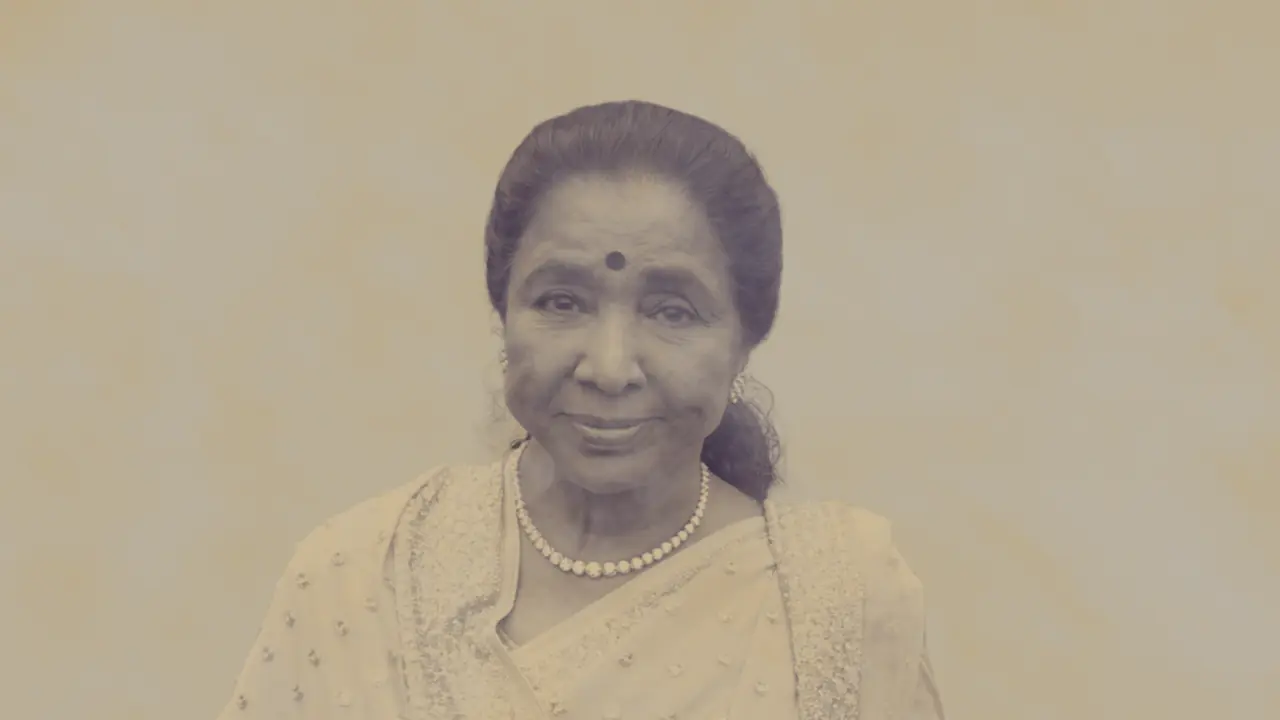
Asha Bhosle — a voice that will never fade


It was a sad day when news spread that Asha Bhosle, the singer with an eternal voice, had left for her heavenly abode. To many of us who grew up on Indian films on VHS, and audio cassettes, Bhosle was like family.
No mehndi celebration in the 90s felt complete without ‘Zara Dholki Baja Goriyo’. No child drifted off to sleep without ‘Chanda Mama Door Ke’. No birthday could be celebrated without ‘Tum Jiyo Hazaron Saal’. No lovers’ quarrel truly ended without ‘Acha Ji Main Haari Chalo’. No journey ever began without ‘Hawa Ke Saath, Ghata Ke Sang Sang’. No moment of romance was whole without ‘Tumse Milke Aisa Laga’ and admit it, no shower felt complete without ‘Thande Thande Pani Se’.
Bhosle was part of the lives of many, like me, yet her journey was never a bed of roses. Born in 1933 into a family already defined by the towering legacy of Lata Mangeshkar, she faced the immense challenge of stepping out of her sister’s shadow and establishing her own identity in music. She never had the luxury of choosing songs like Lata did and sang whatever came her way. While her younger sister Usha Mangeshkar did not achieve the same level of prominence, Bhosle eventually found her path through perseverance, talent, and the opportunities that came her way.
The collaborators she worked with — be it OP Nayyar, SD Burman, RD Burman, or AR Rahman — reflected how perfectly her timing aligned with changing musical eras, allowing her talent to flourish across generations.
When Nayyar decided not to work with Lata, he relied on Bhosle and they produced songs like ‘Maang Ke Saath Tumhara’ and ‘Urain Jab jab Zulfain Teri’ (Naya Daur, 1957), ‘Aye Meherbaan’ (Howrah Bridge, 1958), ‘Bahut Shukriya’ and ‘Aap Yunhi Agar’ (Ek Musafir Ek Haseena, 1962), ‘Deewana Hua Baadal’ and ‘Ishaaro Ishaaro’ (Kashmir ki Kali, 1964), ‘Jaiye Aap Kahan Jayenge’ and ‘Yeh Hai Reshmi Zulfo’ (Mere Sanam, 1965) and ‘Ao Huzoor Tumko’ and ‘Kajra Muhabbat Wala’ (Keemat, 1968).
A tussle between music director SD Burman and Lata created a rift between the two that lasted from 1958 to 1962, and Bhosle benefited from it. ‘Chor Do Aanchal’, ‘Haal Kaisa Hai Janab Ka’, ‘Acha Ji Main Haari’, ‘Ab Ke Baras Bhej Bhaiya Ko Babul’, ‘Tujhe Mili Roshni Mujhko Andhera’, ‘Koi Aya Dhadkan Kahti Hai’, ‘Dhalki Jaye Chunariya Hamari Ho Ram’ and ‘Raat Akeli Hai’ from Jewel Thief were simply outstanding.
Later, the 70s and 80s defined the Asha-RD era, a musician six years younger than her and the son of her guru. Though RD Burman and Bhosle married in 1980, the list of hit songs they produced from 1966 to 1993 is tremendous. Be it Teesri Manzil’s peppy ‘Aaja Aaja Main Hoon Pyar Tera’, the hippy ‘Dum Maro Dum’, the jazzy ‘Jaane Jaan Dhoondta Phir Raha’, or the cabaret classic ‘Piya Tu Ab To Aaja’, the sultry ‘Chura Liya Hai Tumne Jo’, the playful ‘Chori Chori Solah Singar’, the melodious ‘Do Lafzon Ki Hai’, or the deeply reflective ‘Mera Kuch Saamaan’ — each song showcased a different shade of her brilliance. Even the songs in Rangeela, Taal or Lagaan by the techy AR Rehman were a piece of cake for Bhosle, who had no qualms in changing gears.
She also had a brief contact with Pakistan, though she never actually crossed the border. At the time, Pakistan had a very similarly-named actor, Asha Posley, the heroine of the very first movie produced in Pakistan, Teri Yaad. The movie starred Posley alongside Nasir Khan, Dilip Kumar’s brother. At the time, Bhosle was in Bombay and was still known as Asha Mangeshkar.
Posley was born Sabira Begum and was rechristened by the legendary music director Ghulam Haider, who also played a key role in shaping the careers of Lata Mangeshkar. Posley was the daughter of music director Inayat Ali Nath and came from a musically gifted family — her sister, Kausar Parveen, was also a well-known singer in the 1950s. Although senior to both Lata and Bhosle, Posley had already made her debut as a supporting actor in the Punjabi film Gawandi (1942) long before any of the Mangeshkars entered the picture.
When Asha Mangeshkar eventually married Ganpatrao Bhosle she became Asha Bhosle, a name strikingly similar to Asha Posley, which led to occasional bouts of confusion and brief controversy.
Collaboration with Pakistanis
By the 1990s, only a handful of songs by Bollywood singers were recorded in Pakistan — often as personal favours (like Hemant Kumar for Muslehuddin in Humsafar, 1959) or through last-minute arrangements (such as Talat Mehmood for Fazl Karim Fazli for Chiragh Jalta Raha 1962).
Bhosle became the first major female voice to record multiple songs for a Pakistani film, lending her voice to Adnan Sami Khan’s Sargam 1995. Tracks like ‘Pyar Bina Jeena Nahin Jeena’, ‘Barse Baadal Dil Mein Hulchul’, ‘Pyar Hai Yehi To Pyar Hai’, and the evergreen ‘Zara Dholki Bajao Goriyo’ went on to become anthems for the generation born in the 1990s.
The leading lady of Sargam, Zeba Bakhtiar — who knew Bhosle personally from her Bollywood days and had travelled with her to India for several shows — played a key role in bringing her on board. Speaking to Images, she recalled Bhosle as “lovely, affectionate, and extremely kind”. However, she also expressed regret that Bhosle’s songs in Sargam were later dubbed by Hadiqa Kiani due to censorship concerns, as India–Pakistan relations in the 1990s were not particularly cordial.
Adnan Sami Khan — the music director and leading man of Sargam who was once married to Bakhtiar — shared close ties with the Burman family. He later collaborated with Bhosle again for Badaltey Mausam.
The album received a warm response upon its release in Pakistan in 1997, but when it was released in India, it became a massive hit. The song ‘Kabhi Tu Nazar Milao’ turned into a chartbuster and eventually paved the way for Adnan’s move to India, with significant support from Bhosle.
After Sargam, Bhosle collaborated once again with another Pakistani legend, Nusrat Fateh Ali Khan who was composing for Aur Pyaar Ho Gaya 1997. The introductory song for Miss World 1994 Aishwarya Rai, ‘Thoda Sa Pagla Thoda Deewana’, carried an energy that only Bhosle could bring. The duet with Udit Narayan, ‘Jaagi Hui Fizayein Hain’, was equally impressive.
Bhosle was also part of the soundtrack of Javed Fazil’s Mein Ek Din Laut Kay Aaoon Ga, where she sang a duet with Jawad Ahmad, also the music director of the film. Ahmad recalled to Images recording the song with her. “I had the privilege of working with her in 2007 on the film Mein Ek Din Laut Kay Aaoon Ga, where I recorded a song titled ‘Dil Ke Taar Baje’ with her in India at Jagjit Singh’s studio. She was not only an extraordinary singer but also a gracious, humble, and encouraging personality. Despite her legendary status, she treated everyone with kindness and respect, and even engaged deeply with the creative process, refining her performance with great artistry,” he said.
“I still remember how she once sang a line differently to add her signature style, then graciously adjusted it after discussion, reflecting her openness and professionalism. Working with her was an unforgettable experience. She belongs among the greatest voices of South Asian music, alongside legends like Lata Mangeshkar and Noor Jehan. Her voice and legacy will continue to inspire generations, and she will always be remembered with love, admiration, and prayers across the world.”
In 2005, Bhosle released an album as a tribute to legendary ghazal maestros Mehdi Hassan, Ghulam Ali and Farida Khanum. The album featured eight of her favourite ghazals, reinterpreting timeless classics with her own expressive style. It included renditions such as ‘Aaj Jaane Ki Zid Na Karo’, Ghulam Ali’s ‘Chupke Chupke’, ‘Aawargi’ and ‘Dil Mein Ek Lahar’, along with Mehdi Hassan’s ‘Ranjish Hi Sahi’, ‘Rafta Rafta’, and ‘Mujhe Tum Nazar Se’.
She also appeared as a guest on Sur Kshetra, a collaborative musical talent show between India and Pakistan. Aired in 2012, it was a musical battle between teams of two neighbouring countries that brought together a truly iconic judging panel featuring three legendary voices of South Asia: Bhosle, Runa Laila, and Abida Parveen.
Their presence transformed the competition into a celebration of music beyond borders, where classical depth, playback brilliance, and Sufi spirituality met on one stage. Together, they represented the golden era and timeless diversity of South Asian music, making the show not just a contest, but a historic meeting of legends.
Ironically, Bhosle made her debut when India and Pakistan were one, and one of her last famous songs was ‘Prem Me Tore’ for Begum Jaan in 2017, which depicted Partition.
Bhosle was far more than a legendary playback singer — she was a living bridge across eras, borders, and musical traditions. From the golden age of Indian cinema to cross-border collaborations in Pakistan, her voice evolved with time while never losing its emotional depth, versatility, or freshness. Whether in classic duets, playful cabaret numbers, romantic melodies, or modern experimental tracks, she continuously reinvented herself and expanded the possibilities of what South Asian music could be.
Comments