
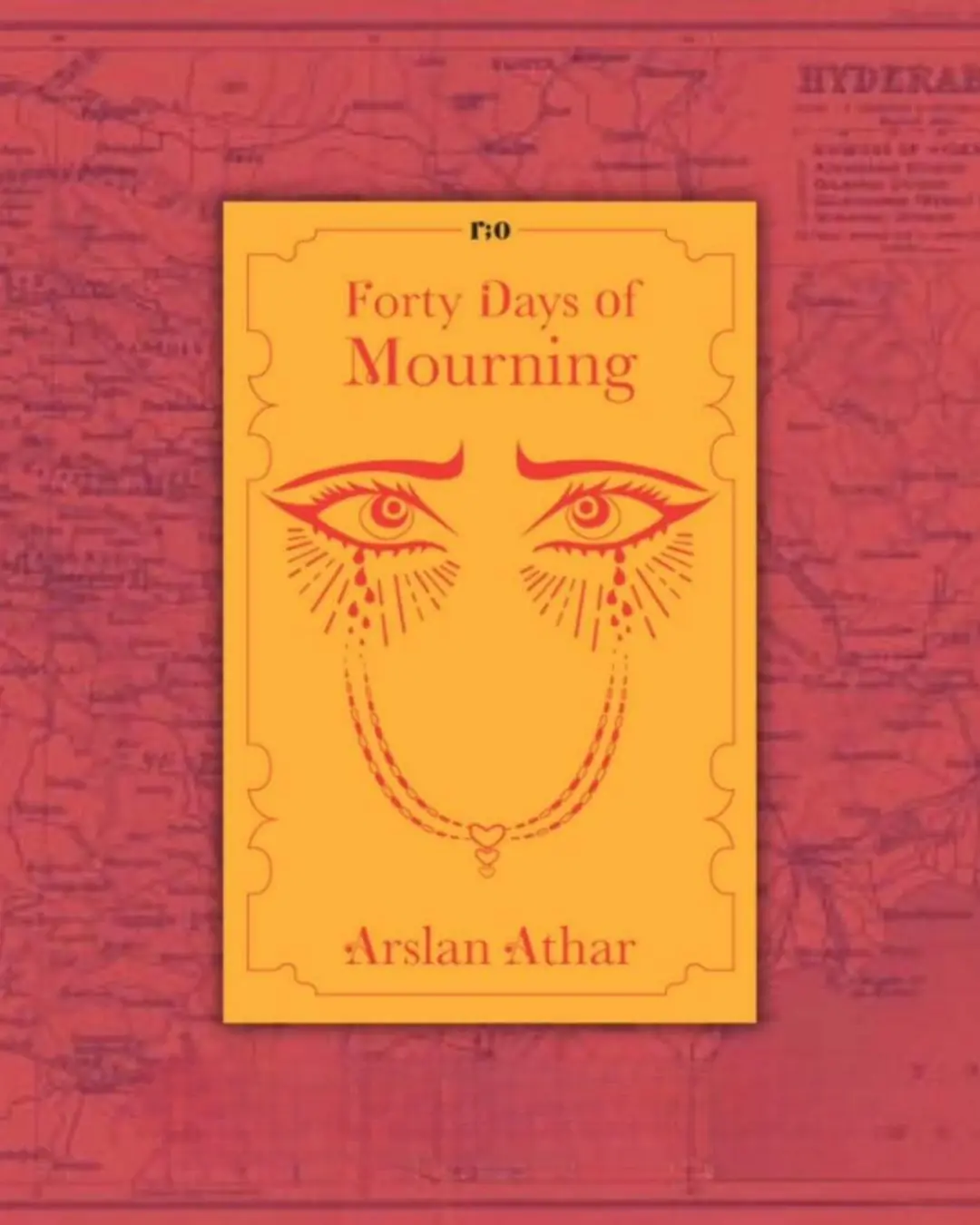
Arslan Athar’s debut novel Forty Days of Mourning remembers Hyderabad Deccan through grief and silence
Arslan Athar’s Forty Days of Mourning arrives quietly but confidently, announcing itself as a debut deeply aware of history, place and emotional restraint.
Set in the princely state of Hyderabad Deccan, the novel revisits a place often sidelined in mainstream narratives of the British Raj and Partition. It provides a textured, intimate portrayal of a world shaped as much by memory as by loss. Athar does not attempt spectacle; his strength lies in layering, in creating depth in his characters, in addition to language and historical awareness.
From the very first pages, it is clear that this is a novel that takes its readers seriously and asks them to pay attention to subtleties rather than grand gestures. The book opens with a note from the author that serves almost as an invitation, gently guiding the reader into the story’s geography and emotional terrain.
Hyderabad Deccan is not merely a setting in this novel. It is a living, breathing presence that shapes the people who inhabit it and the events that unfold. Once a princely state rich in terms of material wealth and cultural plurality, Hyderabad carried a distinct identity that rarely finds adequate representation in narratives of colonial India. Discussions around the British Raj and Partition often reduce history to binaries, and Hyderabad’s nuanced past is frequently overlooked. Athar’s novel resists this erasure with care and precision.
One of the most compelling aspects of this historical richness is the attention paid to language. The state’s capital Hyderabad is depicted not only as a city of wealth and political significance but also as a place with a unique linguistic and cultural identity.
Dakhani, which I had previously known only as a dialect, is presented as a fully realised language in the novel. Through dialogue and everyday interactions, the story illustrates how Dakhani carries centuries of history, memory and cultural pride. This attention to linguistic detail adds layers of authenticity, making the city feel lived-in and complex. Language in Forty Days of Mourning is not just a means of communication; it is a vessel of memory and identity.
At the centre of the story is Saleema, a protagonist who immediately challenges assumptions. Wealthy, sharp-edged and emotionally guarded, she initially comes across as snobbish, which feels deliberate and familiar, given its realism. Athar does not attempt to soften her for the reader’s comfort, and Saleema is complex and contradictory from the very beginning. Her wealth creates distance between her and those around her, but it also functions as a shield, hinting at experiences of loss, obligation and survival beneath the surface.
The novel is set during the uneasy year after the British left, when Hyderabad briefly existed as its own independent state. Life goes on, but under a constant sense of waiting, waiting for decisions, for war, for things to fall apart. Political negotiations drag on, rumours spread through streets and homes, loyalties are tested, and fear quietly seeps into everyday routines.
As pressure from the newly formed Indian state increases, Hyderabad’s fragile independence begins to crack. The story follows this slow unravelling, moving from hope and denial to violence, loss and reckoning, ending with the state’s forced integration and the collective grief of a world that disappears almost overnight.
As the wife of a high-ranking army officer, Saleema moves through the city’s elite circles, aware of every whisper of political tension, every shifting alliance. But as the Nizam’s Hyderabad faces the inevitability of annexation, Saleema realises that neither status nor cunning can fully shield her, and the choices she makes ripple through both her personal life and the crumbling world around her.
Within the first few chapters, we see Saleema interacting with her husband and her family, which complicate our initial impressions and begin to reveal emotional layers that are not immediately apparent. If these moments are insufficient to fully convince the reader of her complexity, the narrative later delves into her backstory, revealing motivations, insecurities and the personal history that informs her present behaviour.
Athar does not justify her actions, and neither does he ask the reader to excuse them. He provides context, allowing empathy to develop without demanding approval. It is a subtle yet significant distinction that demonstrates the author’s careful attention to character psychology.
Athar’s writing is another strength of the novel. The prose is measured, deliberate and restrained, never overreaching or indulgent. Scenes are allowed to unfold naturally, and silences carry as much weight as dialogue. There is a rhythm to the narrative, especially when history and memory intersect, and this makes the reading experience immersive.
Hyderabad Deccan emerges not merely as a backdrop but as a character in its own right. The streets, the buildings and the everyday life of the capital are all integrated into the story, influencing the people who live there and reflecting their histories, anxieties and desires.
The novel’s historical elements are woven into daily life rather than presented as exposition. References to the British Raj, Partition and the political uncertainty surrounding Hyderabad surface organically in conversations, traditions and silences. The novel captures how history persists in private lives, shapes relationships, and continues to resonate long after the events themselves have passed.
This approach makes the past feel intimate and personal rather than distant and abstract. The reader is invited to experience history as lived experience rather than as a series of dates and events.
Even the book’s cover contributes to the narrative experience. The bright yellow background and the striking red eyes immediately draw one’s attention. The eyes feel watchful, almost confrontational, mirroring the story’s emotional undercurrents. They demand that the reader engage with them, much as the novel itself does.
The cover is visually striking but also thematically resonant. It sets the tone for the story inside, signalling that this is not a conventional or safe narrative but one that examines grief, memory and human complexity with honesty and care.
What is most refreshing about Forty Days of Mourning is that it centres on a woman’s inner world unapologetically. Saleema is not written to be likeable or to provide comfort to the reader. She is allowed contradiction, anger, grief and quiet moments of reflection. Her emotional life is complex and layered. In focusing on her experiences, the novel resists reducing her to her relationships or her social roles alone.
It allows the reader to sit with her, to witness her inner life, and to understand her as a fully realised human being. In a literary landscape where women’s complexity is often softened or simplified, this focus feels quietly radical.
The novel is also remarkably patient. It does not rush to reveal everything about its characters or setting. It trusts the reader to notice subtleties, to observe behaviour, and to draw connections between the past and the present.
Even small gestures or conversations carry significance. Saleema’s silences, choices, and interactions are given space to breathe. The novel builds its emotional resonance gradually, which makes the impact of its revelations all the more powerful.
At the end of the day, Forty Days of Mourning is a debut that is confident, layered and assured. It invites the reader to reflect on history, engage with a city that has often been overlooked, and witness a woman’s emotional life in all its complexity. It is a novel that lingers, quietly but persistently, long after the final page has been read. Saleema’s presence, Hyderabad’s streets, and the weight of history remain in the mind.
This is a book that reminds readers why literature matters. It does not seek to entertain with spectacle or drama. Instead, it engages the intellect, empathy and the imagination. For a debut novel, Athar has delivered something rare, thoughtful and lasting.
Originally published in Dawn, Books & Authors, February 1st, 2026







Comments