In Broken Images, a writer’s reflection becomes her harshest critic


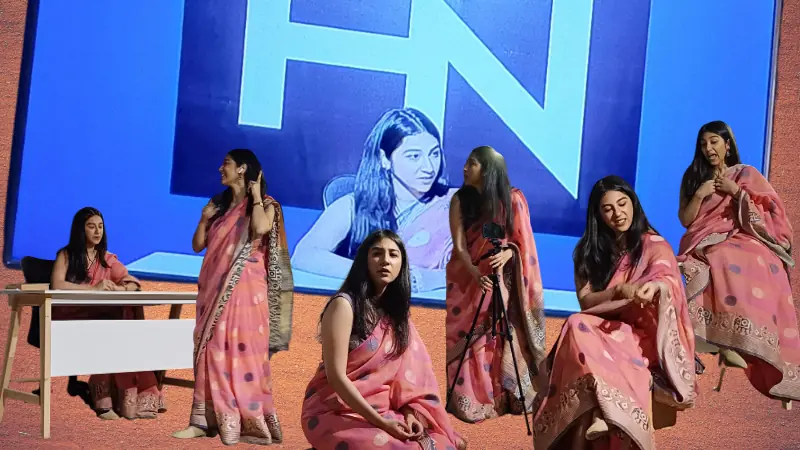
Broken Images, written by Girish Karnad, was directed by Yogeshwar Karera in Karachi and staged over the weekend at T2F by Mauj, featuring Raana Kazmi in a demanding single-actor performance. The English play explored fractured identities, the weight of technology, and the confrontation of a woman with her own reflection.
The play followed Mahjabeen Raza, a best-selling author whose book The River Has No Memories is being adapted into a telefilm in Urdu. Mahjabeen, originally an Urdu short story writer, has ventured into English literary fiction, and the play opens with her being interviewed by Heritage News English. What begins as a routine promotional appearance (after several global literary tours) soon turns into something far more layered, revealing cracks not just in her public image but in her inner world.
Throughout the 10-minute interview, we see reflections of Pakistan’s publishing industry — its hierarchies, insecurities, and cultural divides. Having some experience in this field myself, I could relate to the tension of moving “upwards and onwards,” while those you once called friends quietly turn into silent spectators, observers, critics, or worse, rivals.
The play subtly exposes how Pakistani writers who shift from Urdu to English are often “accused” of betraying their language or pandering to global audiences. Yet, ironically, global publishers see our stories as deeply local, raw, and authentic. This duality of being too Western for home and too Eastern for the world sits at the heart of Mahjabeen’s struggle.
The dialogue also touches upon the economics of writing, the uncomfortable realities of royalties and the perception that authors chasing international acclaim are complicit in capitalism. Without giving away spoilers, the narrative eventually folds into a psychological thriller. Mahjabeen believes the interview has ended, but due to a technical glitch, it continues to air, and her own image appears on the TV screen. What follows is a chilling conversation between Mahjabeen and her recorded self: her conscience, her alter ego, or, as one might say today, her chatbot (that’s just how I saw it).
This exchange is where the play becomes eerily relevant. In that lonely dialogue, you can feel Mahjabeen’s isolation, her frustration within a hollow marriage where she feels like an outsider, and her need to confide in a digital version of herself. The boundaries between reality and reflection blur. When the illusion breaks, it’s like the collapse of every façade she built — her self-image, her moral justifications, her relationship with her husband Asif, a software developer now working in the US.
Raana Kazmi’s performance carried the entire play. In a confined space with minimal movement, it was her face, tone, and timing that drove the emotion. She balanced dignity and despair, shifting between subtle control and breaking vulnerability. The on-screen Mahjabeen felt slightly robotic, but perhaps intentionally so. It mirrored the dynamic of talking to an algorithm that listens, prompts, and learns — just as chatbots do today. The reworking of Karnad’s script felt deliberate, updated to fit the context of digital loneliness and misinformation in a tech-saturated age.
The references to Karachi’s everyday realities, Saddar, commute troubles, and KDA bungalows, gave the play a strong local grounding. These small details spoke to the city’s class divide, the familiar “pull ke is paar and pull ke us paar” sentiment. It’s rare to see Karachi represented with such cultural nuance in English theatre.
If there was one limitation, it was the venue. T2F’s intimacy worked well for emotional engagement, but this story deserves a bigger stage and wider reach. The subjects, identity, the intimacy of a married couple, and the moral cost of ambition, need to be part of a larger public dialogue. Yet even if it does travel further, it might only resonate with a certain audience: those fluent in English and familiar with the creative or literary scene.
Still, Broken Images leaves you thinking long after the lights go off. How many of us would survive if we had to face our own true selves and admit the truths we hide behind our screens?
The play is running at T2F on Saturday and Sunday from 7:00–8:00 PM and 9:00–10:00 PM on both days.
Comments